
New Scientist International Edition – 12 September 2026
Summary
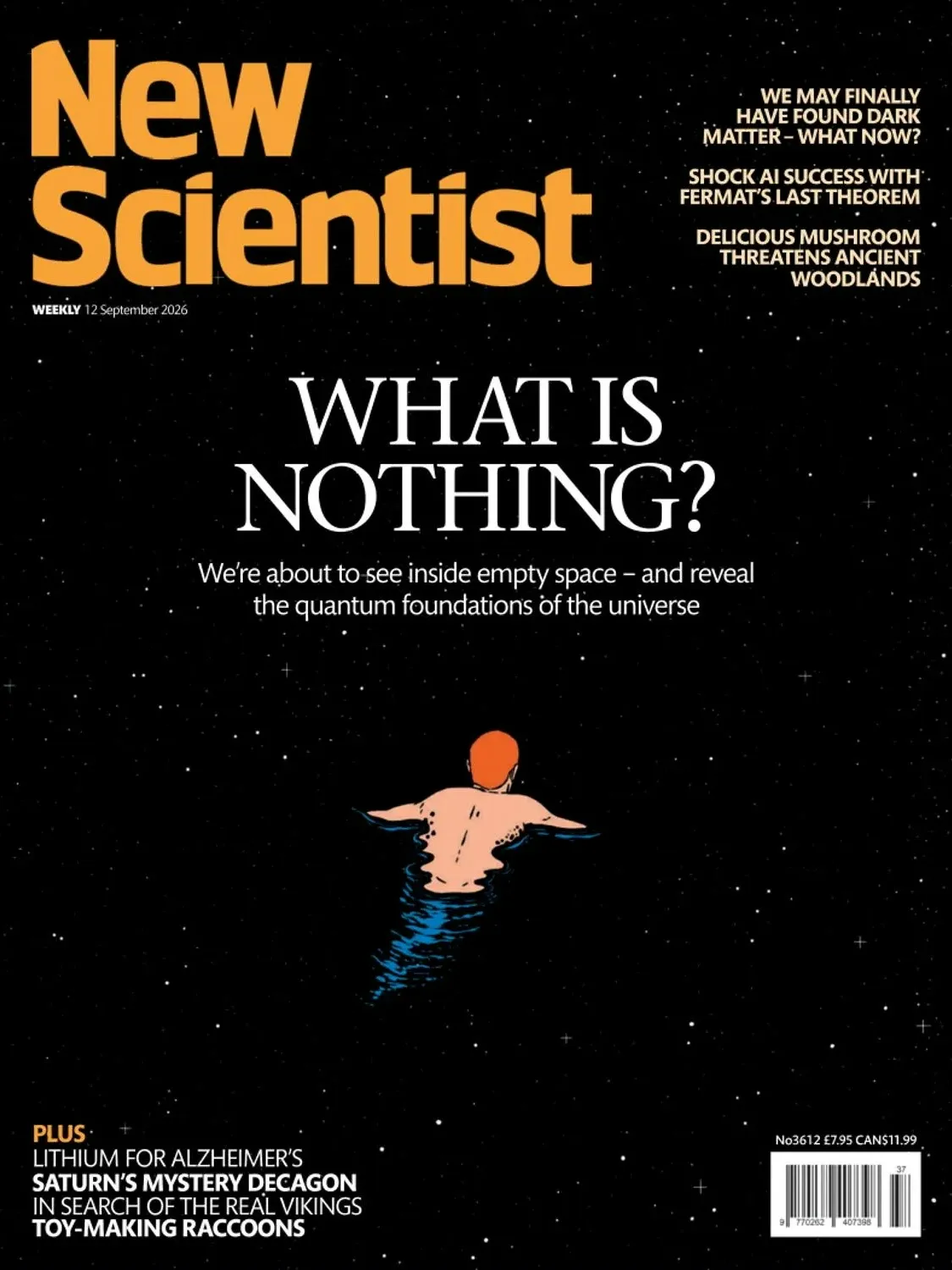
Vol 271 No 3612 (12 September 2026) poses the ultimate physics question on the cover: "What is nothing?"—as probes prepare to see inside empty space via powerful lasers and reveal the quantum foundations of the universe. The issue also reports that we may finally have found dark matter (p.4), shock AI success with Fermat's last theorem (p.9), and a delicious mushroom threatening ancient woodlands (p.36).
Three features anchor: the vacuum-probing cover (p.32), the mushroom biodiversity crisis (p.36), and preserving quantum character in particle collisions (p.40). News leads with a record pig-kidney transplant (p.5), Europe's spreading wildfire zone (p.6), and lithium for Alzheimer's prevention (p.21). Alice Klein looks into low-dose lithium's potential.
The back pages ask whether anti-black holes are possible, and Feedback gives houseplants a voice through generative AI.
—————
Content Guide
▸ Cover Story / Physics
p.32 · Inside the vacuum — Probing a vacuum with powerful lasers could finally expose its hidden structure
The cover feature explains that the quantum vacuum is not empty: it is seething with virtual particle pairs. Next-generation laser facilities—especially the European XFEL upgrade—aim to detect vacuum birefringence, the slight polarisation shift caused by the vacuum itself. The article walks through the experiment: fire a 100-petawatt laser pulse into a vacuum chamber and measure the photon-photon scattering signature. A predicted signal of 10^-12 radians. Readers learn that "nothing" may turn out to have more structure than solid matter.
p.4 · We may finally have found dark matter — what now?
The LUX-ZEPLIN experiment's 2.6 sigma excess at 248 keV is the closest any direct-detection experiment has come. The article explains the next step: five years more data, a larger detector, and cross-checks with the XENONnT collaboration.
p.9 · Shock AI success with Fermat's last theorem
An AI system independently rediscovered the modularity theorem that underlies Wiles' proof of Fermat's last theorem, but using a completely different mathematical framework. The result suggests that AI can find novel proof pathways humans have overlooked.
▸ Environment / Biodiversity
p.36 · The great escape — Are home-grow mushroom kits seeding a biodiversity crisis?
Popular oyster mushroom grow-kits contain live mycelium that can colonise local woodlands, outcompeting native fungi. A citizen-science survey found lion's mane mushrooms (Hericium erinaceus) growing on beech trees in six UK counties where they were never recorded. The article offers a simple precaution: cook the kit substrate before disposal. A map plots the spread of escaped species.
▸ Health / Medicine
p.21 · Lithium's new frontier — Alice Klein looks into whether low doses of lithium can prevent Alzheimer's
Microdose lithium (300 mcg daily, not the gram-level psychiatric doses) reduced tau phosphorylation in a 2-year observational study. The mechanism: lithium inhibits GSK-3 beta, an enzyme overactive in Alzheimer's brains. The article warns that lithium blood levels must be monitored even at microdoses.
p.5 · Record transplant — Pig kidney kept a man off dialysis for a record time
A genetically modified pig kidney functioned in a brain-dead recipient for 271 days without rejection, using a single immunosuppressive drug. The article notes that the waiting list for human kidneys exceeds 90,000 patients in the US alone.
▸ Space / Particle Physics
p.40 · Quantum collisions — Preserving more of the quantum character of particle collisions could help us uncover new physics
A new analysis technique that preserves quantum phase information in LHC collision data has revealed a slight excess in B-meson decay asymmetries that was invisible to standard statistical binning. If confirmed, it would be a direct signal of physics beyond the Standard Model.
▸ Regulars
p.45 · Puzzles — Try our crossword, puzzle and quick quiz
The quick quiz asks what the predicted vacuum birefringence signal amplitude is (10^-12 radians), directly testing the cover story.
p.46 · Almost the last word — Are anti-black holes possible, and how could we tell if we saw one?
Theoretical physicists answer that a white hole would be the time-reversal of a black hole, but no mechanism exists to form one. If one existed, it would be visible as a region emitting matter.
—————
Editor's Take
The "What is nothing?" cover is New Scientist at its best: a deep physics concept made concrete through an upcoming experiment (XFEL upgrade, 100-petawatt laser, 10^-12 radian signal). The mushroom-biodiversity piece (p.36) is the dark horse—a genuinely practical public-service article that every home-grower should read. The lithium-Alzheimer's piece (p.21) is cautious and well-sourced. Weakest item: "Against the clock" (p.22) is a thin thought experiment about time dilation that does not match the depth of the rest of the issue. Best for physics enthusiasts and anyone growing mushrooms at home.
Strengths
• Vacuum-structure feature: conceptually deep, experimentally concrete
• Mushroom-biodiversity warning: practical, immediately actionable
• Dark-matter news coverage appropriately cautious about 2.6 sigma
Weaknesses
• "Against the clock" column insufficiently developed
• Heavy ad insert for a watchmaker in the first 10 pages
Verdict: Recommended — The vacuum physics cover is excellent; the mushroom piece is a bonus.
