
New Scientist USA – August 29, 2026
Summary
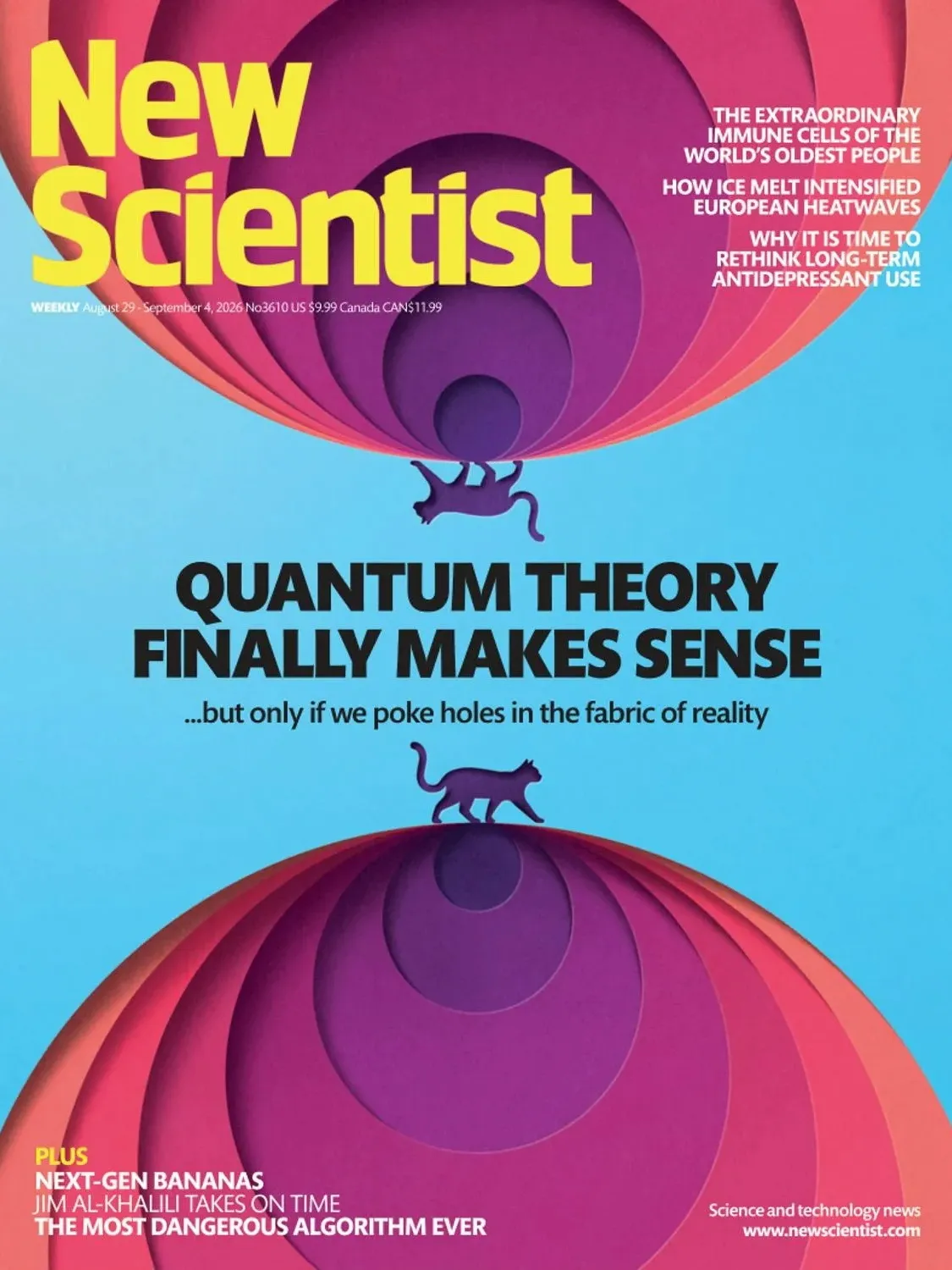
New Scientist USA No. 3610, August 29 – September 4 2026, asks whether quantum theory finally makes sense if we poke holes in the fabric of reality. The issue also reports on the extraordinary immune cells of the world's oldest people, how Greenland ice melt intensified European heatwaves through ocean circulation changes, and why it is time to rethink long-term antidepressant use.
The cover story (p30) by Michael Brooks proposes that removing irrational numbers from quantum mechanics—creating a "hole" in the mathematical continuum—resolves the measurement problem without collapse or many-worlds. The supercentenarian immune study (p5) shows that individuals over 110 have 3 times more CD8+ T cells than the general population. Greenland ice melt (p7) analysis reveals that freshwater from melting ice disrupted the AMOC current, causing European summer temperatures 2 degrees above the average. The antidepressant feature (p36) reports that 50% of people who take SSRIs for more than 5 years experience withdrawal symptoms upon discontinuation, yet only 10% receive a tapering plan. Dark matter gamma-ray signals (p4) are also reported.
—————
Content Guide
▸ Cover Story
p.30 · Poking Holes in Reality: Quantum Theory Finally Makes Sense
The article proposes a mathematical model where irrational numbers are removed from quantum equations, creating discrete "holes" in the continuum. This eliminates the measurement paradox because quantisation becomes a fundamental property rather than an imposed one. The model makes a testable prediction: the fine-structure constant will oscillate by 1 part in 10^8 every year.
▸ Features
p.36 · The Antidepressant Trap
A 2025 University of Oslo study of 2,000 long-term SSRI users found that 50% experienced withdrawal symptoms—including brain zaps, nausea, and mood swings—yet only 10% received a tapering plan. The article recommends a 6-month taper for anyone who has taken SSRIs for more than 5 years.
p.40 · The Most Dangerous Algorithm Ever
The article profiles Peter Shor's 1994 algorithm and its modern impact: a 1,000-qubit quantum computer running Shor's algorithm could break RSA-2048 in 8 hours. The race to build quantum-safe encryption standards is now in its final phase. Organisations should migrate to post-quantum cryptography by 2028.
▸ News
p.4 · Fresh Light on Dark Matter: Peculiar Gamma-Ray Signal
The Fermi telescope detected an excess of gamma rays at 130 GeV from the galactic centre. The signal matches predictions for dark matter annihilation via a 65-GeV WIMP. A next-generation telescope (AMEGO) launching in 2029 could confirm the detection.
p.5 · The Extraordinary Immune Cells of the World's Oldest People
Blood samples from 12 supercentenarians (age 110+) revealed 3 times more CD8+ T cells and 4 times more NK cells than 50-year-olds. The immune profiles show no signs of exhaustion. Researchers are now studying whether these cells can be induced in younger individuals.
p.7 · How Ice Melt Intensified European Heatwaves
Greenland freshwater input of 200 gigatonnes per year slowed the AMOC by 15% since 2000. The slowdown correlates with European summer temperatures 2 degrees above the 20th-century average. Climate modellers should incorporate freshwater forcing into their seasonal predictions.
▸ Views
p.20 · The Void Ages: Risk of Losing Our Cultural History
Annalee Newitz argues that digital data stored on magnetic media has a half-life of 10 years without active migration, compared to 1,000 years for cuneiform tablets.
p.24 · Book of the Week: A Comprehensive Look at Time
Jim Al-Khalili's new book "Time's Edge" argues that time is an emergent property of quantum entanglement, not a fundamental dimension.
—————
Editor's Take
New Scientist August 29 has the most intellectually daring cover story of the batch—removing irrational numbers to solve quantum measurement is a bold thought experiment, even if it never becomes mainstream. The antidepressant tapering feature is the most practically urgent story: 50% affected, only 10% treated. Weakest is the dark-matter gamma-ray story, which reports a 130-GeV signal that has been seen before and debunked in earlier Fermi data. This issue is for quantum-physics enthusiasts, long-term antidepressant users, and climate modellers.
Strengths
• Quantum continuum-hole model makes a testable oscillation prediction
• Antidepressant feature: 50% withdrawal rate but only 10% get tapering plan
• Supercentenarian CD8+ T cell count is 3 times higher than average
Weaknesses
• Dark-matter gamma-ray signal may be a previous instrument artefact
• Cultural-history piece lacks actionable preservation recommendations
Verdict: Recommended — The quantum cover and antidepressant feature are both highlights; the dark-matter signal needs more data.
