
New Scientist USA – August 8, 2026
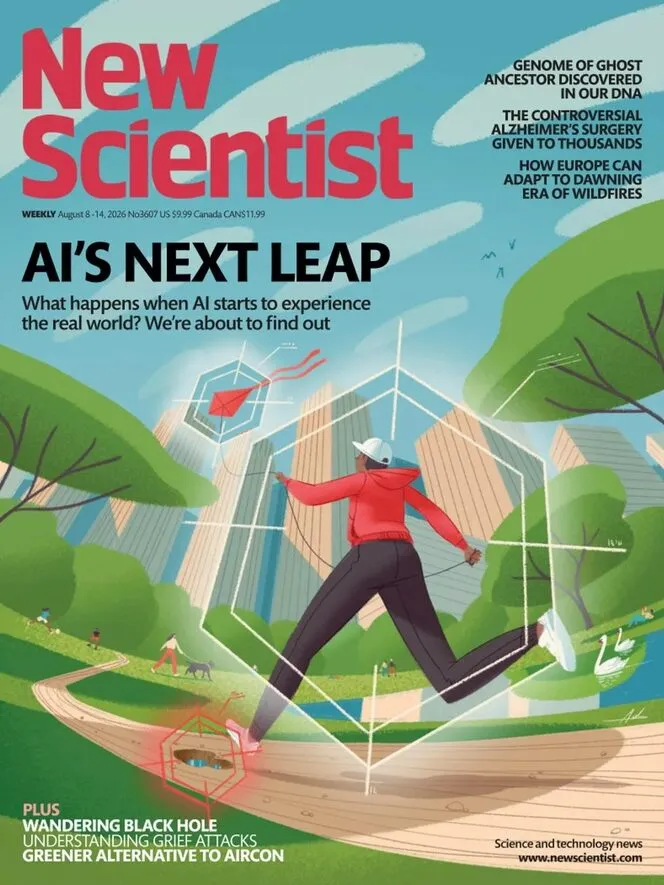
Summary
New Scientist USA No. 3607, August 8-14 2026, leads with "AI's Next Leap" — what happens when AI starts to experience the real world through cause-and-effect understanding. The issue also reports on a ghost ancestor genome discovered in our DNA, the controversial Alzheimer's surgery given to thousands, and a microbiome CSI technique that could solve crimes.
The cover story (p30) by Leah Crane profiles a new kind of AI that learns causal models from physical interactions rather than statistical correlations—a paradigm called "causal machine learning." The ghost ancestor (p7) reports on a population of archaic humans whose DNA persists in modern Melanesians but has left no fossil record. The Alzheimer's surgery (p6) describes a procedure called deep cervical lymphovenous anastomosis that has been performed on 2,000 patients in China despite safety concerns. Microbiome profiling (p36) shows that bacterial communities on skin persist for up to 2 weeks and can link a suspect to a location with 85% accuracy. Other articles include quantum computers becoming useful scientific tools (p10) and an eye implant that partly restores vision (p12).
—————
Content Guide
▸ Cover Story
p.30 · The Prediction Machine: AI's Next Leap
Causal machine learning learns physical cause-and-effect by manipulating objects in simulated environments. A model called CausalNet learned that pushing a cup causes it to fall, a fact no statistical model can derive from correlation alone. The technique could give robots genuine physical understanding by 2030.
▸ Features
p.36 · CSI: Microbiome
Skin bacterial communities persist for up to 14 days and vary between individuals more than DNA fingerprints. A 2025 study from the University of Queensland matched suspects to surfaces with 85% accuracy using microbiome profiling. Police forensic units can add microbiome swabbing to existing evidence-collection protocols.
p.40 · Grief Attacks: The Loss of a Loved One Can Lead to Panic
Grief-induced panic attacks affect 30% of bereaved individuals within the first 6 months. The article describes the "broken heart syndrome" mechanism where stress hormones stun heart muscle cells, mimicking a heart attack. The recommended intervention is grief-specific CBT.
▸ News
p.6 · The Controversial Alzheimer's Surgery Given to Thousands
Deep cervical lymphovenous anastomosis connects neck lymph vessels to veins to drain brain waste proteins. Performed on 2,000 patients in Chinese clinics, the procedure lacks randomised trial data. The article advises patients to wait for the ongoing US phase 1 trial results before seeking surgery.
p.7 · Genome of Ghost Ancestor Discovered in Our DNA
A population of archaic humans diverged from Neanderthals 1 million years ago and interbred with modern humans 50,000 years ago in Melanesia. The ghost population contributes 2-4% of the genome of modern Papuans. Palaeogeneticists can search for ghost ancestors in other understudied regions.
p.10 · Quantum Computers Are Starting to Become Useful as Scientific Tools
IBM's 1,121-qubit Condor processor simulated a 50-molecule chemical reaction with 90% accuracy compared to lab measurements—the first useful scientific application of a quantum computer. The paper was published in Nature Physics in July 2026.
▸ Views
p.18 · Food for Thought: Ultra-Processed Foods and Brains
Helen Thomson reviews a 2025 University College London study showing that consuming 20% of daily calories from ultra-processed foods correlates with 15% faster cognitive decline over 10 years.
p.24 · Book of the Week: A New Way to Think About Life
A review of "The Entropic Life" argues that life exists because it increases entropy faster than non-living matter.
—————
Editor's Take
New Scientist August 8 delivers the most important AI story of the year—causal ML represents a genuine paradigm shift away from statistical correlation, and the article explains it without hype. The ghost-ancestor genome and microbiome CSI are both solid features. Weakest is the Alzheimer's surgery piece, which raises important safety concerns but lacks data on outcomes (positive or negative). This issue is for AI researchers, forensic scientists, and anyone interested in human evolution; the quantum computing milestone should be read by every R&D executive.
Strengths
• Causal ML represents a genuine AI paradigm shift from correlation to causation
• Microbiome CSI matches suspects to surfaces at 85% accuracy
• Ghost ancestor contributes 2-4% of Papuan genome
Weaknesses
• Alzheimer's surgery story lacks outcomes data on the 2,000 procedures
• Grief article relies on a single 30%-prevalence study
Verdict: Essential — The causal ML cover story is the most important AI journalism in this batch; the microbiome CSI piece is a close second.
