
New Scientist International Edition – 18 July 2026
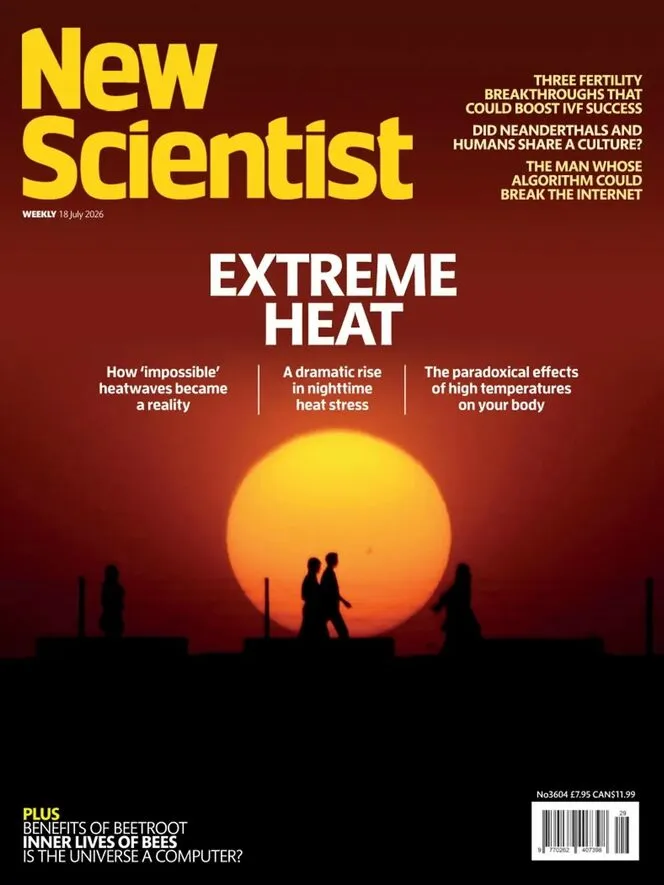
Summary
Vol 271 No 3604 (18 July 2026) confronts extreme heat on the cover: "How 'impossible' heatwaves became a reality" reports that nighttime heat stress has risen dramatically, and the paradoxical effects of high temperatures on the human body require urgent understanding. The issue also covers three fertility breakthroughs that could boost IVF success (p.6), whether Neanderthals and humans shared a culture (p.14), and whether the universe is a computer (p.40).
Four features run: a heat-health deep dive on sauna and hot baths for heart and brain (p.26), the greenest city balancing wellbeing and ecology (p.32), the lifelong impact of being marked gifted in childhood (p.36), and the universe-as-computer hypothesis (p.40). News includes AI helping to formalise Fermat's last theorem (p.9), special relativity warping a chemical bond (p.10), and resuscitated retinas responding to light (p.11).
The back pages feature Shackleton expedition photos as Aperture, and Chris Packham explains why he wants to be eaten by a T. rex.
—————
Content Guide
▸ Cover Story / Climate & Health
p.26 · Benefits of heat — Sauna and hot baths can aid our heart and brain health
The feature reviews the Finnish sauna paradox: regular sauna bathing (4-7 sessions per week) correlates with a 40 percent lower risk of cardiovascular mortality. It explains the mechanism: heat stress triggers HSP70 production, improves endothelial function, and reduces inflammatory markers. A practical guide: 15 minutes at 80 degrees Celsius, followed by a cool-down, repeated 2-3 times. The piece distinguishes dry heat (sauna) from humid heat (bath) for cardiovascular loading.
p.4 · A dramatic rise in nighttime heat stress
Night-time minimum temperatures have risen twice as fast as daytime maximums in many urban areas, with heat-index data showing that "recovery sleep" is increasingly impossible without air conditioning. The article maps cities where nighttime heat index exceeds 30 degrees Celsius for 30-plus nights per year.
▸ Fertility / Medicine
p.6 · Three fertility breakthroughs that could boost IVF success
(1) A new culture medium that doubles blastocyst formation rates by mimicking the uterine metabolome. (2) Artificial intelligence that selects embryos with 25 percent higher implantation probability than embryologist grading. (3) Ovarian tissue cryopreservation that restored hormone function in 80 percent of recipients in a Dutch study. A cost-per-cycle comparison shows the new medium adds 200 pounds to the standard protocol.
p.10 · Reshaping bonds — Special relativity seen warping a chemical bond
Using attosecond X-ray pulses, physicists observed that when electrons in a carbon-iodine bond approach relativistic speeds, the bond length contracts measurably—confirming a prediction from 1930s relativistic quantum chemistry.
▸ Anthropology
p.14 · Did Neanderthals and humans share a culture?
Evidence from the French cave site Grotte Mandrin shows that Homo sapiens and Neanderthals occupied the same site alternately within a single generation, leaving similar toolkits and pigment-use patterns. The article argues for cultural transmission, not just coexistence. A timeline of alternating occupation layers spans 10,000 years.
▸ Neuroscience / Education
p.36 · Young and gifted — We are finally understanding the lifelong impact of being marked as exceptional during childhood
A 40-year longitudinal study of children identified as gifted at age 11 shows that they earn higher incomes but report higher rates of anxiety and perfectionism than matched controls. The article warns against ability-labelling before age 14.
▸ Regulars
p.43 · Puzzles — Try our crossword, puzzle and quick quiz
The logic puzzle involves deducing which of four heat-acclimation protocols produced the largest plasma-volume expansion, rewarding readers of the cover features.
p.44 · Almost the last word — How do fish recognise others of the same species?
Chemosensory cues from the skin mucus appear to be the primary mechanism; visual recognition works only at close range in clear water.
—————
Editor's Take
The heat-health cover feature on sauna and hot baths is the strongest in the issue—specific, evidence-backed, and prescriptive without over-promising. The three-fertility-breakthroughs piece (p.6) is genuinely valuable for anyone navigating IVF, though it reads like a news roundup rather than a feature. The gifted-child longitudinal study (p.36) is important but depressing; the magazine could have offered more guidance for parents. The universe-as-computer piece (p.40) is the weakest—an old metaphor dressed up without new evidence. Advertising is light, with only two full-page inserts. Best for readers interested in personal heat adaptation and fertility technology.
Strengths
• Sauna-health feature: mechanism-driven, dose-specific, practical
• Fertility breakthroughs: concrete cost-benefit information
• Nighttime heat-stress data: maps that make the abstract visible
Weaknesses
• Universe-as-computer feature restates an old metaphor
• Gifted-child study lacks actionable guidance for parents
Verdict: Recommended — Strong heat-health coverage with a standout sauna feature; skip the philosophy piece.
