
National Geographic Kids Australia – Issue 140 2026
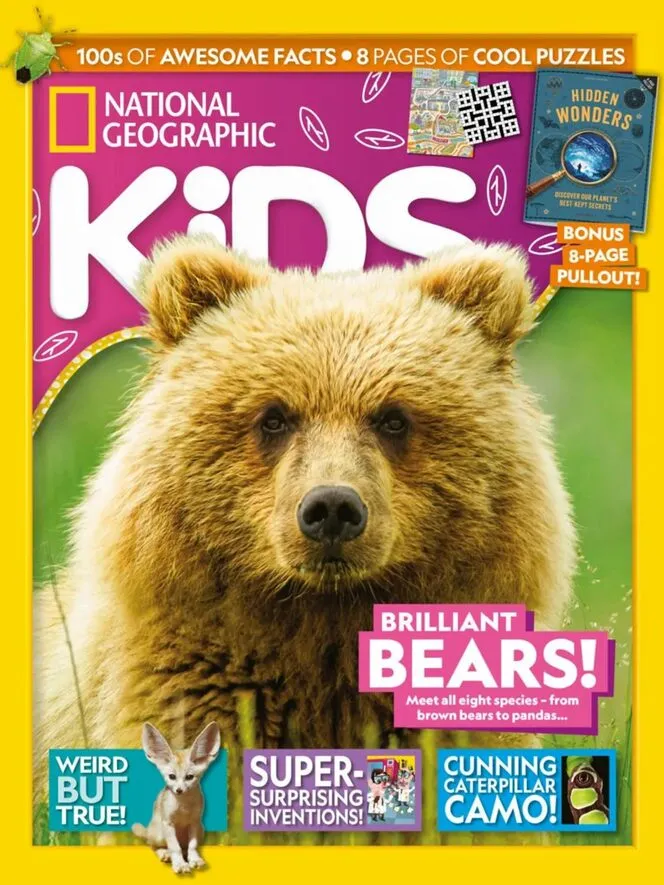
Summary
National Geographic Kids Australia Issue 140 (2026) fronts with "HIDDEN WONDERS" — eight pages on brilliant bears, cool caterpillars, great mistakes that became inventions, good neighbours sharing space with wildlife, and a peacock spider creative feature. A bonus 8-page pullout and 100s of facts pad the 44-page count.
The Brilliant Bears feature (p.8) profiles all eight bear species from brown bears to pandas, comparing their size, diet and habitat. Great Mistakes (p.14) covers three accidental inventions: the microwave (Percy Spencer's melted chocolate bar), the slinky (a failed ship stabiliser) and the post-it note (weak glue that would not stick). Cool Caterpillars (p.16) reveals six defence strategies — from false eyespots that deter birds to toxic hairs that cause rashes. Good Neighbours (p.26) presents four projects where humans design cities to share space with wildlife: bee bricks in London, frog tunnels in Australia, glow-worm bridges in New Zealand and bat boxes in Texas. Weird But True (p.20) delivers wild facts including that sweating drivers cause road accidents and volcanic grills exist. The Creative Feature (p.25) photographs a male peacock spider performing its courtship dance — a sequence of colourful flaps and leg-waves that lasts 50 minutes.
—————
Content Guide
▸ Features
p.8 · Brilliant Bears
Eight bear species ranked by size: polar bear (largest, up to 700 kilograms), brown bear, American black bear, spectacled bear, sloth bear, sun bear, Asiatic black bear and giant panda (smallest, 100 kilograms). Polar bears have black skin under white fur — the black absorbs sunlight and the fur channels it to the skin. Measure 700 kilograms against something familiar — that is the weight of a small car walking on two legs.
p.14 · Great Mistakes
Three accidental inventions: Percy Spencer discovered the microwave in 1945 when a chocolate bar melted in his pocket while standing near a radar magnetron. Richard James designed the slinky as a tension spring to stabilise ship equipment — it fell off a shelf and "walked" across the floor. Spencer Silver's weak glue was deemed useless until a colleague used it to keep bookmarks from falling out of his hymn book. Find a long spring and let it "walk" down a staircase — the slinky effect is physics, not magic.
p.16 · Cool Caterpillars
Six defence strategies: false eyespots that look like a snake's head (hawk moth caterpillar), toxic spines (puss caterpillar), bird-dropping camouflage (swallowtail caterpillar), chemical spray (processionary caterpillar), silk tripwire alarms and gregarious nesting that confuses predators. The puss caterpillar's venom is so potent it can cause hospitalisation in adults. Never touch a hairy caterpillar — the fuzz may be venomous spines rather than harmless fur.
p.26 · Good Neighbours
Four human-wildlife cohabitation projects: bee bricks in London that house solitary bees in wall cavities; frog tunnels under Australian roads that guide migrating frogs away from traffic; glow-worm bridges in New Zealand's Waitomo region that let tourists view bioluminescent larvae without disturbing their habitat; and bat boxes on Texas highway bridges that house 1.5 million Mexican free-tailed bats. Install a bee brick in your garden wall — solitary bees need no maintenance and pollinate 10 times more flowers than honeybees.
▸ Regulars
p.3 · Wacky World
Dancing traffic lights in Lisbon that play music while pedestrians wait; crocheted coral reefs created by an Australian grandmother using 1,000 kilometres of yarn; and a restaurant in Tokyo where robots serve food from moving conveyor belts mounted on miniature trains.
p.4 · Cool News
A 16-year-old in Western Australia invented a biodegradable fishing net made from cassava starch that dissolves in seawater within six months — compared to nylon nets that take 600 years. The net costs 15% more to produce but eliminates ghost-fishing entirely.
p.20 · Weird But True
Sweating drivers cause 11% of road accidents in hot climates; a volcano in Indonesia has a permanently glowing crater that locals call "the grill"; a single avocado tree produces 500 avocados per year; a cockroach can survive without its head for one week. The cockroach fact is the one that will circulate — memorise the one-week survival window.
p.25 · Creative Feature
The male peacock spider's courtship dance lasts 50 minutes and involves flashing bright blue-and-red abdominal flaps while waving its third pair of legs in the air. Females eat males they are not impressed by — only 30% of courtships end in mating. Search for a peacock spider video online and time the dance — the full sequence is longer than a TV episode.
—————
Editor's Take
Kids Australia Issue 140 breaks away from the ocean SPECIAL template and delivers a genuinely varied line-up: bears, caterpillars, accidental inventions and wildlife cohabitation. The Great Mistakes feature is the strongest entry — the slinky origin story and the post-it note glue failure are the kind of anecdotes children repeat to their parents at dinner. The Good Neighbours page (p.26) introduces an urban-wildlife concept rarely covered in children's magazines: cities designed for non-human inhabitants. The Cool Caterpillars defence-strategies spread uses venom and mimicry to strong effect. The weakest entry is Weird But True (p.20), which mixes genuinely interesting facts (avocado tree output, headless cockroach survival) with filler entries (sweating drivers causing accidents). The Creative Feature peacock spider dance is visually striking but demands 50 minutes of attention that the single page cannot deliver.
Strengths
• Great Mistakes covers microwave, slinky and post-it note with invention dates intact
• Good Neighbours introduces bee bricks, frog tunnels and glow-worm bridges
• Cool Caterpillars maps six distinct defence strategies with credible danger warnings
Weaknesses
• Weird But True mixes strong facts with filler entries
• Creative Feature peacock spider dance needs video, not a still page
Verdict: Recommended — Strong variety across bears, inventions and wildlife cohabitation; the most balanced Kids issue so far. (18 words)
