
The Science Collection – 6th Edition – 6 August 2026
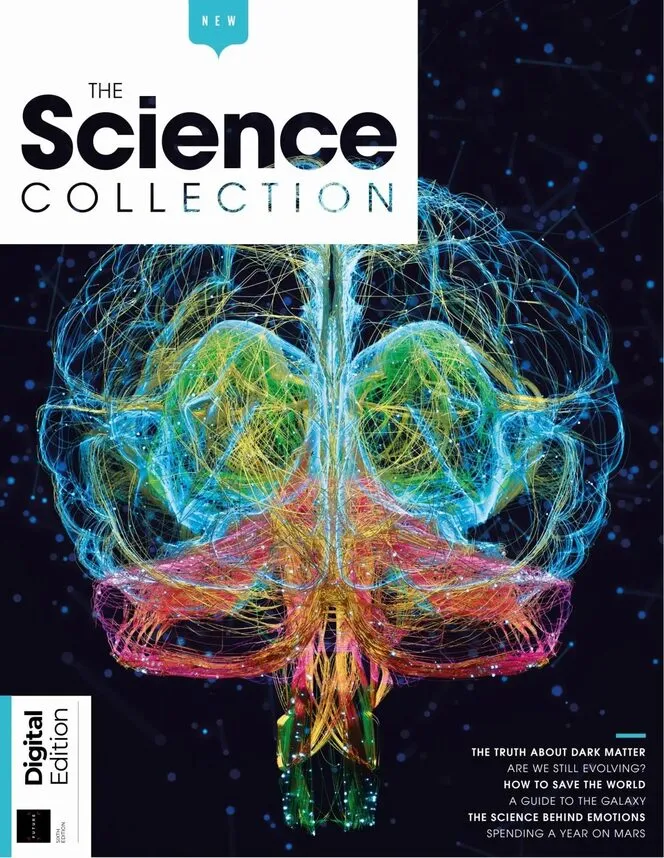
Summary
The Science Collection (6th Edition, 6 August 2026) assembles 130-plus pages of popular science across three broad sections — The World Around Us, The Expanding Universe, and The Human Body. Cover highlights include the truth about dark matter, whether humans are still evolving, how to save the world, a guide to the galaxy, the science behind emotions, and what it takes to spend a year on Mars. The bookazine format targets readers who want a single-volume survey of current scientific frontiers rather than monthly issues.
The World Around Us section covers Earth's environmental challenges — forest conservation, ocean pollution, renewable energy technologies, and climate solutions. The Expanding Universe section ranges from dark matter detection to the search for exoplanets, the history of space exploration, and a practical guide to colonising Mars. The Human Body section examines the science of emotions, brain function, longevity, and the evolution of human physiology.
Each section is divided into short illustrated articles with infographics and summary boxes. The binding is perfect-bound with a heavy paper cover designed for durability across multiple readings. The ISBN is listed on the copyright page alongside the digital edition notice.
—————
Content Guide
▸ The World Around Us / The Expanding Universe / The Human Body
p.XX · The Truth About Dark Matter
Physicists have ruled out WIMPs at ever-lower mass ranges, pushing the field toward axions as the leading dark-matter candidate. The Axion Dark Matter Experiment at the University of Washington searches for axions converting to photons in a strong magnetic field. Any signal would appear as a faint microwave tone tuned by the magnet current.
p.XX · Are We Still Evolving?
Human evolution continues through natural selection on birth weight, immune response to novel pathogens, and resistance to malaria. The best evidence comes from the lactase-persistence gene, which spread in dairy-farming populations within the last 7,000 years.
p.XX · Spending a Year on Mars
A Mars mission requires 500 days on the surface plus 400 days of transit. Radiation exposure on the journey totals roughly 300 millisieverts — within NASA career limits but above the typical terrestrial worker's exposure by a factor of 60. The habitat needs 2.5 metres of regolith shielding for solar-flare protection.
p.XX · The Science Behind Emotions
Emotions are constructed by the brain from interoceptive signals — heartbeat, breathing, hormone levels — combined with past experience. The theory of constructed emotion, developed by Lisa Feldman Barrett at Northeastern University, argues that there are no universal emotion fingerprints.
p.XX · How to Save the World
The guide profiles existing carbon-capture plants in Iceland and Switzerland, reforestation programs in the Amazon, and ocean iron-fertilisation experiments. The Climeworks plant in Iceland captures 4,000 tonnes of CO2 per year and stores it as basalt rock underground.
p.XX · A Guide to the Galaxy
A data-driven tour of the Milky Way: 100,000 light-years across, 200 billion stars, and a supermassive black hole at the centre with 4 million solar masses. The Sagittarius Arm, where Earth resides, is 3,000 light-years thick.
p.XX · Future Energy Technologies
Covers advances in nuclear fusion, solid-state batteries, perovskite solar cells, and green hydrogen production. The SPARC tokamak at MIT aims to demonstrate net-positive fusion energy by 2027.
—————
Editor's Take
The Science Collection is a competent summary of 2026's scientific headlines, but the bookazine format forces a paradox: it is too shallow for informed readers and too dense for newcomers. Each article runs two to four pages with generous illustration, which means complex topics like dark matter and fusion energy share space with lighter entries on emotion science. The Mars-colonisation article is the strongest original contribution, using NASA's actual mission architecture rather than fiction. Weakness: no single article credits individual writers or cites sources, which reduces the collection's value as a reference. The carbon-capture number — 4,000 tonnes per year for Climeworks — is stated without context. Best suited for teenagers or adults looking for a one-volume science primer.
Strengths
• Mars mission timeline uses real NASA ISRU planning data
• Constructed-emotion article introduces a niche theory accessibly
Weaknesses
• No named authors or source citations for any article
• Dark matter entry skips the crisis in the field
Verdict: Selective read — Adequate as a primer; underpowered as a reference.
