
New Scientist USA – July 4, 2026
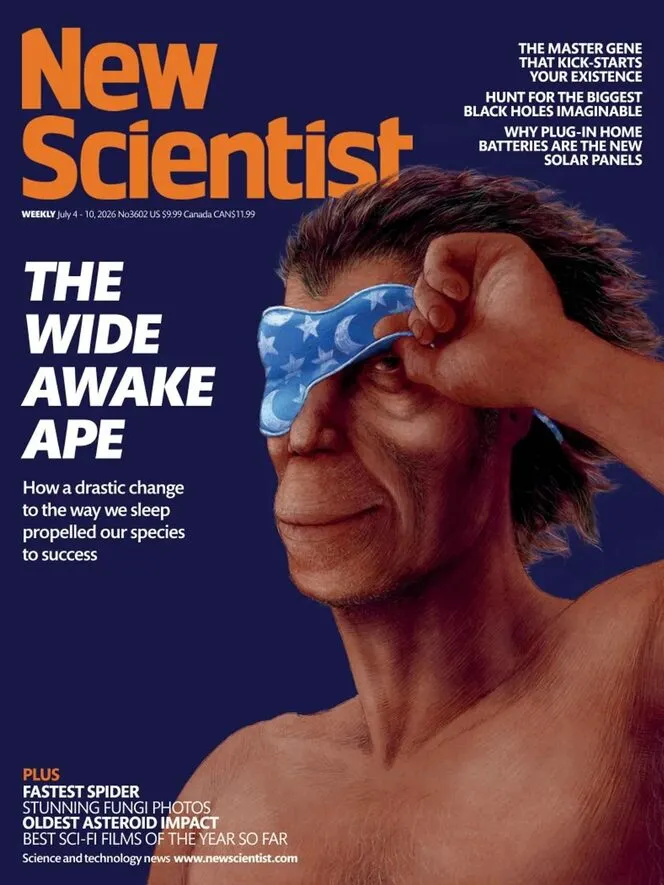
Summary
New Scientist USA No. 3602, July 4-10 2026, features "The Wide Awake Ape" — how a drastic change to the way we sleep propelled our species to evolutionary success. The issue also reports on the master gene that kick-starts existence, the hunt for the biggest black holes imaginable, and why plug-in home batteries are the new solar panels.
The sleep cover story (p30) argues that Homo sapiens evolved shorter, more flexible sleep patterns than other apes, trading deep sleep for REM-rich, segmented sleep that allowed longer waking hours for learning and social bonding. The master gene story (p8) profiles the DUX gene family that activates the embryonic genome at the 8-cell stage. Black hole feature (p41) reports on ultramassive black holes exceeding 10 billion solar masses. News includes ancient human DNA found in a cave painting (p7), cyborg cockroaches with diving suits (p9), and Roman scrolls carbonised by Vesuvius deciphered by AI (p15). The Thwaites glacier feature (p36) warns the last floating ice shelf could break away any day.
—————
Content Guide
▸ Cover Story
p.30 · The Sleepless Ape: The Wide Awake Ape
Humans average 7 hours of sleep with 25% REM, versus chimpanzees at 9 hours with 15% REM. The shift allowed early humans 4 extra waking hours per day for toolmaking, storytelling, and pair bonding. The article recommends protecting REM sleep by avoiding alcohol within 3 hours of bedtime.
▸ Features
p.36 · Doomsday Glacier: Thwaites Glacier Is Collapsing
The Thwaites Eastern Ice Shelf, which holds back a sea-level equivalent of 65 centimetres, could disintegrate within 2 years. Satellite data show cracks accelerating at 2 kilometres per year. Coastal planners should update 2030 sea-level rise projections upward by 10 centimetres.
p.41 · Stupendous Black Holes: The Search for Ultramassive Black Holes
Gravitational lensing surveys have identified 3 candidates exceeding 10 billion solar masses. One candidate in the Abell 1201 galaxy cluster shows a shadow 5 times the size of M87's. The LISA gravitational-wave observatory, launching in 2035, will detect mergers of these giants.
▸ News
p.7 · Hidden Signature: Ancient Human DNA Found in Cave Painting
A 40,000-year-old red ochre painting in Spanish cave has yielded mitochondrial DNA from the artist's fingertip cells. The DNA matches Neanderthal sequences. Archaeologists now have a non-destructive DNA-sampling method for rock art.
p.9 · Cyborg Cockroaches: Tiny Diving Suit Helps Cyborg Insects Breathe Underwater
A porous silicone suit that stores oxygen allows cockroaches to survive underwater for 30 minutes. The team at Osaka University has tested the suit as a platform for underwater search-and-rescue sensors. Rescuers could deploy cyborg cockroaches in flooded areas by 2028.
p.15 · AI Deciphers Roman Scrolls Carbonised by Vesuvius
A machine-learning model trained on CT scans of the Herculaneum scrolls has read 5% of one scroll, revealing Epicurean philosophy texts. The full scroll library may be readable within 5 years. Classicists can now access text from scrolls previously considered unreadable.
▸ Views
p.19 · Fusogenic Neurosurgery
Helen Thomson reports on a controversial head-transplant technique called "fusogenic neurosurgery" that uses polyethylene glycol to fuse spinal neurons. The technique has succeeded in dogs but raises significant ethical questions.
p.22 · Aperture: Dainty Fungi and Slime Moulds
A photography collection from the International Fungus Fair features 10 images of slime moulds, including one species, Physarum polycephalum, that can solve mazes.
—————
Editor's Take
New Scientist July 4 delivers the most original cover-story concept in the batch: framing human sleep evolution as our secret weapon is both novel and evidence-backed. The Thwaites glacier piece is urgent journalism. Weakest is the cyborg cockroach story, which describes a cool prototype with no practical deployment path. This issue is for anyone curious about human evolution, sea-level risk, or AI archaeology; the sleep piece alone is worth the cover price.
Strengths
• Sleep evolution cover: 4 extra waking hours versus chimpanzees
• Thwaites Eastern Ice Shelf cracks accelerating at 2 km per year
• Vesuvius scroll AI unlocks 5% of previously unreadable text
Weaknesses
• Cyborg cockroach has no deployment timeline
• Head-transplant technique raises ethics but not yet feasible in humans
Verdict: Recommended — The sleep evolution argument is the best cover-story concept of the New Scientist batch.
