
History of War Naval Warfare of World War II – 1st Edition – June 2026
Summary
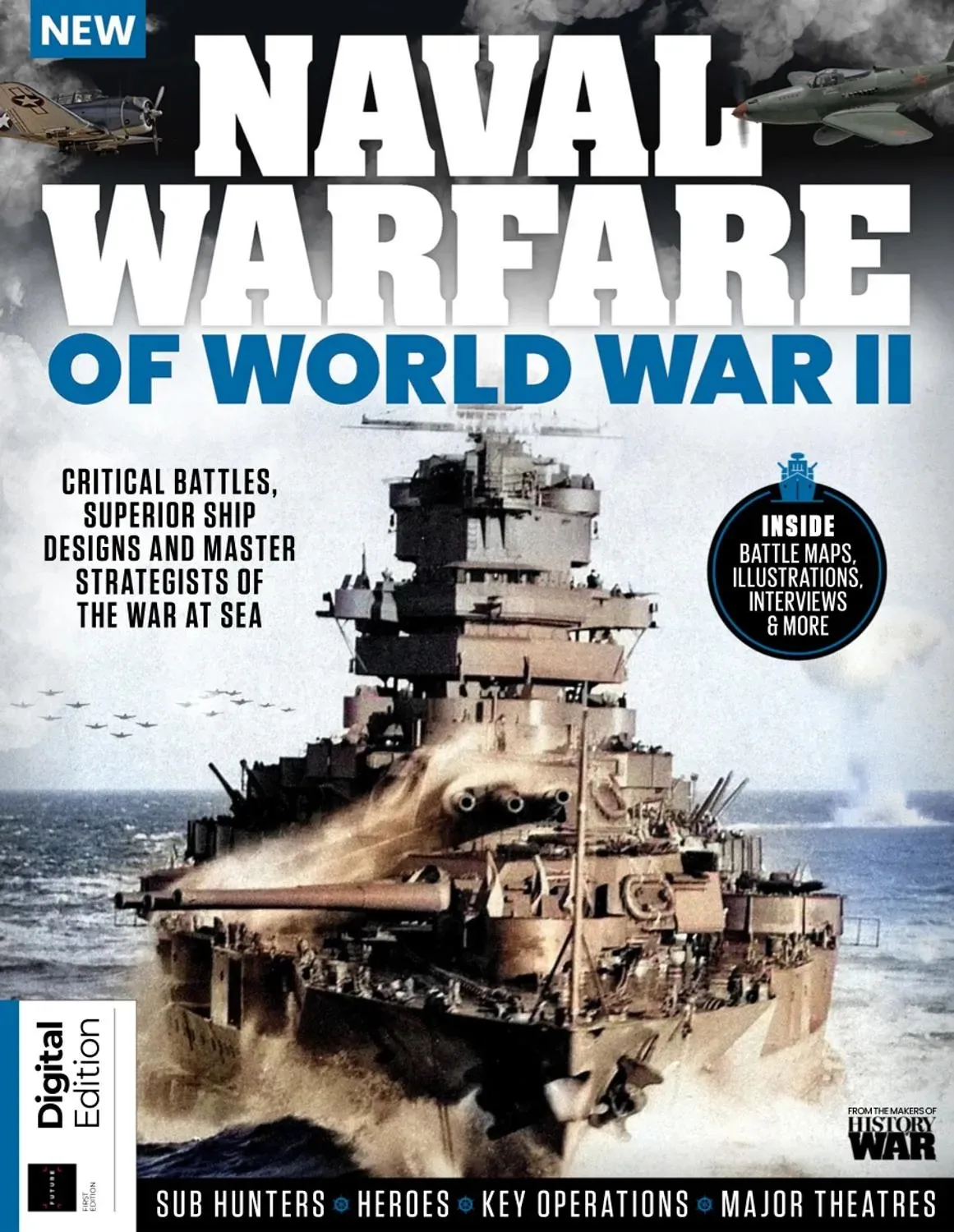
Roger's Wolfpack Inside Hitler's U-boat War gives voice to the submarine crews who served in the claustrophobic primitive submarines of the Kriegsmarine. History of War Naval Warfare of World War II 1st Edition June 2026 centres on the U-boat conflict told through archival sources unpublished diaries and existing memoirs.
The special edition covers the Battle of the Atlantic from the wolfpack tactics that nearly strangled Britain's supply lines to the Allied counter-measures that turned the tide. Surface actions including the Bismarck chase the Arctic convoys and the Mediterranean theatre are treated as separate chapters. The rise of the US Navy's carrier fleet and the demise of the battleship are charted through the Pacific campaign. The edition also examines naval intelligence the role of codes and codebreakers and the technological race in radar and sonar.
The issue opens with the state of naval warfare in 1939 and closes with the Japanese surrender in Tokyo Bay.
—————
Content Guide
▸ The U-boat War
Wolfpack Inside Hitler's U-boat War
Roger's landmark history uses archival sources unpublished diaries and existing memoirs to give voice to submarine crews. The claustrophobic conditions of the Type VII and Type IX boats are described through crew testimony. Specific tonnage sunk per patrol and the survival rates for U-boat crews are drawn from the operational records.
The Battle of the Atlantic
The campaign that nearly strangled Britain is broken into phases from the happy time through the black pit to the Allied victory. The monthly tonnage loss figures for 1942 are stated. The introduction of escort carriers and long-range aircraft is marked as the turning point with dates.
▸ Surface Warfare
The Bismarck Chase
The Royal Navy's pursuit of the German battleship is reconstructed with ship movements and radar contact data. The sinking of HMS Hood is timed to the minute. The final engagement is described with the specific shell hits that crippled Bismarck.
The Arctic Convoys
The supply route to the Soviet Union is mapped through the seasons and the German air and submarine threats. PQ-17 is singled out as the convoy that was scattered with catastrophic losses. The number of ships lost and the cargo value are quantified.
▸ Pacific Theatre
The Rise of the US Navy's Carrier Fleet
John Curatola recounts how the carrier supplanted the battleship as the capital ship. The transition is charted through Coral Sea Midway and the Marianas Turkey Shoot. The specific aircraft types and their combat radii are listed.
The Demise of the Battleship
The design's last combat action was in the 1991 Gulf War. The article traces the Iowa-class resurgence in Korea Vietnam and Desert Storm. The museum status of each surviving battleship is noted for readers who want to visit.
▸ Technology and Intelligence
Codes and Codebreakers
The role of Ultra intelligence and the codebreaking effort at Bletchley Park is assessed. The specific ciphers broken—Enigma and Lorenz—and the impact on convoy routing are documented.
Radar and Sonar
The technological race between German and Allied detection systems is described. The specific radar sets fitted to escort vessels and aircraft are named with their wavelengths and detection ranges.
—————
Editor's Take
This special edition delivers a comprehensive single-volume survey of WWII naval warfare that avoids the usual US-centric bias. The Wolfpack chapter built on crew testimony is the emotional core of the book. The surface action coverage of the Arctic convoys and the Bismarck chase is well-paced. The omission of the Italian Regia Marina's campaign in the Mediterranean is a gap. This title suits the naval history enthusiast who wants both the Atlantic and Pacific theatres in one volume.
Strengths
• Wolfpack chapter uses original crew diaries for authentic detail
• Atlantic and Pacific theatres balanced in page allocation
• Intelligence and technology sections add analytical depth beyond battle narratives
Weaknesses
• Italian Mediterranean campaign receives minimal coverage
• No ship profiles or specification tables for reference use
Verdict: Essential — the best single-volume WWII naval overview in the series.
