
The History of Horror – 1st Edition – 27 August 2026
Summary
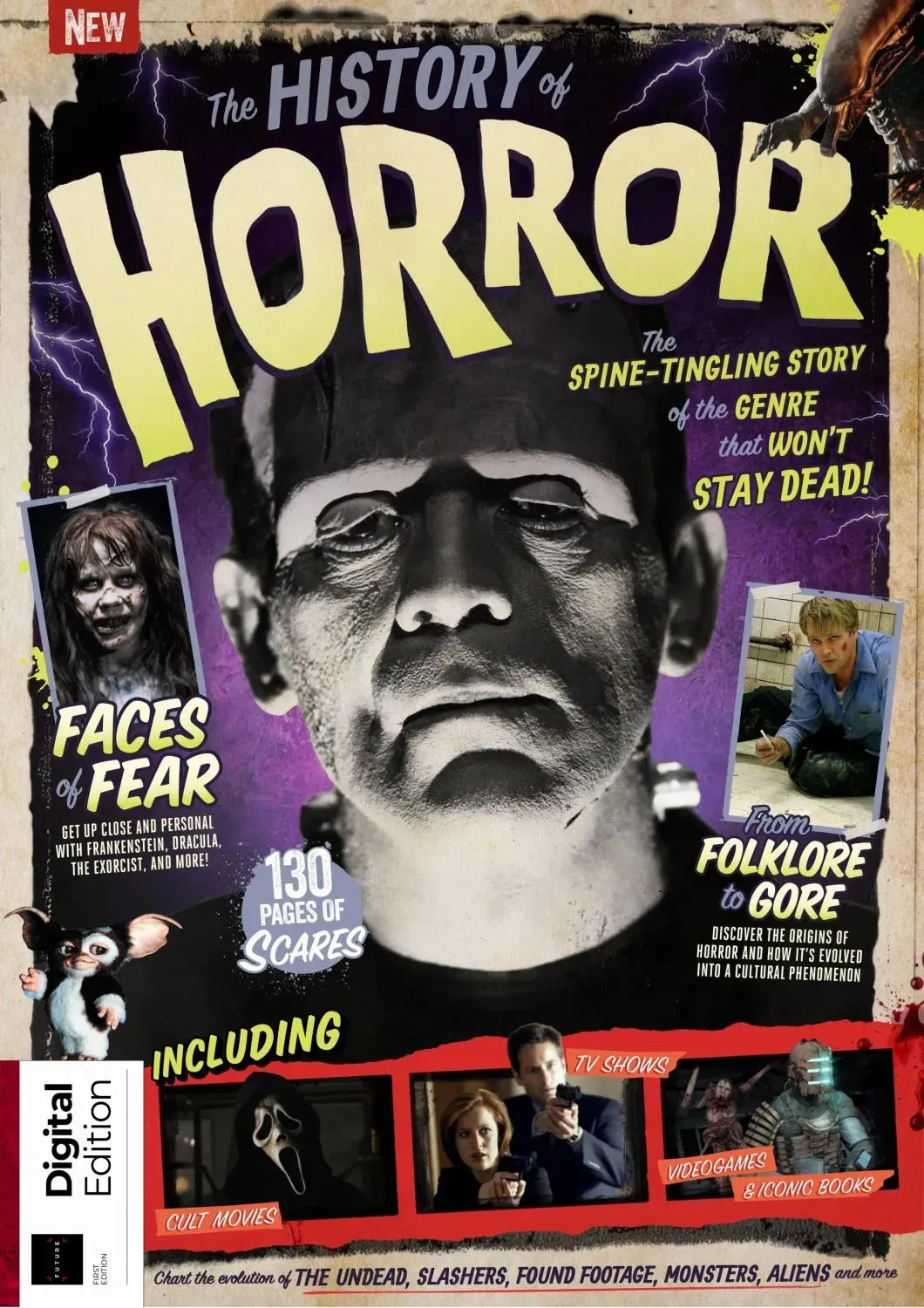
The History of Horror (1st Edition, 27 August 2026, Digital Edition, £11.99) traces 130 pages of spine-tingling genre evolution from folklore to gore — covering the origins of Frankenstein and Dracula through silent German Expressionism, Universal's monster cycle, Cold War chaos, slashers, found footage, and the postmodern turn. The spotlight section gives individual chapters to nine landmark horror films including The Exorcist, Scream, Saw, and Get Out.
The chronological structure moves from ancient mythology and Gothic literature through the 1930s Universal horror boom, the radioactive monster films of the 1950s, the psychological terror of the 1970s (The Exorcist, Halloween), the 1980s excess of practical-effects gore, and the 1990s self-awareness of Scream and The Sixth Sense. The New Wave section covers Jordan Peele's Get Out and Ari Aster's hereditary and Midsommar era.
The Spotlight entries provide detailed production histories: Frankenstein (1931) with Boris Karloff's iconic performance under Jack Pierce's makeup; Dracula (1931) with Bela Lugosi's stage-trained interpretation; Night of the Demon (1957), Jacques Tourneur's folk-horror masterpiece; The Exorcist (1973), William Friedkin's documentary-like approach; Poltergeist (1982), the suburban ghost story with uncredited Tobe Hooper direction; Scream (1996), Wes Craven's meta-slasher; and Saw (2004), James Wan's low-budget originator of the torture-porn cycle.
—————
Content Guide
▸ Genre Eras / Spotlights / Cult Classics / Modern Horror
p.6 · The Origins of Horror
From ancient Greek theatre and medieval morality plays to Horace Walpole's The Castle of Otranto (1764), which founded Gothic fiction. Mary Shelley's Frankenstein (1818) and Bram Stoker's Dracula (1897) established the two archetypes that still dominate the genre.
p.14 · Reel Terror — Silent German Expressionism
F.W. Murnau's Nosferatu (1922) and Robert Wiene's The Cabinet of Dr. Caligari (1920) used distorted sets and chiaroscuro lighting to externalise psychological states. Caligari's jagged buildings were painted directly onto canvas to save budget.
p.22 · Cold War Chaos
The 1950s saw radioactive monsters — Them! (1954), The Blob (1958) — as stand-ins for atomic anxiety. Invasion of the Body Snatchers (1956) used pod-people duplicates to mirror McCarthy-era conformity paranoia.
p.28 · The New Wave of Horror
Jordan Peele's Get Out (2017) used the horror framework to expose liberal racism, earning an Oscar for Best Original Screenplay. Ari Aster's Hereditary (2018) deployed slow-burn family trauma culminating in a pagan sacrifice finale.
p.36 · The Era of Excess — 1980s Gore
Practical-effects pioneers Tom Savini (Dawn of the Dead, Friday the 13th) and Rob Bottin (The Thing) pushed on-screen violence to new levels. The MPAA's X-rating battles forced directors to trim gore for R-rated theatrical release.
p.44 · From Pulp to Postmodernism
Wes Craven's Scream (1996) broke the fourth wall by having its characters reference horror-film rules — "never say 'I'll be right back.'" The film grossed $173 million worldwide on a $15 million budget.
p.54 · Spotlight: Saw
James Wan and Leigh Whannell made Saw (2004) for $1.2 million over 18 days of shooting. The reverse-bear-trap scene used a practical mechanism that genuinely terrified the actress — the prop was not disclosed to her before the camera rolled.
p.62 · Spotlight: Get Out
Jordan Peele's directorial debut cost $4.5 million and grossed $255 million worldwide. The "sunken place" was filmed with a simple drop-away floor and a television monitor displaying the character's point of view.
—————
Editor's Take
This bookazine succeeds because it treats horror film history with the same chronological rigour a music magazine would apply to rock — there is a clear through-line from Gothic novels to A24. The Spotlight entries are the issue's strength: each gets a compact production history with budget figures, box office, and practical-effects breakdowns. The Cold War chapter connects monster movies to their political moment without overreading. Weakness: the 1990s and 2000s sections are compressed compared to the 1970s and 1980s — Scream and Saw share a transition page rather than getting full-chapter treatment. The video-game section is a single page despite the medium's current dominance in horror. Best suited for film students and casual horror fans alike.
Strengths
• Spotlight entries include real production budgets and shooting schedules
• German Expressionism chapter links visual style to economic constraints
• Get Out analysis treats the film as craft, not just cultural phenomenon
Weaknesses
• Video-game horror dismissed in one page
• Post-2010 horror covered only through Get Out and Hereditary
Verdict: Recommended — Solid genre history with genuine production detail; skip if you only watch post-2010 horror.
