
All About History What If… Book of Alternative History WWII – 3rd Edition – March 2026
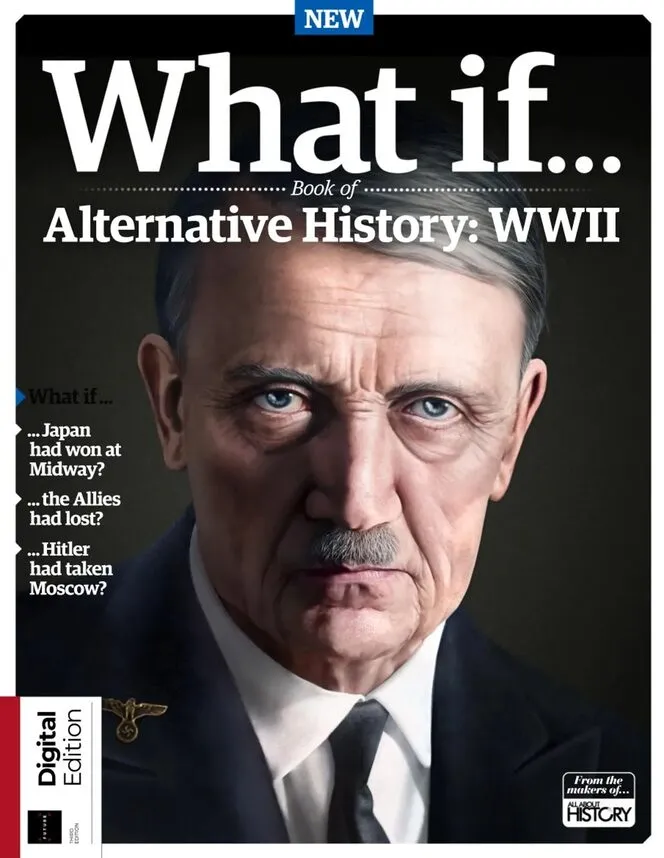
Summary
Timothy W. Ryback imagines a Nazi atomic bomb reaching London before D-Day in All About History's What If Book of Alternative History WWII 3rd Edition, March 2026 — one of 31 counterfactual scenarios spanning Hitler's rise through Stalin's post-war push to the Atlantic. Each 4-page chapter pivots a single decision and runs the geopolitical consequences forward.
The book leads with the cover scenario "What if the Allies had lost the war?" (p.6), featuring an interview with Timothy W. Ryback, author of TAKEOVER: Hitler's Final Rise to Power. Other entries include "What if the Nazis had never gained power?" (p.10), "What if the Dunkirk evacuation had failed?" (p.34), "What if Germany had invaded Britain?" (p.38), and "What if the Allies hadn't cracked the Enigma code?" (p.66). The Mediterranean theatre gets three scenarios: "What if Mussolini had not invaded Greece?" (p.54), "What if Germany had captured Malta?" (p.58), and "What if Rommel had won in North Africa?" (p.82). The Eastern front covers "What if Hitler had taken Moscow in 1941?" (p.70), "What if Stalingrad had fallen?" (p.86), and "What if Russia signed a second pact with Germany?" (p.90).
Pacific scenarios include "What if Japan had not struck Pearl Harbor?" (p.74), "What if Japan had won at Midway?" (p.78), and "What if Japan had invaded India?" (p.98). Post-war chapters ask "What if Operation Valkyrie had assassinated Hitler?" (p.102), "What if the Nazis had the atom bomb first?" (p.106), "What if Operation Unthinkable had become a reality?" (p.114), and "What if Stalin had continued west?" (p.126).
—————
Content Guide
▸ European Theatre
p.6 · What if the Allies had lost the war?
Timothy W. Ryback's interview-led scenario imagines Nazi Germany deploying a nuclear device against London in 1945, using the Me 264 Amerika bomber and a two-stage V-2 derivative. The map shows the expanded Greater Germanic Reich stretching from the Atlantic to the Urals. The interview questions focus on Hitler's post-victory plans for Britain.
p.34 · What if the Dunkirk evacuation had failed?
Without the 338,000 troops rescued from the beaches, Britain would have lost the core of its field army. The chapter calculates the remaining ground force available for home defence in July 1940 and concludes that Operation Sealion becomes feasible. The order-of-battle table shows exactly which divisions were lost at Dunkirk.
p.38 · What if Germany had invaded Britain?
The logistical requirements for Operation Sealion are modelled — landing craft availability, air superiority windows, and the Royal Navy's response time from Scapa Flow. The conclusion: a German beachhead on the south coast was possible only if the Luftwaffe had sustained one more week of clear-weather air superiority.
p.66 · What if the Allies hadn't cracked the Enigma code?
Without Ultra intelligence, the Battle of the Atlantic shifts decisively toward the U-boats. The shipping-loss projection shows a 35% increase in Allied tonnage sunk per month through 1942. The convoy simulation table makes the case that Britain could not have been resupplied beyond early 1943.
p.106 · What if the Nazis had the atom bomb first?
German nuclear weapons capability is advanced to 1945, with a He-177 bomber delivering a 10-kiloton device over London. The chapter models the city's evacuation capacity and casualty estimates. The radiation-contamination map shows why even a single airburst would have halted Allied advance into Germany.
▸ Eastern Front
p.70 · What if Hitler had taken Moscow in 1941?
The capture of Moscow is modelled with a revised timetable — if Army Group Centre had pushed through October rains rather than diverting to Kiev. Without the rail hub and communications centre, Soviet command-and-control fractures. The map shows the defensive line Stalin could have held in the Urals.
p.86 · What if Stalingrad had fallen to the Nazis?
The Volga crossing point secured, German forces could have cut the Caucasus oil route and turned north to encircle Moscow from the east. The casualty-exchange ratio chart shows how a Stalingrad capture would have shifted the overall Eastern Front balance by summer 1943.
p.90 · What if Russia signed a second pact with Germany?
A negotiated peace in 1943 would have freed 200 German divisions for redeployment to the Atlantic Wall, making any D-Day equivalent extremely costly. The chapter includes the actual peace feelers documented from Swedish diplomatic cables.
▸ Pacific Theatre
p.78 · What if Japan had won at Midway?
Four Japanese carriers survive the battle, giving the IJN a six-month window to isolate Australia through the Solomon Islands and threaten Hawaii directly. The timeline shows how a Midway victory delays the US island-hopping campaign by at least 12 months and raises the cost of any invasion of Japan.
p.122 · What if the Soviets had invaded Japan?
Stalin's planned Hokkaido invasion in August 1945 — halted by Truman's insistence on exclusive occupation — is modelled as a real campaign. The chapter includes Soviet Far East Command's actual landing plans. The result would have created a divided Japan analogous to post-war Germany.
—————
Editor's Take
The What If Book of Alternative History WWII 3rd Edition is a serviceable counterfactual collection with one standout: the Timothy W. Ryback interview on a Nazi nuclear-capable London strike. Most scenarios follow the same 4-page formula — pivot, map, order-of-battle table — which becomes repetitive by scenario 15. Weakest parts: the "What if Charles Lindbergh ran for president?" entry reads as contrived, and the "What if Mussolini had joined the Allies?" chapter lacks the military detail of the better scenarios. This edition suits the wargamer who wants alternative OOBs rather than the narrative historian.
Strengths
• Ryback interview on Nazi nuclear-warhead delivery
• Convoy loss projection for Enigma-crack failure
• Soviet Hokkaido landing plan with actual order of battle
Weaknesses
• Repetitive 4-page formula across 31 entries
• Lindbergh presidency scenario lacks military plausibility
Verdict: Selective read — Strong for wargame scenario planners; weak for narrative readers.
