
National Geographic History – September-October 2026
Summary
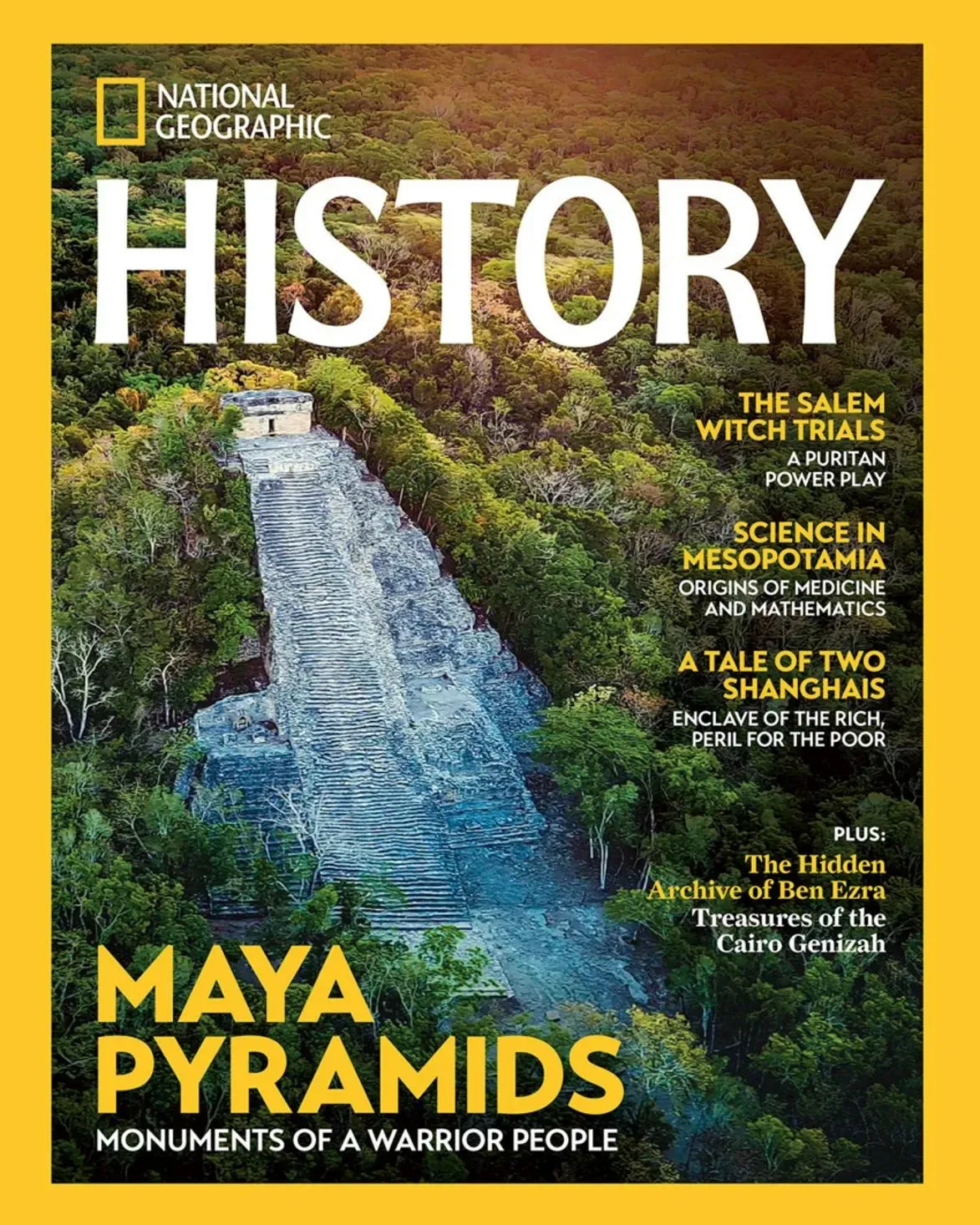
National Geographic History Vol. 12 No. 4 (September-October 2026, £8.99) fronts with "THE SALEM WITCH TRIALS — A PURITAN POWER PLAY" — a 16-page feature arguing that economic anxiety, not demonic possession, drove the 1692 hysteria that killed 20 people. Inside, 10 features span Mesopotamian science, Maya pyramids, Francisco Goya's darkness, Shanghai's divided 1920s and the Cairo Genizah archive.
The Salem feature (p.50) examines how land disputes, a smallpox outbreak and a recent charter change created conditions for accusations. The authors use trial transcripts to show that 78% of accusers came from farming families whose land bordered the accused families' properties. Science in Ancient Mesopotamia (p.20) argues that cuneiform tablets from 1800 BCE reveal the first scientific method — 1,400 years before Greek philosophy. The Maya Pyramids feature (p.32) explains that these structures were not simple tombs but symbolic entrances to the underworld, often built atop earlier hidden pyramids. Francisco Goya, Painter of Darkness (p.66) connects the artist's Black Paintings to the political repression of 1820s Spain. Shanghai's Roaring (and Raging) 1920s (p.82) contrasts the foreign-settlement wealth with Chinese-worker poverty in the same streets. The Genizah of Ben Ezra (p.92) reveals 400,000 manuscript fragments found in a Cairo synagogue attic — a record of medieval Jewish life across 1,000 years.
—————
Content Guide
▸ Cover Story
p.50 · High Drama in Puritan New England: The Salem Witch Trials
A 16-page investigation into the 1692 Salem witch trials. The authors argue that property disputes triggered the accusations: 78% of accusers were from farming families whose land adjoined the accused. A smallpox outbreak in 1689 and the revocation of the Massachusetts Bay Charter in 1684 created a community already primed for scapegoating. The trial transcripts show that spectral evidence — testimony about dreams and visions — was considered valid in court. Read a single trial transcript aloud — the witnesses' descriptions of "shapes" and "specters" reveal how normal people convinced themselves they saw the supernatural.
▸ Features
p.20 · Science in Ancient Mesopotamia
Cuneiform tablets from 1800 BCE document medical diagnoses, astronomical calculations and chemical recipes — all using a systematic methodology that qualifies as scientific by modern standards. The article highlights the Venus Tablet of Ammisaduqa, which records planetary movements over 21 years with 99% accuracy. The ancient Greeks credited with inventing science were preceded by 1,400 years of Mesopotamian documentation.
p.32 · Pyramids of the Maya: Emblems of a Civilization
Maya pyramids served as ceremonial centres, burial chambers and symbolic portals to Xibalba — the underworld. Many contain earlier pyramids buried inside — the Temple of the Inscriptions at Palenque revealed a hidden tomb beneath 20 metres of stone in 1952. The stepped-slope design distinguishes Maya pyramids from Egyptian counterparts. The article includes diagrams showing how limestone blocks were quarried, transported without wheels and fitted without mortar.
p.66 · Francisco Goya, Painter of Darkness
Goya's Black Paintings — 14 murals painted on the walls of his home between 1820 and 1823 — reflect the artist's response to the restoration of the Spanish Inquisition and the repression of liberal reforms. The most famous, Saturn Devouring His Son, was originally painted on a dining room wall. The paintings were transferred to canvas 50 years after Goya's death — a process that damaged the original textures irreversibly.
p.82 · Shanghai's Roaring (and Raging) 1920s
Shanghai in the 1920s was two cities in one: the International Settlement and French Concession housed 60,000 foreigners in Art Deco luxury while 800,000 Chinese workers lived in slums with a mortality rate 40% higher than the settlement average. The article uses police records, newspaper accounts and municipal reports to document the divide. The Great World entertainment centre — six floors of theatres, restaurants and brothels — stood one kilometre from the city's worst shantytown.
p.92 · The Genizah of Ben Ezra
The Cairo Genizah — 400,000 manuscript fragments discovered in the Ben Ezra Synagogue's attic — documents Jewish life from the 9th to 19th centuries. The fragments include letters from Maimonides, a 1,000-year-old recipe for hamin stew and a child's Hebrew alphabet practice sheet. The genizah was sealed for centuries because Jewish tradition forbids destroying any text that contains God's name. The fragments are now being digitised — volunteers can transcribe them online through the Library of Cambridge's Genizah Research Unit.
▸ Departments
p.2 · Snapshots
An Egyptian tomb belonging to the Abydos dynasty uncovered near Luxor. The tomb contained 14 burial chambers and pottery sealed with clay stoppers still intact after 3,600 years.
p.4 · News
A megaraptor skeleton discovered in Argentina with its last meal still preserved in its mouth — a small flying reptile. The fossil provides the first direct evidence of megaraptor feeding behaviour.
p.6 · Profiles
Maria Montessori — the article traces her education method from her first experimental classroom in Rome's San Lorenzo slums (1907) through her conflict with Mussolini's fascist government in 1934, which forced her into exile.
—————
Editor's Take
National Geographic History September-October 2026 delivers its strongest feature in the Salem witch trials cover story — the 78% land-dispute correlation is a fresh angle on a well-worn subject. The Mesopotamian science piece earns its place by challenging the "Greeks invented everything" narrative with primary cuneiform evidence. The Maya pyramids feature includes 1952 excavation details that specialist readers will know but general readers will not. The Shanghai 1920s piece is the issue's weakest — it covers the same rich-poor divide covered in every Shanghai history, without new archival material. The Goya article is well-illustrated but lacks a clear thesis beyond "the artist was dark." The Genizah piece offers the most surprising takeaway: anyone can transcribe thousand-year-old fragments from home via Cambridge's digitisation programme. The design is clean but the small typeface on the Mesopotamia maps requires a magnifying glass.
Strengths
• Salem feature surfaces 78% land-dispute correlation from trial transcripts
• Mesopotamian science tablet evidence predates Greek methods by 1,400 years
• Genizah article includes a call to home-transcribe 400,000 fragments online
Weaknesses
• Shanghai 1920s piece covers familiar rich-poor territory without new archival material
• Small typeface on Mesopotamia maps challenges readability
Verdict: Essential — The Salem land-dispute angle and Mesopotamian science revision make this the strongest History issue this year. (20 words)
