
National Geographic Little Kids USA – September-October 2026
Summary
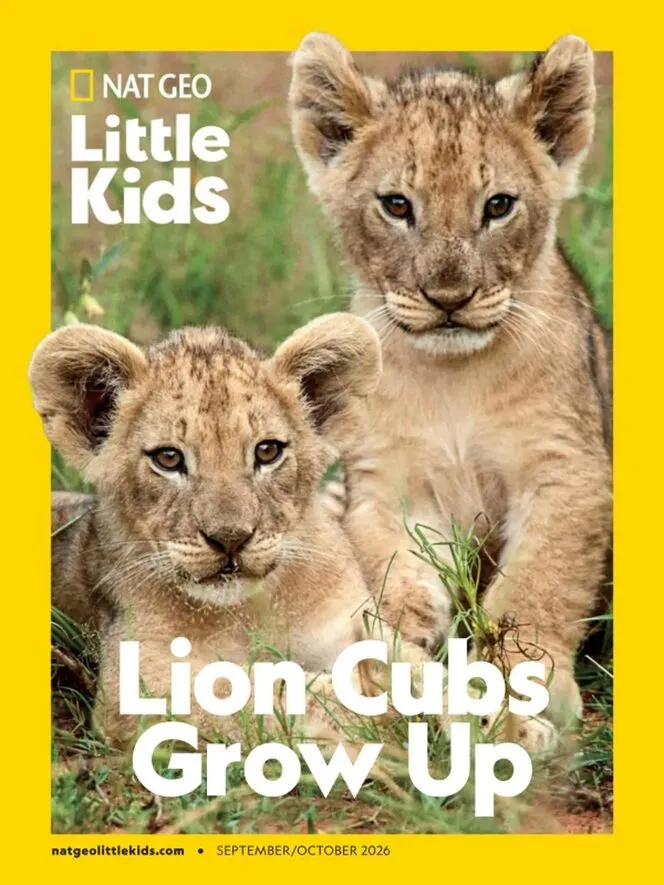
National Geographic Little Kids USA Issue 118 (September/October 2026, ages 3-6) teaches preschoolers how lion cubs grow up, why trees have roots and what makes a beluga a beluga — all through 24 pages of photos, simple text and interactive games. The cover feature "Lion Cubs Grow Up" follows cubs as they stalk, roar and pounce under their mother's watch.
The issue's animal content is structured around photo-driven spreads: lion cub behaviour, a leaping lemur feature, swimming sea turtles, a giraffe playtime page and a Tyrannosaurus rex dinosaur spotlight. Non-animal pages cover tree roots, seashell identification, ocean exploration and pumpkin season. Activity pages include "Copy Cats" (matching game), "Stalk! Roar! Pounce!" (action prompts), "What Are These?" (guess-the-object), "Where Do We Live?" (habitat matching), "B is for Beluga" (letter recognition) and a "Moment of Wow!" close-out. A subscription pitch closes the issue.
Every spread follows the Little Kids format: one short factual sentence, a simple question prompt and a parent-chat tip. The magazine supports Early Years Foundation Stage learning objectives in literacy, numeracy and understanding the world.
—————
Content Guide
▸ Animal Features
p.2 · Lion Cubs Grow Up
Three stages of cub development: stalking practice, roaring drills and the first pounce. The photo sequence shows a cub mimicking its mother's hunt technique. Ask your child to count the cubs in each photo — the answer changes across the page.
p.8 · Leaping Lemur
A ring-tailed lemur demonstrates its signature jump: hind legs propel it six times its body length in a single bound. The spread includes a "can you leap like a lemur?" action prompt. Time your child's standing long jump against the lemur's nine-foot equivalent.
p.14 · Swimming Sea Turtles
A green sea turtle glides past coral, with callouts for its flippers, shell and beak. The page asks children to trace the turtle's path with their finger. Take the finger-tracing exercise one step further — draw a maze on paper and let your child guide a toy turtle through it.
▸ Science & Nature
p.6 · Why Do You Think Trees Have Roots?
The three jobs of roots: anchor, drink, store food. A cutaway diagram shows an oak's underground network stretching as wide as its canopy. Next time you walk past a tree, stop and look at the base — roots that break the surface are often as wide as the trunk itself.
p.18 · What Are These?
A guess-the-object page featuring seashells, a starfish and a piece of coral. Each item is photographed against a white background with a silhouette clue. Collect three shells on your next beach trip and let your child sort them by size, colour and texture.
p.20 · See Seashells
Five common shell types — whelk, scallop, cowrie, conch and limpet — labelled with their animal names. A simple counting game asks children to find three scallops. Use the shell chart as a scavenger-hunt checklist on your next shoreline walk.
▸ Activities & Games
p.4 · Copy Cats
A matching game: lion cubs strike poses on the left, and children draw lines to the identical poses on the right. The poses include stretch, crouch and leap. Let your child act out each pose before drawing the line — gross motor movement reinforces visual matching.
p.10 · Your Turn!
A spot-the-difference puzzle with two nearly identical photos of a giraffe enclosure. Seven differences are hidden in the scene. Start from the top of the image and work down in rows — children who scan systematically find more differences than those who jump around.
p.12 · B Is for Beluga
Letter-recognition spread: the beluga's rounded head, white skin and melon-shaped forehead are introduced alongside the letter B. The activity asks children to circle every "B" in a short sentence. Point to the beluga's melon — it changes shape when the whale makes sounds.
▸ Special Features
p.22 · Meet a Dino: Tyrannosaurus Rex
One page on T. rex: 40 teeth, arms shorter than a preschooler's, and a bite strong enough to crush a car. The size comparison uses a school bus as a reference. Stand your child next to a tape measure on the wall — mark 13 feet to show T. rex's height.
p.24 · That's Cool!
Closing spread with a pumpkin growing time-lapse and a "Moment of Wow!" — a freeze-frame of a jumping spider mid-pounce. Ask your child which "wow" moment they would capture if they had a camera. Their answer reveals which page they connected with most.
—————
Editor's Take
Little Kids USA Issue 118 sticks to the formula that works: one animal per two-page spread, a letter-of-the-month, and interactive games that don't require screen time. The lion cub cover delivers exactly what it promises — stalk, roar, pounce — and the sequential photography is good enough to hold a three-year-old's attention. The beluga letter-B page is the issue's best-designed spread, using the whale's round shape to reinforce the letter form. But the Tyrannosaurus rex page (p.22) feels rushed: one page with no activity beyond a size comparison. The pumpkin time-lapse on the closing spread is too abstract for the target age group — preschoolers need concrete objects, not seasonal processes. The subscription pitch on the final page is a wasted opportunity for one more game.
Strengths
• Lion cub behaviour sequence uses three action verbs (stalk, roar, pounce) toddlers can imitate
• Beluga letter-B spread integrates shape recognition with animal anatomy
• Tree roots cutaway diagram shows an oak's hidden underground network
Weaknesses
• T. rex spread has no interactive component — just a one-page size comparison
• Pumpkin time-lapse closing spread is too abstract for ages 3-6
Verdict: Recommended — Solid early-learning content with the lion cub cover doing the heavy lifting. (17 words)
