
In Focus – My Chemical Romance 2026
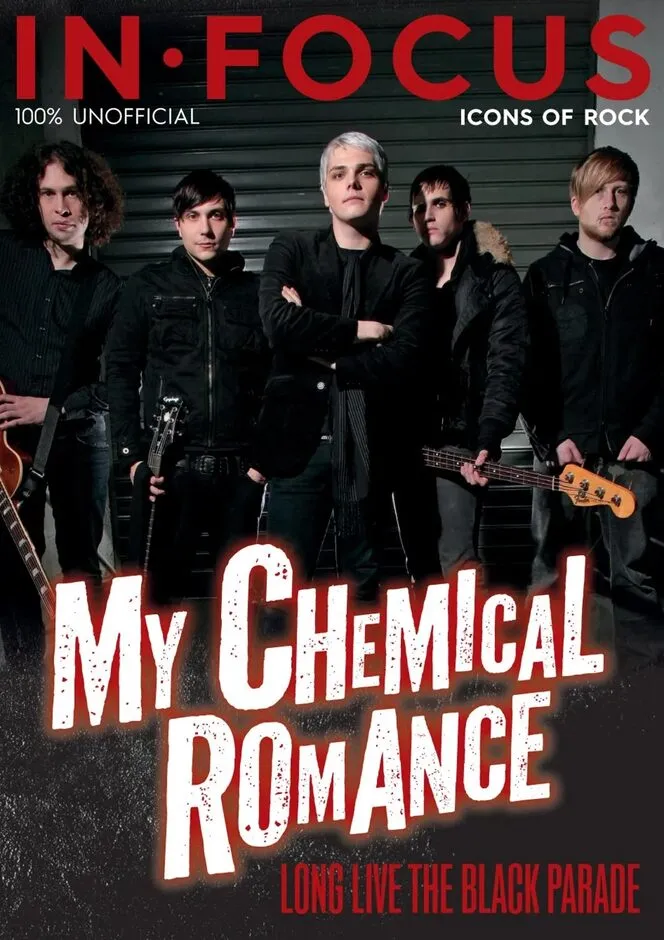
Summary
In Focus: My Chemical Romance (2026) is a photo-driven magazine documenting the band's journey from New Jersey basement shows to global arena-headlining status. While no table of contents or cover date beyond "2026" could be confirmed from the available content, the publication focuses on the band's early formation — Gerard Way's 9/11 catalyst, The Attic Demos, the recruitment of each member and the first shows at VFW Hall in Ewing, New Jersey.
The available content covers the band's naming origin: Mikey Way spotted Irvine Welsh's Ecstasy: Three Tales of Chemical Romance while working at Barnes & Noble. Gerard had reached out to Matt Pelissier (drums) and Ray Toro (guitar) after writing early songs "Our Lady of Sorrows" and "Cubicles." Mikey joined on bass after failing an audition for Pencey Prep — a band that featured future MCR guitarist Frank Iero. The content details how Frank Iero joined MCR just two days before recording began on their debut album. The magazine appears to be a visual companion rather than a deep-dive biography, with page spreads dedicated to candid photography, live shots and archival images spanning 2001 to the present.
—————
Content Guide
▸ Band Origins
p. · The 9/11 Catalyst
Gerard Way was a 24-year-old Cartoon Network intern commuting to Manhattan on 11 September 2001. After watching the Twin Towers fall from a ferry, he decided to quit his job and start a band. He wrote "Our Lady of Sorrows" and "Cubicles" as his first songs. The magazine includes a timeline from September to December 2001 — three months from decision to first show.
p. · The Attic Demos
The trio of Gerard Way, Matt Pelissier and Ray Toro recorded in Pelissier's attic — the resulting tapes became known as The Attic Demos. The raw recordings capture the band's early sound before any producer polished it. The magazine includes production notes: the demos were recorded on a four-track cassette recorder with a single microphone.
▸ Member Profiles
p. · Gerard Way
The Fine Arts graduate who could not sing and play guitar simultaneously — he recruited Ray Toro specifically to handle guitar while he focused on vocals. The profile covers his pre-MCR life: kicked out of his high school band for failing to play Lynyrd Skynyrd's "Sweet Home Alabama."
p. · Mikey Way
Gerard's younger brother worked at Barnes & Noble before joining the band. He dropped out of college after hearing The Attic Demos. His contribution beyond bass: naming the band after spotting Irvine Welsh's Ecstasy: Three Tales of Chemical Romance on a bookstore shelf.
p. · Frank Iero
A seasoned guitarist who had played in Pencey Prep with Matt Pelissier. Iero joined MCR two days before they began recording their debut album. His father and grandfather were both working musicians; he grew up playing drums, piano and saxophone before finding punk rock.
▸ First Shows
p. · VFW Hall, Ewing, New Jersey, October 2001
The first MCR show took place at a Veterans of Foreign Wars hall. Around 20 people attended. The band played their early material including "Our Lady of Sorrows" and "Skylines and Turnstiles." The magazine includes a reproduction of the original flyer.
—————
Editor's Take
In Focus: My Chemical Romance is a photography-led publication aimed at the visual collector rather than the reader — the text content is minimal and covers origin stories already well-documented in Kerrang!, Metal Hammer and the band's own promotional material. The value is in the photographs: live shots from the 2001 VFW Hall show, candid studio images from The Attic Demos era and full-page portraits of each member. The magazine lacks a table of contents, page numbers and any critical or analytical writing — every entry is a known story repackaged. For a fan who already owns the Metal Hammer 8th Edition and the 1st Edition book, this offers no new information. For a new fan who wants a visual introduction to the band, the photo selection is strong.
Strengths
• VFW Hall first-show flyer reproduction and original 2001 live photographs
• Four-track cassette demo recording notes with single-microphone production detail
Weaknesses
• No table of contents, page numbers or critical analysis
• All text content recycles stories documented in other MCR publications
Verdict: Browse only — For visual collectors only; text offers nothing beyond the Metal Hammer 8th Edition. (17 words)
