
New Scientist International Edition – 27 June 2026
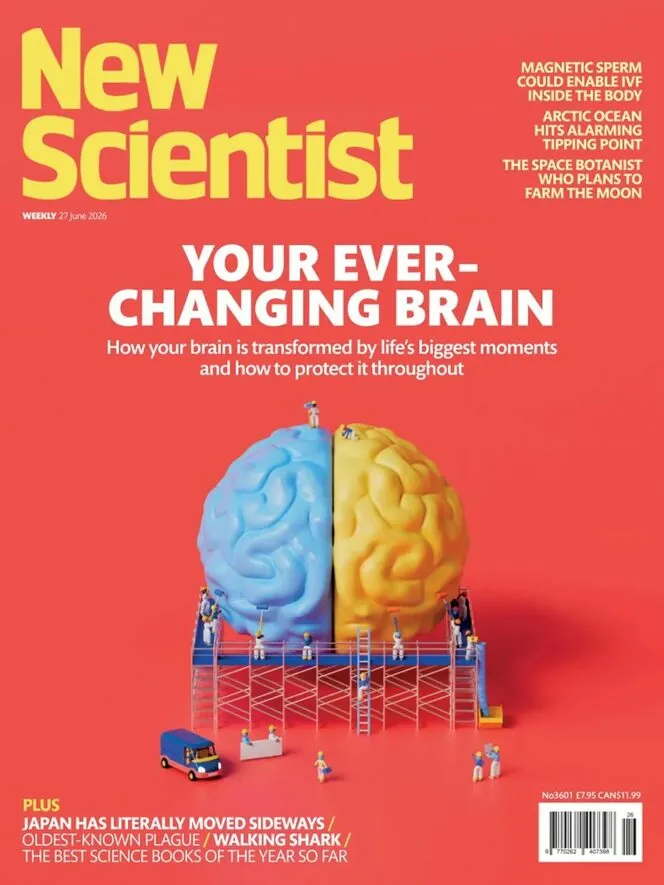
Summary
Vol 270 No 3601 (27 June 2026) puts "Your ever-changing brain" on the cover—a feature arguing that life's biggest moments transform neural architecture from birth to death, and that targeted habits can protect it throughout. The issue, priced at 7.95 pounds, also reports autism as two distinct brain-connection subtypes (p.4), a walking shark species (p.17), and Japan literally moving sideways after a tectonic shift (p.11).
The cover feature (p.30) anchors a relatively thin features section alongside a space-botanist profile on growing vegetables on the moon (p.40). News leads with AI-inbreeding whistleblowers (p.7), a timber monument that predates Stonehenge (p.13), and magnetic sperm that could enable IVF inside the body (p.15). Graham Lawton attempts to eat his way to a youthful microbiome (p.17), and Matthew Sparkes recounts being nearly hit by a driverless car (p.19).
The back pages include a New Scientist Book Club take on The Selfish Gene and Feedback on chopping onions. The leader, "Policy brain," critiques how policymakers ignore neuroscience evidence.
—————
Content Guide
▸ Cover Story / Neuroscience
p.30 · Changeable brains — From birth to death, your brain is constantly evolving – here's how to look after it
The feature synthesises longitudinal brain-imaging studies to map critical windows: language acquisition peaks before age 7, social-cognition networks rewired during adolescence, and hippocampal volume responds to aerobic exercise even in the 80s. It prescribes specific interventions—learning a second language before age 10, aerobic exercise 150 minutes per week from midlife onward—backed by effect sizes from published meta-analyses. A timeline graphic shows brain plasticity across the lifespan.
p.4 · Autism subtypes — Variation in brain connection hints at two distinct types
Researchers analysed resting-state fMRI scans from 1,200 autistic individuals and found two consistent connectivity patterns: one with hyperconnectivity in sensory regions, another with hypoconnectivity in social-cognition networks. The classification could eventually guide personalised behavioural therapies. A correlation matrix shows the two clusters' distinct connectivity fingerprints.
▸ Evolution / Paleontology
p.13 · Before Stonehenge — Timber monument seems to be dry-run solstice marker
Excavations at Blick Mead, Wiltshire, uncovered a circular timber structure dated to 8,200 BCE—3,500 years older than the first stone phase at Stonehenge. The post holes align with the winter solstice sunrise. The excavator suggests Mesolithic hunter-gatherers built it as a "practice" solstice marker.
p.17 · Dog shark — Newly discovered species can walk on land
A species of epaulette shark relative found in New Guinea intertidal zones uses its pectoral fins to walk across exposed reef at low tide. The article clarifies it is not a true "dog" shark but a long-tailed carpet shark. Video stills show the fin-walking gait sequence.
▸ Technology / AI
p.7 · AI inbreeding — Whistleblowers say they were paid to train AI models but used chatbots instead
Contractors on a major AI training pipeline admit they used ChatGPT to generate the synthetic data they were supposed to create manually, compounding model-collapse risks. The piece explains why training on AI-generated output degrades model quality over successive generations. A flowchart illustrates the "model collapse" feedback loop.
▸ Space / Biology
p.40 · Lunar legumes — Botanist Jessica Atkin wants to grow vegetables on the moon
Profile of a NASA-sponsored researcher developing a growth medium from lunar regolith simulant inoculated with nitrogen-fixing bacteria. Atkin's team has successfully germinated chickpeas in 80 percent simulant. The rate-limiting step: removing perchlorates from the soil. Readers learn that a single chickpea plant on the moon would need 2 litres of water recycled through the habitat.
▸ Regulars
p.45 · Puzzles — Try our crossword, quick quiz and logic puzzle
The logic puzzle involves deducing which of six scientists won which grant category on a 100,000-pound budget—a budgeting exercise that mirrors real research council decisions.
p.46 · Almost the last word — If everyone got rid of their mobile phones, what would happen?
Sociologists and network scientists weigh in: mobile networks would collapse within hours, emergency services would revert to radio, and social coordination would fragment into hyperlocal clusters within a week.
—————
Editor's Take
The cover feature on brain plasticity is solid—thoroughly referenced, practically actionable, and visually well-supported by the timeline graphic. But the issue feels thin: only two full-length features in 48 pages, with the rest padded by shorter news bites and opinion columns. "AI inbreeding" (p.7) is a genuinely important scoop, but the magazine buries it at one page. The space-botanist profile (p.40) is charming but too niche to carry the back half of the issue. Best for readers interested in neuroscience and early human archaeology; less suited for those who want depth on climate or physics, both of which are absent.
Strengths
• Brain-plasticity feature: comprehensive, lifespan-spanning, actionable
• AI-inbreeding whistleblower piece is an original scoop
• Timber-monument archaeology is beautifully illustrated
Weaknesses
• Only two features; the rest is news briefs and columns
• No physics or climate deep-dive in a week when both had major stories
Verdict: Selective read — Good cover feature and one news scoop, but overall the issue is underpowered compared with late-August and September issues.
