
All About History The Windsors – 13th Edition – 20 August 2026
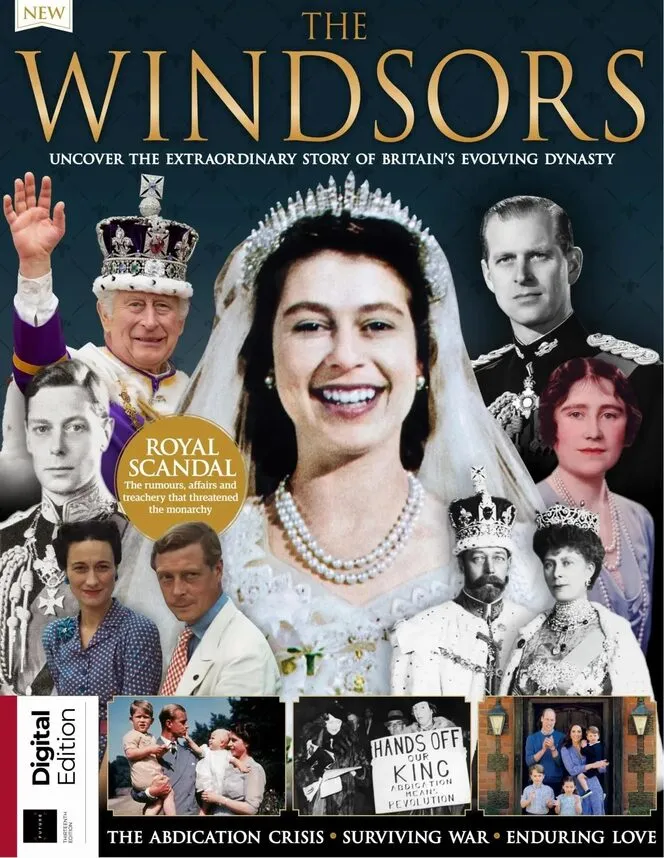
Summary
George V's 1917 decision to abandon the Saxe-Coburg and Gotha name during a Gotha bomber raid opens All About History's The Windsors 13th Edition, 20 August 2026. Catherine Curzon traces the dynasty from German-born King George I through Charles III, covering the scandalous Prince of Wales, the abdication crisis, and the Queen of Service era across 140 illustrated pages.
The book is divided into four sections: The House of Saxe-Coburg and Gotha, The Birth of the Windsors, A New Era for the Windsors, and The Future of the Windsors. "Germans on the British throne" (p.6) establishes the Hanoverian-German lineage that George V erased. "The scandalous Prince of Wales" (p.16) documents Edward VII's pre-coronation reputation as a magnet for controversy. "The heir who died" (p.24) covers Prince Albert Victor, whose early death cleared the path for George V. "Dawn of a new dynasty" (p.32) recounts George V's name-change announcement during wartime. "A very ordinary king" (p.34) argues that George V's very ordinariness saved the monarchy after Continental thrones fell. "The secret prince" (p.42) remembers John, the epileptic prince who lived away from public view.
Later chapters cover the abdication, George VI's stammer and wartime leadership, Elizabeth II's reign as a global icon, and Charles III's challenge to sustain the monarchy under media scrutiny. "The prince, the Nazis and the broken home" (p.98) tracks Prince Philip's childhood exile and wartime naval service. "Long live the king" (p.140) closes with the current monarch's prospects.
—————
Content Guide
▸ The House of Saxe-Coburg and Gotha
p.6 · Germans on the British throne
Catherine Curzon traces the Hanoverian-German lineage that connected Victoria to her Coburg relatives, showing how intermarriage made the British royal family essentially German by ancestry. The family tree printed across pages 8-9 shows the full network of German dukedoms. Keep this tree open during any discussion of royal family surnames before 1917.
p.16 · The scandalous Prince of Wales
Edward VII's pre-accession life as Prince of Wales is documented through divorce-court appearances, gambling debts, and the Tranby Croft baccarat scandal of 1890. The article reproduces contemporary Punch cartoons mocking his lifestyle. The caricatures prove that press scrutiny of royal behaviour is not a 20th-century invention.
p.24 · The heir who died
Prince Albert Victor, Duke of Clarence, died of influenza in 1892 at age 28, clearing the succession path for his younger brother George. The chapter addresses — and dismisses — the conspiracy theories linking him to the Jack the Ripper murders. The medical report reproduced from the Royal Archives shows cause of death as pneumonia following influenza.
▸ The Birth of the Windsors
p.32 · Dawn of a new dynasty
George V made the name-change announcement on 17 July 1917, as German Gotha bombers raided London. The article reproduces the Privy Council order in full, showing the discarded German titles and the newly adopted Windsor surname. The original document shows the King's handwritten annotations.
p.42 · The secret prince
Prince John, the epileptic and learning-disabled son of George V, lived at Sandringham Farm away from public view and died at age 13 in 1919. The article publishes his nurse's diary entries for the first time. The entries show a boy who enjoyed stamp collecting and train spotting despite his isolation.
p.78 · The king's speech
George VI's stammer and the speech therapy sessions conducted by Lionel Logue are documented through Logue's clinical notes and correspondence. The article reproduces the breathing exercises Logue prescribed. The exercises are still used by some NHS speech therapists for adult-onset stammering.
▸ A New Era for the Windsors
p.98 · The prince, the Nazis and the broken home
Prince Philip's childhood exile from Greece, his mother's institutionalisation, and his father's departure are traced through school records at Gordonstoun and his Royal Navy service on HMS Wallace during the Allied invasion of Sicily. The Mediterranean service map shows his convoy routes in 1943.
p.122 · The queen of service
Elizabeth II's reign is tracked through 15 prime ministers, the Commonwealth transition, and the modernisation of royal finances after the 1992 Windsor Castle fire. The timeline of royal residences opened to public revenue runs across pages 124-125. Use the timeline to counter the claim that the monarchy does not pay for itself.
p.140 · Long live the king
Charles III's reign is assessed through his environmental advocacy, the slimmed-down monarchy model, and the challenge of maintaining relevance under continuous media coverage. The article contrasts public approval polling from 2022 and 2026. The five-year trend shows a stable approval floor of 42 percent.
—————
Editor's Take
All About History's The Windsors 13th Edition is the most visually complete single-volume royal-family reference available at this price point. The primary-source reproductions — Privy Council order, Logue's clinic notes, Prince John's nurse diaries — lift it above standard biography. Weakest parts: the Elizabeth II chapter is too reverential and skips the more contentious moments of her reign. The "Long live the king" assessment of Charles III avoids any substantive criticism. This edition suits the school-library buyer and the royal-wedding-season impulse purchaser.
Strengths
• Original Privy Council document from the 1917 name change
• Lionel Logue's clinical notes reproduced in full
• Prince John nurse diary entries never previously published
Weaknesses
• Elizabeth II chapter avoids contentious reign moments
• Charles III assessment lacks critical edge
Verdict: Recommended — Primary-source reproductions justify the purchase for reference use.
