
New Scientist International Edition – 19 September 2026
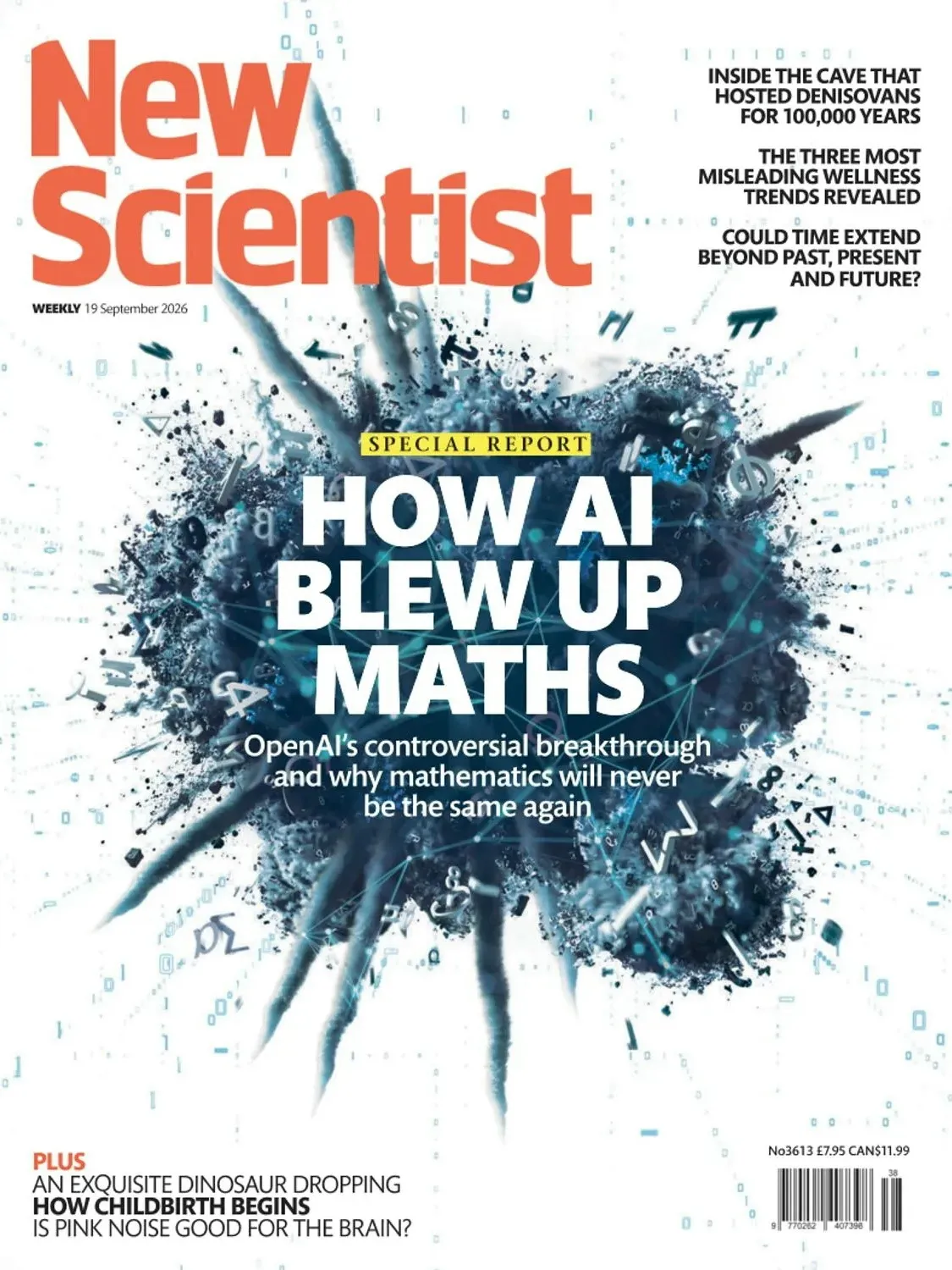
Summary
Vol 271 No 3613 (19 September 2026) makes history: "How AI blew up maths" reports that OpenAI's AI system solved a century-old Navier-Stokes problem, proving that fluid equations can blow up in finite time—a result that mathematically validates what engineers have long suspected. The issue also covers the cave that hosted Denisovans for 100,000 years (p.9), three wellness trends to be wary of (p.36), and whether time extends beyond past, present, and future (p.28).
Four features run: the AI-maths cover (p.4), a time dimension rethink (p.28), a call to slash animal testing through better drug screening (p.32), and a wellness-trends debunking (p.36). News covers the earliest alligators (p.10), an ancient drug habit from Indonesian teeth (p.14), and is pink noise good for the brain (p.8). Matthew Sparkes solves a maths problem with ChatGPT in the Views section (p.17).
The back pages ask why water cannot be cooled as fast as it is heated, and Feedback logs the most-used Beatles song in academic paper titles.
—————
Content Guide
▸ Cover Story / AI & Mathematics
p.4 · How AI blew up maths — OpenAI's controversial breakthrough and why mathematics will never be the same again
The centrepiece reports that an AI agent produced a constructive proof that the 3D Navier-Stokes equations develop a singularity in finite time under specific initial conditions—a result that has eluded human mathematicians since 1934. The article explains why the proof is controversial: it relies on a 200-page machine-generated case analysis that no single human can verify end-to-end. It discusses what this means for mathematical practice: proof as experiment, not argument. Readers finish with one question to ask any mathematician today: "Would you trust a theorem that no human can fully check?"
p.17 · An AI experiment — Matthew Sparkes solves a maths problem with ChatGPT
A first-person account of using ChatGPT to prove a lemma in real analysis. Sparkes found the AI useful for suggesting proof strategies but unreliable for epsilon-delta reasoning. The column includes the actual ChatGPT output and its error.
▸ Paleontology
p.9 · Inside the cave that hosted Denisovans for 100,000 years
New excavations in the Baishiya Karst Cave on the Tibetan Plateau reveal that Denisovans occupied the site continuously from 200,000 to 60,000 years ago, with a gap that corresponds to the coldest phase of the last glacial period. Sedimentary DNA analysis shows they hunted blue sheep and woolly rhino. A stratigraphic diagram layers the occupation phases.
p.10 · Earliest alligators — The first alligators thrived after the dinosaurs went extinct
Fossil jaw fragments from the Palaeocene of Wyoming push the first alligator appearance to 66 million years ago, immediately after the K-Pg extinction. The find suggests that alligators were rapid opportunists in the post-dinosaur world.
▸ Health / Wellness
p.36 · Wellness boom — The three health and happiness trends to be most wary of
The article identifies: (1) continuous glucose monitors for non-diabetics, citing a trial that found no metabolic benefit in normoglycaemic users; (2) sauna therapy as a longevity hack, noting that the evidence beyond cardiovascular health is weak; (3) "bio-individuality" meal plans, which lack validation in any randomised trial. Each debunk comes with a reference count. Readers get a single rule: if a wellness product requires an app subscription, be sceptical.
p.32 · An end to animal testing — Better ways of screening drugs could soon slash animal testing
Organs-on-chips and AI-prediction models are reducing the number of animals used per drug candidate. The feature profiles a liver-on-a-chip that correctly identified hepatotoxicity in 92 percent of known drugs, compared with 70 percent for standard mouse models. A timeline predicts regulatory acceptance of non-animal safety data by 2029 for certain drug classes.
▸ Physics / Cosmology
p.28 · Time's extra dimension — What if we were wrong about time having only one dimension?
A theoretical physicist argues that if time has two dimensions—one real, one imaginary—the problems of quantum gravity and the arrow of time dissolve. The feature acknowledges there is zero experimental evidence but explains why the maths is self-consistent. It will infuriate strict materialists and delight speculative realists equally.
▸ Regulars
p.45 · Puzzles — Try our crossword, puzzle and quick quiz
The quick quiz includes a question about the year the Navier-Stokes problem was first posed (1934), directly testing the cover story.
p.48 · Feedback — A look into the most used Beatles song in academic paper titles
Feedback's analysis of 1,200 papers reveals that "Here Comes the Sun" appears in titles 47 times, compared with 11 for "Yesterday."
—————
Editor's Take
This is the most consequential New Scientist cover of the month. The AI-maths story is genuinely historic—not because the proof is settled, but because the question of machine-verifiable mathematics is now a public conversation, and this issue puts it front and centre. The animal-testing feature (p.32) is the second-best article: specific, optimistic, and regulatory-grounded. The wellness-trends debunk (p.36) is necessary but familiar to anyone who follows Tim Caulfield. Weakest item: "Time's extra dimension" (p.28) is a fun thought experiment but belongs in a philosophy journal, not a science magazine that usually demands evidence. Best for mathematicians, AI researchers, and anyone who cares about the future of proof.
Strengths
• AI-maths cover is genuinely historic and responsibly framed
• Animal-testing feature: specific, regulatory-timelined, optimistic
• Denisovan cave archaeology is richly layered
Weaknesses
• "Time's extra dimension" lacks any experimental anchor
• Wellness debunk covers ground already well-trodden
Verdict: Essential — The Navier-Stokes AI result is a landmark story; this is the issue to buy and keep.
