
Astronomy – September 2026
Summary
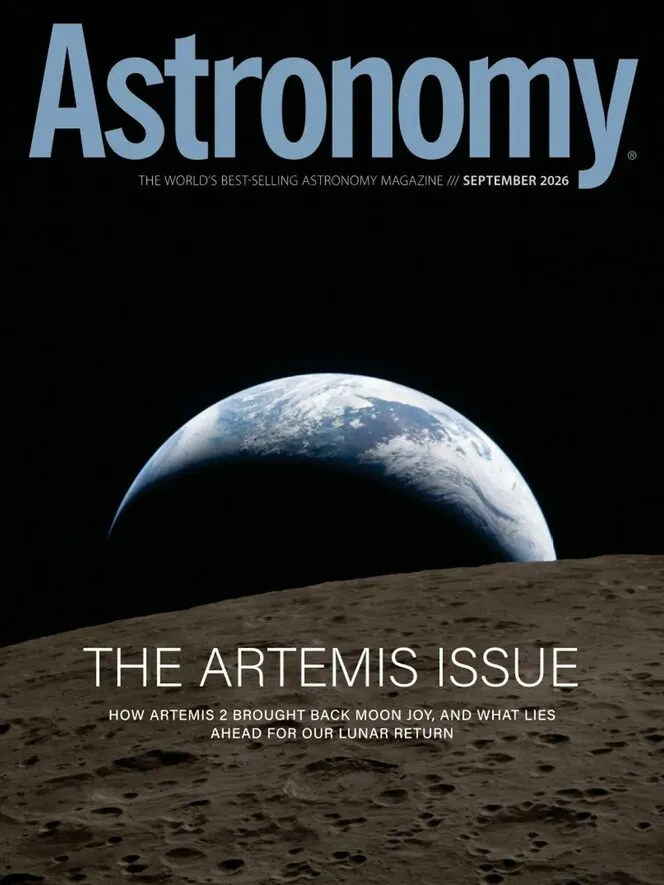
Artemis 2's 10-day lunar flyby captivated a global audience and NASA now targets 2028 for boots on the Moon — but in-orbit refueling remains untried, reports Astronomy September 2026. JWST and Hubble together observe nearly 9,000 star clusters to settle which mature first, while the cover story follows the crew's April journey past a crescent Earth setting behind the Moon.
This Artemis issue leads with Christopher Cokinos' cover story (p.14) documenting the mission from launch to splashdown and the public emotion it reignited. Brooks Mendenhall's "Fueling our lunar return" (p.36) identifies in-orbit refueling as the single unproven step between today and a 2028 landing. Richard Talcott reports on massive star clusters driving galaxy evolution (p.12), combining JWST and Hubble data across 9,000 targets. Sara Novak's "Innovation through Artemis" (p.44) tracks how deep-space navigation hardware is already feeding cancer imaging and remote-clinic tech on Earth.
Regulars include Martin Ratcliffe and Alister Ling's Sky This Month with a distant planet at opposition, Molly Wakeling's Observing Basics column, Ask Astro on rogue planets and moonrise timing, plus the Reader Gallery and Breakthrough. News pages carry coverage of hidden superclusters and Mars dust devils.
—————
Content Guide
▸ Cover Story
p.14 · Artemis 2 brings back Moon joy
Christopher Cokinos follows the 10-day Artemis 2 mission from its April launch to the crew's lunar flyby and Pacific splashdown, capturing the public re-engagement with Moon exploration after a half-century gap. The narrative draws on NASA recordings and crew interviews to show how the Earthrise-style images reshaped the mission's cultural impact. Use the mission-timeline sidebar to separate the four critical burn phases before your next space-news conversation.
▸ Features
p.12 · Massive clusters drive galaxy evolution
Richard Talcott combines JWST and Hubble observations of nearly 9,000 star clusters to answer which type reaches maturity first. The data reveal that globular clusters form earlier and faster than open clusters, shifting the timeline of galactic assembly. The comparative chart lets you see the age-metallicity spread at a glance — a reference for any deep-sky observer interested in what their telescope is actually looking at.
p.36 · Fueling our lunar return
Brooks Mendenhall identifies in-orbit refueling as the single unproven technology between current capability and a 2028 Moon landing. NASA's plan requires transferring cryogenic propellant between tankers in zero-G — a manoeuvre never executed at scale. The article walks through the three competing refueling architectures and their各自的 Technology Readiness Levels. Track which contractor passes the next critical demo in 2027; the winner shapes the entire Artemis landing timeline.
p.44 · Innovation through Artemis
Sara Novak tracks how deep-space navigation and communication hardware designed for Artemis is already being adapted for terrestrial use — cancer treatment imaging, remote clinic connectivity, and bandwidth acceleration for rural broadband. The article names three specific spin-off contracts awarded to US manufacturers. Show this to anyone who asks why public space funding matters on the ground.
▸ Sky & Observing
p.28 · Sky This Month
Martin Ratcliffe and Alister Ling highlight a distant planet at its best for the month, with detailed finder charts for each evening window. The pull-out table gives rising and transit times for all major planets. Mark the date for the Moon-planet conjunction listed in the second week — it requires no optical aid and works from a city balcony.
p.30 · Star Dome and Paths of the Planets
Richard Talcott's monthly all-sky chart covers both northern and equatorial horizons, with Roen Kelly's illustrations labeling the key asterisms. The planetary path overlay shows exactly where to track each visible planet week by week. Laminate this page and keep it at the eyepiece table.
▸ Regulars
p.50 · Ask Astro
This month's Q&A covers why rogue planets remain wanderers without stars, why moonrise times shift by roughly 50 minutes daily, and how astronomers distinguish brown dwarfs from giant planets. Each answer includes a reference to the original research paper. The rogue-planet explanation is the clearest two-paragraph summary available for classroom use.
p.48 · Observing Basics
Molly Wakeling demonstrates a single technique for improving low-contrast planetary detail at the eyepiece, using nothing more than a coloured filter and steady breathing. She specifies the exact Wratten numbers for Jupiter and Mars observation. Add a #21 orange filter to your next Mars session and notice the difference in polar-cap visibility.
—————
Editor's Take
Astronomy September 2026 earns its Artemis-themed cover with genuinely useful reporting. The refueling piece is the standout — it identifies a concrete bottleneck that most space coverage glosses over. Cokinos' Artemis 2 narrative brings the human dimension without becoming sentimental. Weakest parts: the "Massive clusters" feature, while data-rich, reads like a research digest and lacks the narrative pull of the Moon pieces. The Sky This Month section is reliable but formulaic — the same layout as every other issue. This issue suits the space-policy reader who wants to understand what actually stands between today and a lunar base.
Strengths
• In-orbit refueling explained with TRL-level detail
• Artemis 2 mission narrative with crew interview material
• Spin-off tech tracking for terrestrial medical applications
Weaknesses
• Star-cluster feature reads as a research summary
• Sky This Month layout unchanged from prior issues
Verdict: Recommended — Best for readers who follow lunar exploration beyond the press release.
