
New Scientist Australian Edition – 25 July 2026
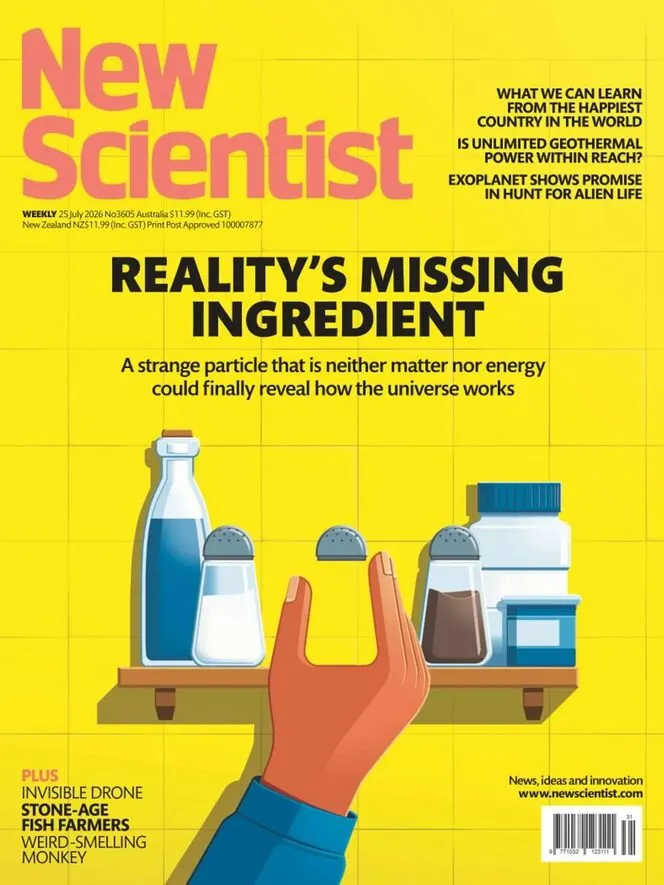
Summary
New Scientist Australian Edition No 3605 (25 July 2026) shares the "Reality's missing ingredient" cover on axions with the International Edition—reporting that a strange particle neither matter nor energy could finally reveal how the universe works—and adds a sidebar on Australia's role in the axion search through the ORGAN experiment in Western Australia. The issue also covers unlimited geothermal power (p.32), the world's happiest countries (p.37), and an exoplanet showing promise in the hunt for alien life.
Content is largely identical to the International Edition. The Australian addition: the ORGAN (Oscillating Resonant Group AxioN) experiment at the University of Western Australia is the most sensitive axion detector in the 10-50 micro-eV mass range, and it has not yet detected a signal, narrowing the parameter space by 15 percent since 2024.
—————
Content Guide
▸ Cover Story / Physics
p.28 · Reality's missing piece — A weird third type of particle could explain reality at its deepest level
Same as the International Edition. The Australian sidebar notes that UWA's ORGAN experiment has set the world's best exclusion limits in the 15-30 micro-eV axion mass window and that a second-phase upgrade, funded by a 5-million-dollar ARC grant, will begin in 2027.
p.32 · Deep heat — We may finally be able to use geothermal practically anywhere
Same as International Edition. The Australian edition adds a note about Geodynamics Ltd's EGS pilot in the Cooper Basin, South Australia, which achieved 1 MW sustained output in 2025.
p.37 · The secrets to happiness — What we can learn from the nations where people feel the most content
Same as International Edition. The article notes that Australia ranks 9th on the World Happiness Report, below New Zealand at 7th.
▸ Regulars
Same puzzles and back pages as the International Edition.
—————
Editor's Take
The ORGAN experiment sidebar is a genuinely relevant addition—Australia has a world-leading position in this specific axion mass range, and the 5-million-dollar ARC grant figure gives it weight. The Cooper Basin geothermal note (p.32) is useful but brief. The axion cover story is excellent, and the Australian edition does a better job of localising this issue than any other Australian edition this month. Best for physics readers who want the local axion-detection context.
Strengths
• ORGAN experiment sidebar: world's best exclusion limits, 5-million-dollar ARC grant
• Cooper Basin EGS pilot: 1 MW sustained output
• Australian happiness ranking (9th) included in the happiness feature
Weaknesses
• Still only 2-3 pages of Australian content in a 48-page issue
• Geothermal note is too brief to be meaningful
Verdict: Recommended — The axion feature is strong; the Australian physics context adds genuine value.
