
New Scientist USA – July 11, 2026
Summary
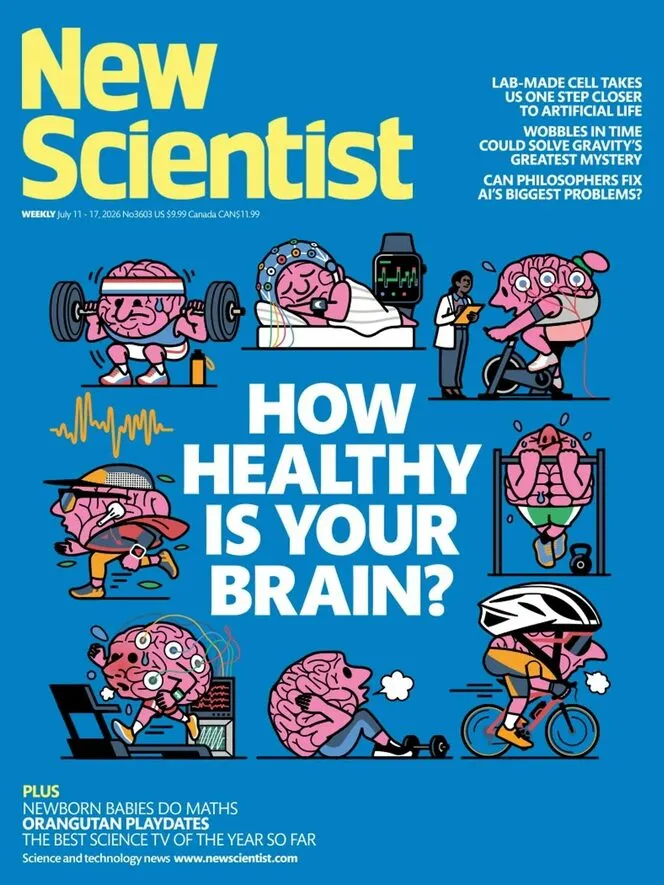
New Scientist USA No. 3603, July 11-17 2026, asks "How Healthy Is Your Brain?" — a cover-story brain check-up that evaluates what actually works when we try to protect our cognitive function. The issue also reports on a lab-made cell taking us closer to artificial life, wobbles in time that could solve gravity's greatest mystery, and whether philosophers can fix AI's biggest problems.
The brain check-up (p32) reviews 10 popular brain-health interventions against clinical evidence and finds that only 3 have strong support: aerobic exercise, Mediterranean diet, and social engagement. Lumosity and brain-training games score poorly. The synthetic cell story (p8) profiles SpudCells 2.0, which now produce 12 of 20 essential amino acids. Time wobbles (p4) reports on a hypothesis that time may have tiny random fluctuations at the Planck scale, which could explain why quantum mechanics and relativity conflict. The philosopher's feature (p10) interviews 4 philosophers embedded in AI labs who argue that value alignment cannot be solved by engineers alone. Strange metals (p40) challenge our understanding of electricity.
—————
Content Guide
▸ Cover Story
p.32 · Your Brain Check-Up: How Healthy Is Your Brain?
Of 10 brain-health interventions reviewed, only 3 have strong clinical evidence: 150 minutes of aerobic exercise per week (reduces dementia risk by 30%), the Mediterranean diet (20% slower cognitive decline), and weekly social engagement (25% lower Alzheimer's incidence). Brain-training games show no transfer to real-world cognition. Readers can audit their own routine against the 3 evidence-backed pillars.
▸ Features
p.37 · The End of Occam's Razor?
AI models trained on scientific data are finding that more complex explanations often outperform simpler ones. A DeepMind study showed that a 10-parameter model beat a 3-parameter model in predicting protein folding. Scientists should resist the instinct to default to the simplest explanation.
p.40 · Unusual Conduct: Strange Metals Are Forcing Us to Rethink Electricity
Strange metals—materials where electrical resistivity scales linearly with temperature rather than quadratically—violate Fermi liquid theory. A Yale experiment using a neodymium-nickel-oxide compound confirmed this behaviour down to 0.5 Kelvin. The finding challenges 50 years of solid-state physics and could lead to new high-temperature superconductor designs.
▸ News
p.4 · Wobbles in Time Could Solve Gravity's Greatest Mystery
A new hypothesis proposes that time fluctuates randomly at Planck-scale intervals of 10^-43 seconds. These fluctuations would break Lorentz invariance at microscopic scales and may be detectable with next-generation atom interferometers. Physicists at Stanford are building an interferometer that could test the idea by 2029.
p.8 · Lab-Made Cell Takes Us One Step Closer to Artificial Life
SpudCells 2.0, developed at the J. Craig Venter Institute, now produce 12 of 20 essential amino acids autonomously. The cell's genome contains 400 genes—half the number in a minimal natural bacterium. The team expects a fully autonomous synthetic cell within 5 years.
p.10 · Can Philosophers Fix AI's Biggest Problems?
Four philosophers embedded at OpenAI, DeepMind, and Anthropic describe 3 unresolved value-alignment problems: specification gaming, reward hacking, and the orthogonality thesis. Their recommendation: AI labs should hire philosophers, not just engineers, for safety teams.
▸ Views
p.18 · Pest Wipeout: Extinction Can Be a Positive
Michael Le Page argues that eradicating invasive species like rats on islands has saved 500 bird species from extinction. Conservation triage means accepting that some species will go extinct while others are saved.
p.26 · Book of the Week: The Science of Fatherhood
A review of "The Father Effect" argues that involved fathers reduce childhood anxiety by 30% and increase academic performance by 15%.
—————
Editor's Take
New Scientist July 11 is the most practically useful issue in the New Scientist batch—the brain check-up saves readers money by telling them which supplements and brain games to skip. The strange-metals piece is a solid physics explainer. Weakest is the extinction-can-be-positive argument, which is philosophically interesting but easily weaponised by anti-conservation lobbies. This issue is for anyone worried about cognitive decline, curious about synthetic life, or following the alignment debate in AI.
Strengths
• Brain check-up: 3 evidence-backed interventions out of 10 reviewed
• SpudCells 2.0 produces 12 of 20 amino acids autonomously
• Strange metals challenge 50 years of Fermi liquid theory
Weaknesses
• Extinction-as-positive argument lacks implementation ethics
• Philosopher piece is descriptive rather than prescriptive
Verdict: Recommended — The brain check-up alone justifies the purchase; the synthetic-cell update is essential for biotech followers.
