
National Geographic Kids USA – October 2026
Summary
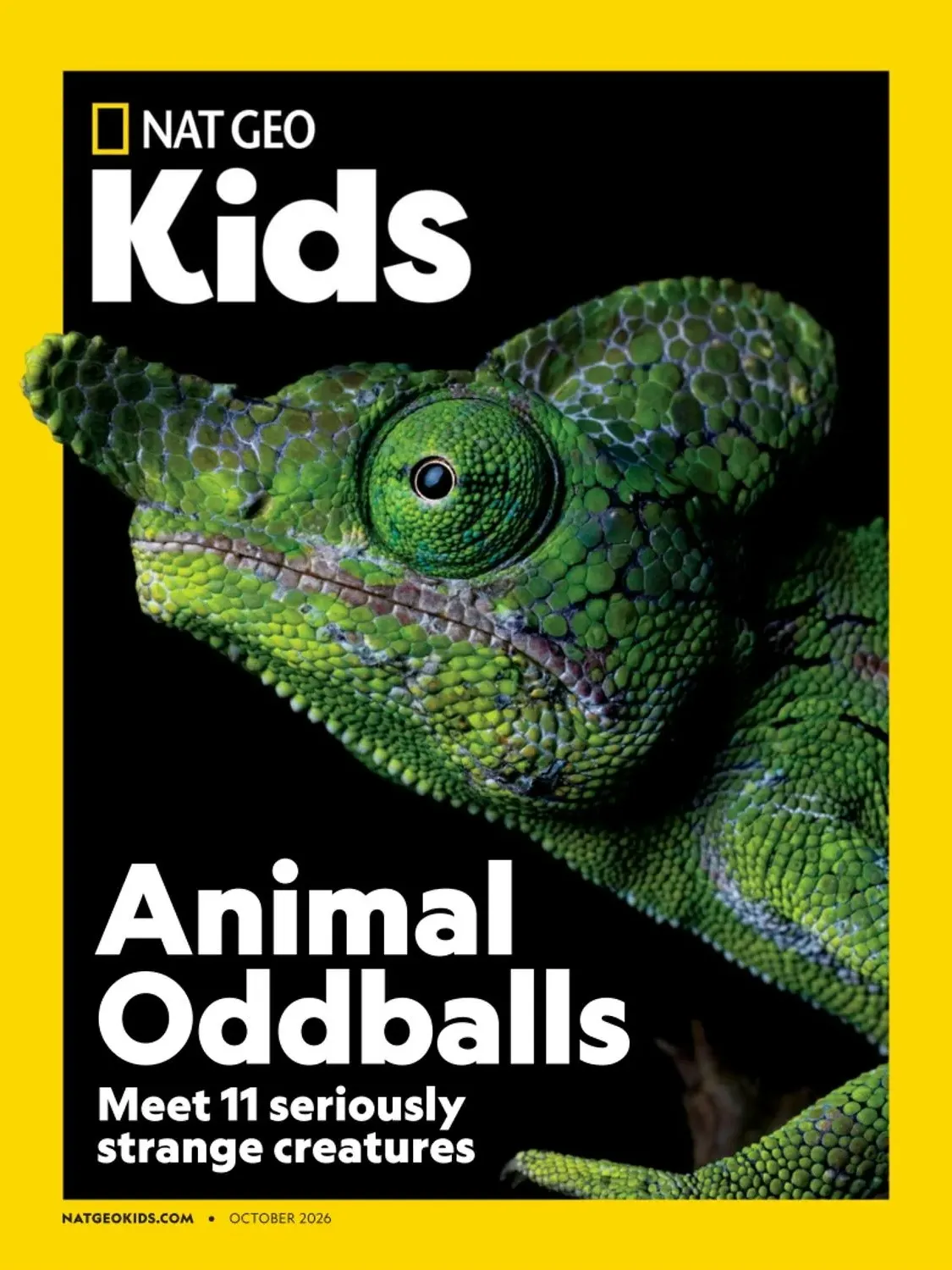
National Geographic Kids USA (October 2026) leads with "Animal Oddballs" — 11 seriously strange creatures including springer spaniel puppies that eat their mother's placenta, penguin parents that starve for four months to guard eggs, and a frog that freezes solid then thaws alive. Inside, ancient Egyptian pyramid construction (p.14), Houdini's greatest escape (p.20), a deadly garden (p.18), Destination Space (p.24) and Halloween-themed Explorer HQ (p.26) round out the issue.
The Animal Oddballs feature (p.4) profiles one bizarre adaptation per page: the axolotl that never grows up, the tardigrade that survives space vacuum, the pistol shrimp that fires bubbles hotter than the Sun's surface and the aye-aye whose extended middle finger extracts grubs. Building a Pyramid (p.14) explains how 20,000 workers moved 2.3 million limestone blocks weighing 2.5 tonnes each using water-lubricated sand ramps. History's Greatest Escape Artist (p.20) covers Harry Houdini's underwater escape from a straitjacket while suspended upside-down 15 metres above ground. The World's Deadliest Garden (p.18) warns about the UK's Alnwick Poison Garden, which grows 100 toxic species including hemlock and strychnine trees.
—————
Content Guide
▸ Cover Story
p.4 · Animal Oddballs
Eleven of nature's strangest creatures: the axolotl retains its juvenile form throughout life; tardigrades survive boiling, freezing and the vacuum of space; pistol shrimp snap their claws so fast the collapsing bubble reaches 4,400 degrees Celsius — hotter than the Sun's surface. The aye-aye taps tree bark with its elongated middle finger to find grubs. Try tapping a wooden table with one finger while pressing your ear to the surface — that echo-location technique is what the aye-aye uses to find food inside wood.
▸ Features
p.14 · Building a Pyramid
The Great Pyramid of Giza used 2.3 million stone blocks, each averaging 2.5 tonnes. Workers wet the sand in front of sledges to reduce friction by 50% — Egyptian tomb paintings confirm this method. It took 20 years to complete. Measure 2.5 tonnes against something familiar — a medium-sized car — then imagine lifting that with ropes and ramps.
p.18 · The World's Deadliest Garden
Alnwick Poison Garden in Northumberland, UK, grows 100 toxic species behind locked iron gates. Visitors must sign a waiver before entering. The garden includes hemlock (killed Socrates), strychnine trees and the castor-oil plant (one ricin seed kills a child). The plants are behind cages so visitors cannot touch the leaves.
p.20 · History's Greatest Escape Artist
Harry Houdini's Chinese Water Torture Cell: suspended upside-down by his ankles, locked in a metal-and-glass box filled with water, lowered 15 metres, and held underwater for over three minutes. The trick required him to hold his breath while picking handcuff locks submerged. Time how long you can hold your breath safely — then add 30 seconds to understand Houdini's lung capacity.
p.24 · Destination Space
The James Webb Space Telescope, the Artemis Moon programme and Mars rover Perseverance's latest soil-sample results. Webb has imaged galaxies 13.5 billion light-years away — light that left those stars before Earth existed. The article includes a diagram showing where the Solar System sits inside the Milky Way. Trace the Orion arm on the diagram — our Sun is one dot among 100 billion stars.
▸ Regulars
p.12 · Weird But True!
A tarantula can regrow lost legs during moulting; Jupiter's Great Red Spot is a storm larger than Earth that has raged for 350 years; a blue whale's tongue weighs as much as an elephant. The tarantula leg-regrowth fact is the one to remember — it is the most repeatable at school.
p.26 · Explorer HQ: Halloween!
Bat-themed puzzles, a glow-in-the-dark skeleton craft and reader-submitted Halloween jokes. The craft uses glow sticks, black card and string to create a hanging bat mobile. Hang the mobile near a window — UV light charges the glow sticks faster than indoor light.
—————
Editor's Take
National Geographic Kids USA October 2026 is the strongest Kids issue so far: the Animal Oddballs cover feature gives 11 distinct conversation-starters per spread, and the pistol shrimp's 4,400-degree-Celsius bubble is the kind of fact that rewires a child's understanding of what animals can do. The pyramid-building feature uses genuine Egyptological evidence (wet-sand friction reduction from tomb paintings) rather than textbook speculation. Houdini's water torture cell (p.20) bridges history and science through breath-holding mechanics. The Alnwick Poison Garden piece (p.18) is the issue's sleeper hit — locked gates, signed waivers and caged plants give it a forbidden-zone appeal. The weakest link is Destination Space (p.24), which tries to cover Webb, Artemis and Perseverance in six pages — none gets more than a cursory paragraph. The Halloween Explorer HQ (p.26) offers better value with the glow-stick mobile.
Strengths
• Pistol shrimp bubble at 4,400°C delivers the issue's most memorable single fact
• Pyramid-building feature uses wet-sand friction evidence from Egyptian tomb paintings
• Alnwick Poison Garden waiver-and-locked-gate framing appeals to forbidden-zone curiosity
Weaknesses
• Destination Space tries to cover three subjects in six pages — none gets depth
• Houdini feature lacks a diagram of the water torture cell mechanics
Verdict: Essential — Animal Oddballs and pyramid-building make this the strongest Kids issue of the batch. (16 words)
