
Bringing History to Life – The Rise of the Third Reich, 2026
Summary
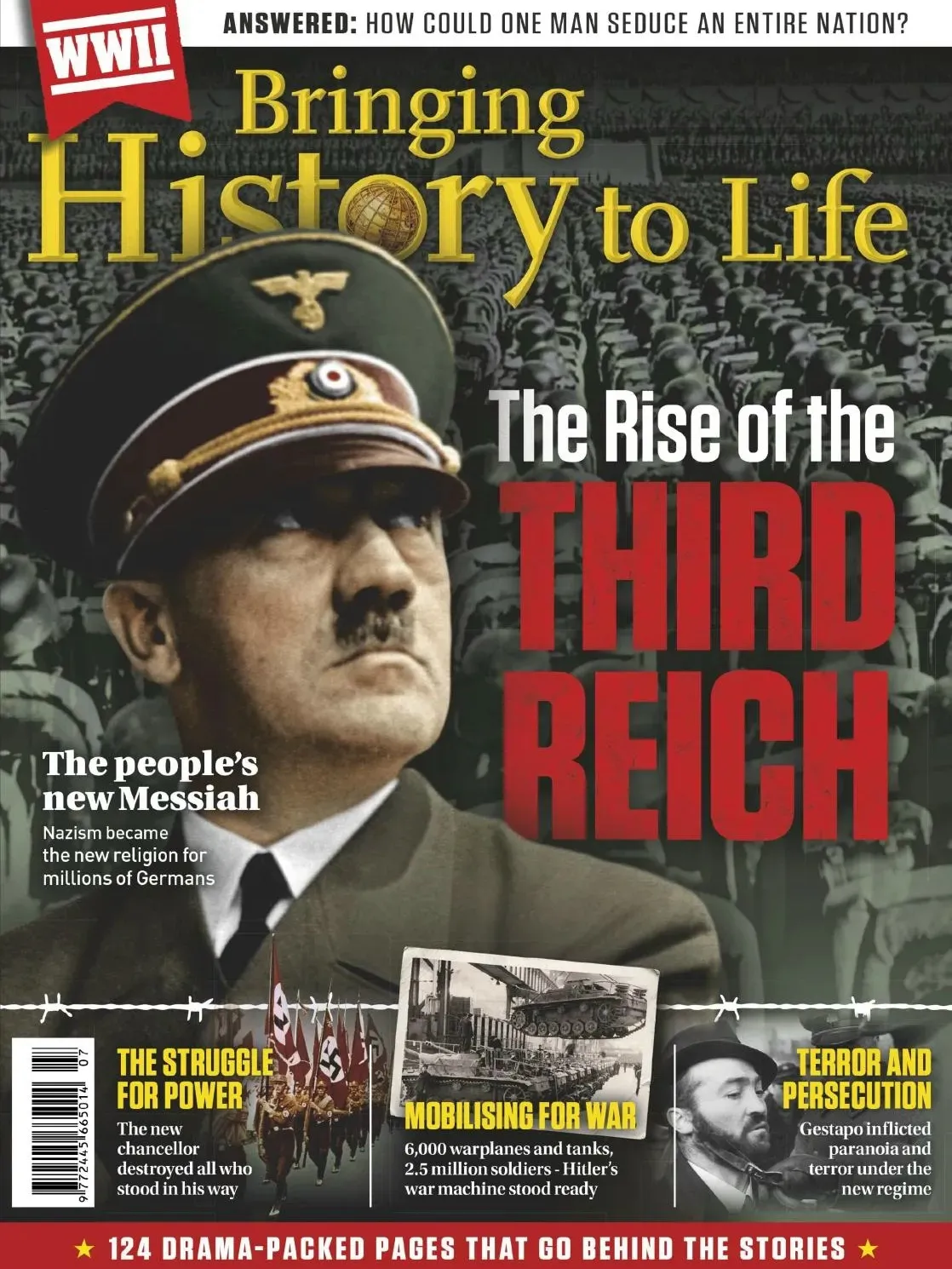
The attack on Poland on 1 September 1939 by 3.7 million German soldiers shook the world to its foundations but Bringing History to Life The Rise of the Third Reich 2026 traces the decade of rearmament and propaganda that preceded that moment. The volume covers the Nazi seizure of power through the Night of Broken Glass to the invasion of Poland.
The story opens with the Weimar Republic's collapse and Hitler's appointment as Chancellor in 1933. The 1936 Berlin Olympics where Jesse Owens won four gold medals are presented as a Nazi propaganda exercise. The 1938 annexation of Austria and the occupation of Czechoslovakia are documented. The Night of Broken Glass in November 1938 is covered in detail with the specific violence against Jewish communities described. The volume closes with theัน invasion of Poland and Britain's declaration of war on 3 September 1939. Throughout the narrative the mechanisms of Nazi control through violence fear education propaganda and the Gestapo are examined. The specific legislation including the Nuremberg Laws that stripped Jewish citizens of their rights is identified.
—————
Content Guide
▸ The Rise of Nazism
p.06 · The Fall of the Weimar Republic
The economic and political crisis that created the conditions for Hitler's rise. The article identifies the hyperinflation of 1923 the Great Depression of 1929 and the political gridlock that followed. The specific election results that brought the Nazi Party to power are documented.
p.10 · Hitler's Seizure of Power
Hitler's appointment as Chancellor on 30 January 1933 is the starting point. The article covers the Reichstag Fire of 27 February 1933 and the Enabling Act that gave Hitler dictatorial powers. The specific civil liberties abolished under the act are named.
▸ Nazi Germany 1933-36
p.14 · Rearmament Gathers Pace
From 1935 German factories mass-produced aircraft for the newly established Luftwaffe. The article identifies the specific aircraft types produced. The treaty violations that the international community failed to address are named.
p.18 · The 1936 Berlin Olympics
The Games were used as a Nazi propaganda drive. Jesse Owens winning four gold medals in athletics at the Olympic Stadium is presented as a moment that embarrassed Hitler. The television broadcast of the Games is noted as a propaganda first.
▸ War Approaches
p.22 · 1938 The Night of Broken Glass
The brutal persecution of Jews in November 1938 is described in detail. The article names the specific destruction across German cities. The international community's response is documented.
p.26 · The Annexation of Austria
The March 1938 Anschluss is covered as Hitler's first territorial expansion. The article identifies the response of the international community. The specific Nazi policies immediately imposed on Austria are named.
p.30 · The Invasion of Poland
On 1 September 1939 the German army attacked Poland. The article states the size of the invasion force at 3.7 million soldiers. Britain's declaration of war on 3 September 1939 is the closing moment of the narrative.
—————
Editor's Take
The Rise of the Third Reich delivers a clear chronological narrative of Nazi Germany from 1933 to 1939 suitable for readers new to the subject. The Jesse Owens at the Olympics anecdote provides a concrete human moment within the larger propaganda story. The volume is explicitly aimed at younger or less specialist readers which shows in the simplified presentation. The absence of any treatment of Nazi racial ideology beyond the Nuremberg Laws is a significant gap. This title suits classroom use or the reader seeking a basic timeline of the pre-war Nazi state.
Strengths
• Clear chronological structure from 1933 to 1939
• Jesse Owens anecdote provides a concrete human moment
• Invasion of Poland section with 3.7 million troop number gives scale
Weaknesses
• Simplified presentation limits value for knowledgeable readers
• Nazi racial ideology receives insufficient analytical treatment
Verdict: Selective read — competent basic chronology but lacks analytical depth.
