
National Geographic Little Kids UK – Issue 46 2026
Summary
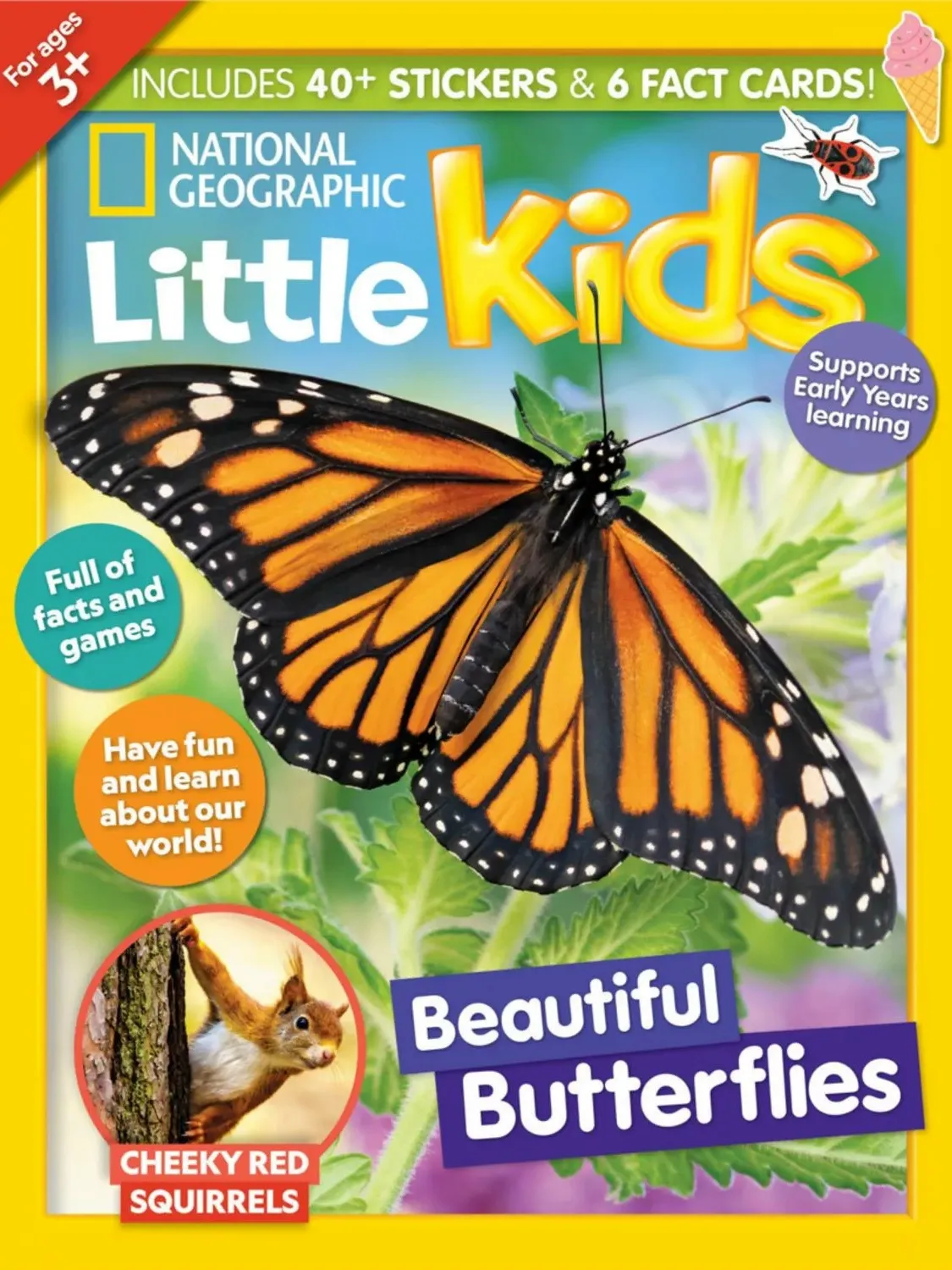
National Geographic Little Kids UK Issue 46 (2026, ages 3+) fronts with CHEEKY RED SQUIRRELS — a cover that follows a single rodent hiding nuts across a Scottish forest. Inside, 36 pages cover peacock feather displays, woodchuck hibernation, monarch butterfly metamorphosis, a dandelion seed-spread sequence and a Rebbachisaurus dinosaur, with 40-plus stickers and 6 fact cards included.
The issue opens with peacocks (p.4) explaining why the tail exists: males with the most eyespots mate more often. A Cool Clothes wardrobe game (p.6) and spot-the-difference (p.7) precede woodchucks (p.8), who sleep through winter. Red squirrels (p.10) are the cover star, hiding nuts in hundreds of locations and recovering only 70%. Bug Games (p.14), monarch butterflies (p.16), an emotions-matching page (p.22), a dandelion growth sequence (p.24), a camping search-and-find (p.26), the Rebbachisaurus (p.28), Let's Visit Greece (p.32) and the Big Quiz (p.34) complete the line-up. The 6 fact cards cover peacocks, woodchucks, red squirrels, monarch butterflies, dandelions and Rebbachisaurus.
—————
Content Guide
▸ Animal Features
p.4 · Peacocks — Why do they have big feathers?
A male peacock fans 150 iridescent eyespots to attract a mate. The eyespot pattern is an honest signal of health — males with more eyespots have stronger immune systems. Count the eyespots on the photo — peacocks with fewer than 120 rarely mate.
p.8 · Woodchucks — Hungary, burrowing rodents
Woodchucks eat 300 grams of vegetation daily in summer, then hibernate from October to March. Their heartbeat drops from 100 to four beats per minute during hibernation. Measure your own heartbeat at rest — then count to 15 and imagine it happening only once every 15 seconds.
p.10 · Red Squirrels — Rare rodents in Scotland
Scotland's native red squirrels hide individual nuts in scattered caches across their territory. They recover only 70% of their stores, which means 30% of the nuts they bury grow into new trees. Find a tree in your garden and count how many squirrels you see — red squirrels have ear tufts; grey squirrels do not.
p.16 · Monarch Butterflies — How they live!
A monarch caterpillar eats milkweed for two weeks, hangs upside-down for 10 hours and emerges as a butterfly after 10 days in the chrysalis. The adult then flies up to 3,000 miles to Mexico. Plant milkweed seeds in a pot — monarchs will find it within a week of the flowers opening.
▸ Science & Nature
p.22 · How Do They Feel?
Emotion-matching game: four animal faces — happy, sad, surprised, scared — are paired with scenarios. A woodchuck seeing its shadow matches with "surprised." Act out each face in a mirror before matching — toddlers recognise expressions on their own face faster than on paper.
p.24 · A Dandelion Grows
Six-stage life cycle: seed, sprout, rosette, bud, flower, seed head. Each dandelion head produces 150 to 200 seeds, each carried up to five miles by wind. Find a dandelion clock and blow — count how many seconds the seeds stay airborne.
▸ Activities & Games
p.14 · Bug Games
Sorting activity: ladybirds, ants, beetles and caterpillars are mixed up. Children sort them by leg count — insects have six legs, not eight. Lift a log in your garden and count the legs on anything that crawls out — most garden bugs are not insects.
p.28 · Giant Dino: Meet the Rebbachisaurus
A sauropod from Morocco that measured 26 metres from nose to tail — longer than two London buses. Its vertebrae were filled with air pockets, making the skeleton lighter than it looks. Mark 26 metres on the pavement with chalk and walk the length — it takes more than 30 child steps.
▸ World Culture
p.32 · Let's Visit… Greece!
Amazing islands (6,000 total, 227 inhabited), ancient buildings (the Parthenon, built 447 BCE) and broken pots (archaeologists reconstruct pottery from shards found in the Aegean). Greek archaeologists dig through 15 metres of buried history in some sites. Crumple a paper bag, flatten it and try to piece it back together — that is how pottery restoration works.
—————
Editor's Take
Little Kids UK Issue 46 leans heavily on the red squirrel cover, and the inside delivers: the nut-caching statistic (70% recovery, 30% accidental reforestation) is the kind of detail that sticks in a four-year-old's memory. The peacock eyespot spread (p.4) uses honest-signal biology without dumbing it down. The Rebbachisaurus vertebra air-pockets fact (p.28) is genuinely surprising — a dinosaur with lighter bones than expected. But the bug-sorting activity (p.14) is too simple even for the target age; sorting into six-legs versus eight-legs assumes children can count to six, which is a variable skill at three. The Greece cultural page (p.32) is visually cluttered, with too many competing photo boxes for the age group.
Strengths
• Red squirrel 70% nut-recovery rate doubles as a reforestation lesson
• Peacock eyespot count links visual appeal to honest-signal biology
• Rebbachisaurus air-pocket vertebrae make dinosaur anatomy surprising
Weaknesses
• Bug-sorting activity assumes reliable counting to six, overreaching for age 3
• Greece pages visual layout competes with too many photo boxes
Verdict: Recommended — Red squirrel cover and peacock eyespot spread are the issue's standouts. (15 words)
