
All About History History of Art – 3rd Edition – 25 June 2026
Summary
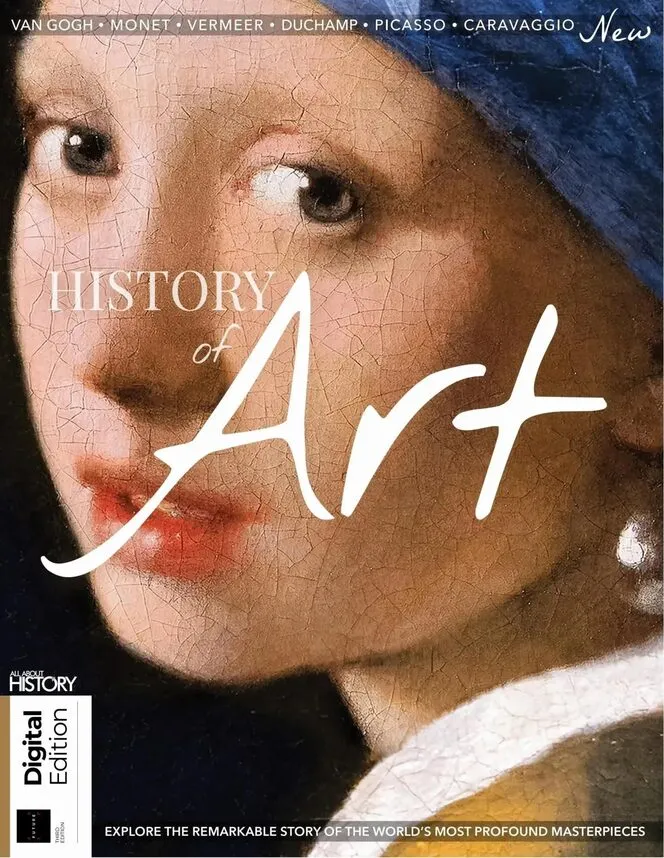
Branches with Almond Blossom by Vincent van Gogh opens All About History's History of Art 3rd Edition, 25 June 2026, tracing 30,000 years of visual culture from the Venus of Willendorf to Roy Lichtenstein's Drowning Girl. The 128-page volume covers Da Vinci vs Michelangelo, Caravaggio's criminal record, Frida Kahlo's self-portraits, and Hitler's war on degenerate art.
The survey opens with the Venus of Willendorf (p.14) and prehistory, then moves through medieval illuminated manuscripts (p.24), the Renaissance rivalry between Leonardo and Michelangelo (p.28), and Caravaggio's life of crime (p.36). Artemisia Gentileschi's career is examined as a feminist pioneer (p.42). The Dutch Masters interior world (p.46), Gainsborough's landscape innovations (p.64), and JMW Turner's Fighting Temeraire (p.72) bridge to modernism. Vincent van Gogh's letters are reproduced (p.90), Picasso's periods are charted (p.96), and the Dadaist Theatre of the Absurd (p.104) confronts wartime meaninglessness. Hitler's war on art (p.110) documents the Degenerate Art exhibition of 1937. Salvador Dali's Persistence of Memory (p.116), Frida Kahlo (p.118), Jackson Pollock (p.124), and Roy Lichtenstein (p.126) close the survey.
Each chapter pairs an "Art in Focus" deep-dive with a broader historical narrative. The Belvedere Torso, El Greco's Burial of the Count of Orgaz, and Angelica Kauffman's Self Portrait Hesitating Between Music and Painting receive full-page treatment.
—————
Content Guide
▸ Renaissance
p.28 · Renaissance rivals: Da Vinci vs Michelangelo
The competition between Leonardo and Michelangelo in early 16th-century Florence is documented through the 1503-1506 Sala dei Cinquecento mural commission and contemporary accounts by Giorgio Vasari. The article reproduces Leonardo's lost Battle of Anghiari drawings alongside Michelangelo's surviving Battle of Cascina cartoon. The compositional comparison shows two fundamentally different approaches to depicting war — Leonardo focused on the horses, Michelangelo on the nude male form.
p.36 · Caravaggio's life of crime
Michelangelo Merisi da Caravaggio's police record — five assault charges, one murder, and a papal death sentence — is traced through Roman court documents from 1600 to 1606. The article argues that his chiaroscuro technique developed from working at night to avoid arrest. The timeline of his crimes vs his paintings shows that his most productive period coincided with his year as a fugitive in Naples.
p.42 · Artemisia Gentileschi: Renaissance feminist?
Gentileschi's 1612 rape trial and the torture she endured to validate her testimony are documented through the trial transcripts. The article argues that her recurring Judith Slaying Holofernes subject was a direct response to her trauma. The transcript excerpts show that her testimony was considered unreliable because she had been "deflowered."
▸ Modernism
p.90 · Vincent in his own words
Van Gogh's 1872-1890 correspondence with his brother Theo is reproduced with facsimile pages showing his sketches alongside the text. The article traces his artistic evolution from the dark Potato Eaters period through Arles' bright palette to the asylum paintings at Saint-Remy. The letter dated July 1888 contains the first written description of Starry Night Over the Rhone — a full year before the asylum version.
p.96 · Picasso's periods
Picasso's Blue Period, Rose Period, African-influenced period, Analytical Cubism, and Synthetic Cubism are charted with representative works for each phase. The colour-palette timeline runs across pages 98-99, showing the precise shift from blue to rose in 1904. The timeline is the clearest single reference for identifying which Picasso belongs to which period.
p.104 · Theatre of the absurd
The Dada movement's response to World War I — Hugo Ball's Cabaret Voltaire, Marcel Duchamp's readymades, and Tristan Tzara's manifestos — is documented through performance posters and period photographs. The article reproduces Ball's sound poem "Karawane" in its original Dada typography. The typography is still studied as a precursor to concrete poetry.
▸ War & Politics
p.110 · Hitler's war on art
The Nazi Degenerate Art exhibition of 1937 is reconstructed through the seizure inventory — 16,000 works confiscated from German museums. The article reproduces the exhibition catalogue covers and the wall labels that ridiculed modernist artists. The label text calling Expressionism "cultural Bolshevism" entered the art-history lexicon and is still referenced in censorship debates today.
p.118 · Face to face with Frida Kahlo
Kahlo's 143 surviving paintings are examined through her medical records — polio at age 6, the 1925 bus accident that fractured her spine and pelvis, and the 35 surgical operations that followed. The article reproduces The Broken Column (1944) showing nails embedded in her body. The self-portrait is a case study in how physical trauma shapes artistic iconography.
—————
Editor's Take
All About History's History of Art 3rd Edition is a capable general survey that hits every canonical name but adds little fresh analysis. The Caravaggio crime-timeline and Van Gogh letter-reproduction chapters stand out for their primary-source value. Weakest parts: the Dutch Masters chapter focuses exclusively on interior genre scenes and ignores Rembrandt and Vermeer's landscape work. The "Hitler's war on art" chapter, while competently written, covers ground already well treated in the 2nd Edition. This edition suits the A-Level art student who needs a survey text with good reproductions.
Strengths
• Caravaggio crime timeline mapped against his painting production
• Van Gogh correspondence facsimiles with sketches
• Picasso colour-palette timeline across periods
Weaknesses
• Dutch Masters chapter skips Rembrandt and Vermeer landscapes
• Hitler art-war chapter repeats prior edition material
Verdict: Selective read — Adequate for students, nothing new for art-history readers.
