
National Geographic Kids UK – Issue 258 2026
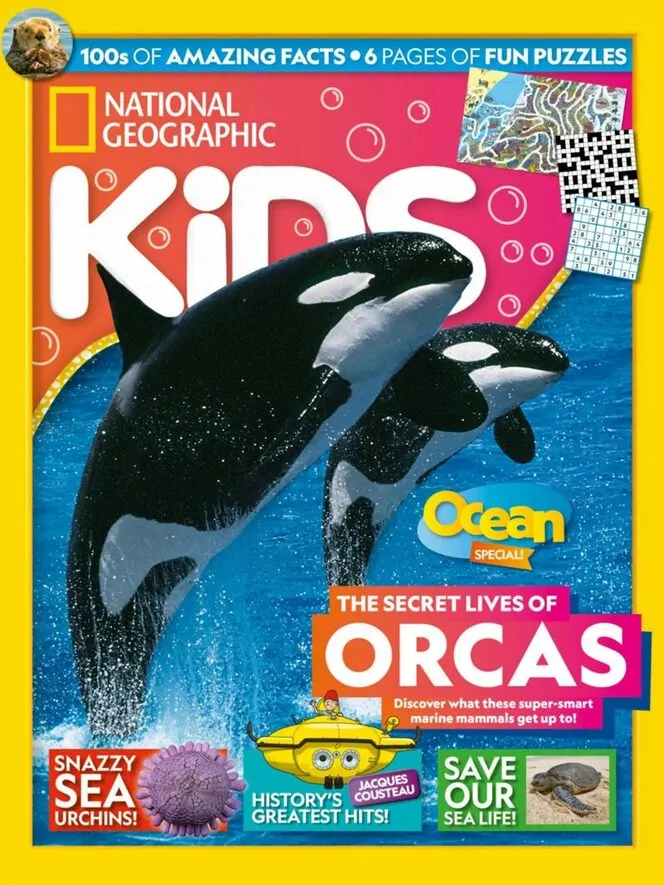
Summary
Issue 258 of National Geographic Kids UK (2026) dives into an Ocean SPECIAL with the cover star "THE SECRET LIVES OF ORCAS" — seven surprising stories about how these marine mammals speak, play and hunt in coordinated family pods. Four free posters, a Jacques Cousteau biography (p.30), World Cup Final football stats (p.32), sea urchin profiles and ocean-saving tips fill 52 pages.
The orca feature (p.8) reveals that different pods speak distinct dialects — calves learn their family's calls the way human babies learn language. Save the Ocean (p.14) lists four actions children can take: reduce plastic, choose sustainable seafood, join a beach clean and never release balloons. Snazzy Sea Urchins (p.16) profiles five species whose spines double as coral-reef protection. Undersea Explorer (p.30) follows Jacques Cousteau from his first goggles at age 11 to commanding the Calypso. Footy Facts (p.32) celebrates the World Cup Final with records on the fastest goal, most goals in a tournament and the youngest player ever to score. The back section delivers Cool News (p.4), Wacky World (p.6), Cool Inventions (p.23), What's New (p.34), Big Picture (p.36), Junior Explorers' Club (p.38), Fun Stuff puzzles (p.40) and a Make It activity (p.46).
—————
Content Guide
▸ Cover Story / Features
p.8 · Orca Secrets
Orcas live in matriarchal pods where grandmothers lead hunting strategies passed down for generations. Different pods speak distinct dialects — the northern resident community off British Columbia uses calls that southern residents cannot understand. Calves imitate their mother's calls within the first month. Record your own voice and compare it to a friend's — the difference is similar to two orca pod dialects.
p.14 · Save the Ocean
Four actionable steps: refuse single-use plastics, choose MSC-certified seafood, join a local beach-clean event, and cut plastic rings on six-pack holders before recycling. The article reports that 8 million tonnes of plastic enter the ocean each year. Start a one-week plastic diary — write down every piece of single-use plastic your family uses, then pick one item to eliminate.
p.16 · Snazzy Sea Urchins
Five urchin species: the purple sea urchin, the fire urchin, the slate pencil urchin, the green sea urchin and the red heart urchin. The fire urchin's spines release venom when touched. Urchins use their five teeth — called Aristotle's lantern — to scrape algae off rocks. Count the spines on one square inch of a purple urchin — there are at least 50.
p.30 · Undersea Explorer
Jacques Cousteau co-invented the Aqua-Lung in 1943, which allowed divers to stay underwater for hours instead of minutes. He filmed the first colour documentaries of the deep sea and discovered that whales sing. His son Philippe once lived underwater for 30 days in a submerged laboratory. Try holding your breath while you watch the second hand on a clock — Cousteau's team could stay under for over 60 minutes with their equipment.
▸ Regulars
p.4 · Cool News
Inspiring global stories: a school in Scotland built a fully operational underwater robot from LEGO that collects microplastic samples. The robot cost £150 to build and can dive to 10 metres. Read the building guide online and challenge a friend to design a simpler floating trash collector.
p.6 · Wacky World
Sock-wearing donkeys, musical architecture and odd contests. One entry: the town of Garmisch-Partenkirchen in Germany holds an annual cowshed-sliding competition where teams slide 50 metres across a lubricated wooden track. The winning team's time was 8.4 seconds.
p.23 · Cool Inventions
A Nat Geo Explorer named Fionn Ferreira created a magnet-based device that removes microplastics from water using ferrofluid — a liquid that becomes magnetic. He won the Google Science Fair at age 17. Mix vegetable oil with iron filings from a craft store — the magnetic liquid you create works on the same principle.
p.32 · Footy Facts
World Cup records: the fastest goal was scored in 11 seconds by Hakan Sukur for Turkey in 2002. The most goals in a single tournament is 13, set by Just Fontaine in 1958. The youngest player to score in a World Cup match was Pele at 17 years and 239 days. Set a timer for 11 seconds — that is how long it took to score the fastest World Cup goal.
p.40 · Fun Stuff
Six pages of puzzles: a word search with ocean animals, a code-breaker challenge using orca symbols, a spot-the-difference on a coral-reef scene and a maze through a shipwreck. The code-breaker uses a simple A=1, B=2 cipher that children can decode without adult help.
—————
Editor's Take
Kids UK Issue 258 is a tightly themed ocean special that works because every feature — orcas, urchins, Cousteau, plastic pollution — connects to the same ecosystem. The orca dialect detail (pod-specific calls that calves learn from their mothers) is the issue's strongest single fact and the one most likely to be repeated at school. The Save the Ocean page follows through with specific actions rather than vague encouragement. The Footy Facts page feels tacked on — it is World Cup-themed but has no connection to the ocean theme. The four posters are a strong physical draw for the cover price, though they take up pages that could have held editorial content. The LEGO underwater robot in Cool News is the sleeper entry — a £150 build that families could replicate.
Strengths
• Orca dialect detail — pod-specific calls learned from mothers — is a school-yard repeat fact
• Save the Ocean page lists four specific, age-appropriate actions
• Cool News LEGO underwater robot costs £150 and dives to 10 metres
Weaknesses
• Footy Facts page has no thematic connection to the ocean special
• Four posters consume editorial space without adding reading content
Verdict: Recommended — A coherent ocean special anchored by the orca dialect and Cousteau features. (17 words)
