
The Travellers Guide to American History – 1st Edition – April 2026
Summary
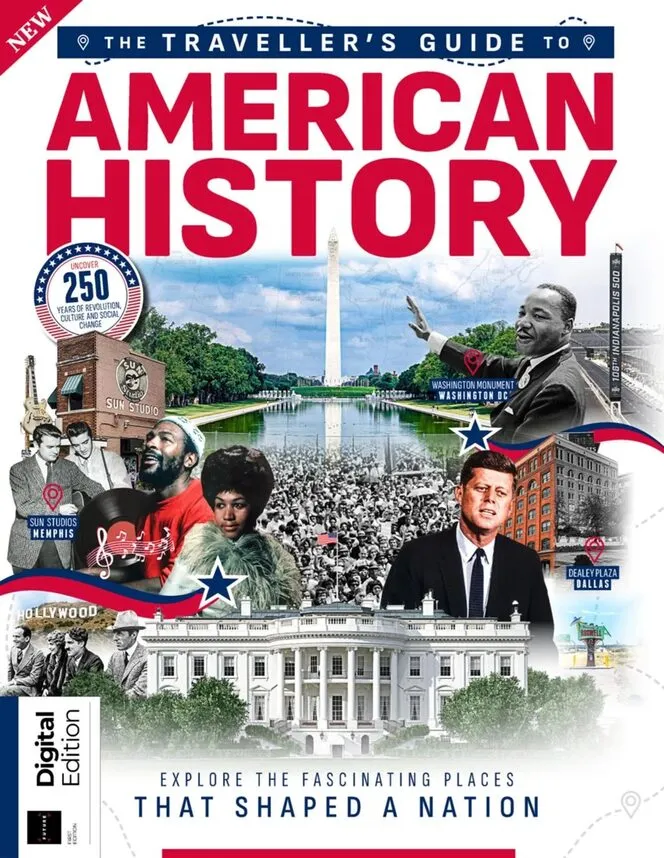
The Traveller's Guide to American History (1st Edition, April 2026, Digital Edition) maps 250 years of revolution, culture, and social change across 22 destinations — from the Mayflower's Plymouth landing to the Apollo 11 launch pad at Cape Canaveral. Three themed sections — Politics, Rights, and Culture — organise sites including Salem's witch-trial memorial, the Gettysburg battlefield, the Stonewall Inn, and Sun Studio in Memphis where Elvis and Johnny Cash first recorded.
The Politics section covers the Mayflower, the Boston Massacre site, the US Constitution's drafting in Philadelphia, the US Capitol, Civil War battlefields including Gettysburg, the attack on Pearl Harbor, Watergate, the JFK assassination in Dealey Plaza, and the 9/11 Memorial. The Rights section traces the Indian Removal Act's Trail of Tears, the Women's Rights National Historical Park in Seneca Falls, Ellis Island, the Lincoln Memorial's I Have a Dream location, and the Stonewall National Monument.
The Culture section visits Thomas Edison's laboratory in Menlo Park, Hollywood's walk of fame origins, the Harlem Renaissance in New York, Roswell's UFO museum, Sun Studio in Memphis where rock 'n' roll began, the Motown Museum in Detroit, and sporting landmarks including the Baseball Hall of Fame. Each entry includes a brief historical background and practical visiting information.
—————
Content Guide
▸ Politics / Rights / Culture
p.14 · The Witch City — Salem, Massachusetts
The Salem witch trials of 1692 resulted in 20 executions. The Salem Witch Trials Memorial in Danvers lists the names of those who died on granite benches — one for each victim. Visit in October for the museum's full trial re-enactment, but arrive before noon to avoid three-hour queues.
p.20 · Writing the US Constitution — Philadelphia, Pennsylvania
The Constitutional Convention met at Independence Hall from May to September 1787. The signed Constitution occupies the Rotunda of the National Archives in Washington DC alongside the Declaration of Independence. Book the timed-entry ticket online at least two weeks in advance.
p.30 · Battlefields of the Civil War — Multiple States
The guide covers Gettysburg, Antietam, and Shiloh. Gettysburg's self-guided auto tour covers 16 miles and 26 markers. Start at the visitor centre at 8 a.m. to beat the tour-bus crowds.
p.62 · The Indian Removal Act — Trail of Tears
The 1830 Indian Removal Act forced 60,000 Native Americans from their homelands. The Trail of Tears National Historic Route crosses nine states. The visitor centre at New Echota, Georgia, marks the Cherokee capital before removal.
p.70 · Ellis Island — New York Harbor
Ellis Island processed 12 million immigrants between 1892 and 1954. The American Family Immigration History Center in the main building allows searches of ship manifests by passenger name. Search the database online before your visit to save queuing time.
p.86 · The Stonewall Uprising — New York City
The June 1969 police raid on the Stonewall Inn sparked three days of protests that launched the modern LGBTQ+ rights movement. The Stonewall National Monument covers 7.7 acres in Christopher Park. The visitor centre opened in 2024 with oral-history recordings.
p.94 · Thomas Edison — Menlo Park, New Jersey
Edison's laboratory complex produced the phonograph and the practical light bulb in 1879. The Edison National Historical Park preserves Building 1 with original workbenches. The carbon-filament bulb on display still works.
p.112 · Where Rock 'n' Roll Began — Sun Studio, Memphis
Sam Phillips recorded Elvis Presley's first session in 1954, followed by Johnny Cash, Jerry Lee Lewis, and Carl Perkins at 706 Union Avenue. The studio operates as a museum by day and working studio by night. Book the 30-minute tour for access to the original recording equipment.
—————
Editor's Take
This is a competent site-by-site guide that never quite becomes more than the sum of its parts. The three-section organisation (Politics, Rights, Culture) works for themed trips but forces some awkward splits — the Apollo 11 site appears in Culture, not Politics. Each entry gives solid logistical advice (booking windows, crowd timing) that travellers will appreciate. Weakness: the writing rarely rises above brochure level; the Salem entry, for example, describes the trials without engaging with the scholarly debates about their causes. The 22-site scope means no single entry runs more than three pages. Best suited for first-time American-history road-trippers; experienced travellers will have already consulted more detailed sources.
Strengths
• Practical visiting advice for all 22 sites
• Thematic organisation suits multi-stop road trips
Weaknesses
• No single topic gets deeper than a guidebook entry
• Apollo 11 in Culture rather than Politics is a confusing editorial call
Verdict: Selective read — Useful for trip planning; too thin for armchair history readers.
