
Search Press Art Collection – What to Paint in Watercolor 2026
Summary
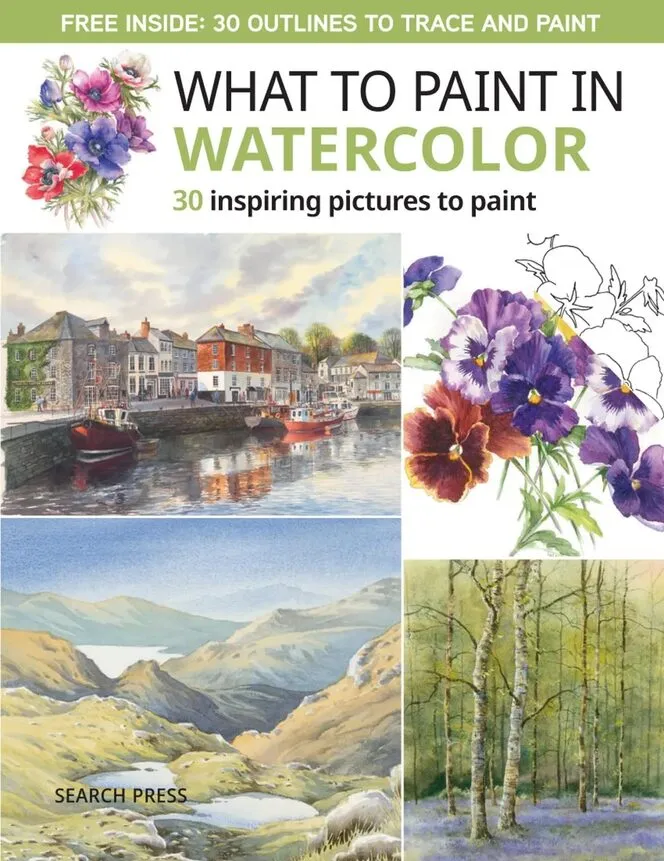
Search Press's What to Paint in Watercolor gathers 30 projects across landscapes, flowers, trees and mountains, and the collection ships with 30 free outlines to trace, so a beginner can transfer any image to watercolour paper and paint it the same afternoon.
What to Paint in Watercolor (Search Press) is a project collection rather than a magazine, built around 30 pictures grouped into four sections: Landscapes from 14, Flowers from 32, Trees and Forests from 50, and Hills and Mountains from 66. Each artist supplies a palette, technique steps and an outline, and the Outlines section at 82 carries the traceable templates. The opening sections cover Composing from the outlines at 8 and Techniques and effects at 10, with the Introduction at 6.
The projects run from Poppies by the Track at 16 through Hills and Lakes at 80, and include Millstream Cottage, Cornish Harbor, Castle Combe, The Mountain Stream, Tulips, Anemones, Snowdrops, Bluebell Wood, Mountain Mist and Sea of Cloud. For a watercolour beginner the value is the outline insert: it removes the drawing step, which is where most new painters stop.
—————
Content Guide
▸ Getting Started
p.6 · INTRODUCTION
The Introduction at 6 sets out how the 30 projects work and what the supplied outlines are for. It explains the structure rather than teaching technique. Read it before the techniques section, since it tells you how to use the templates at 82.
p.8 · COMPOSING FROM THE OUTLINES
Composing from the outlines at 8 shows how to rearrange the supplied outlines into new compositions rather than copying them as given. The section covers moving elements and rebuilding a picture. Take one outline and move two elements before you paint, so the result is yours.
p.10 · TECHNIQUES AND EFFECTS
Techniques and effects at 10 runs through the methods used across the projects, including wet-in-wet. The section names the effects and how to produce them. Practise wet-in-wet on a scrap sheet before starting your first project.
▸ Landscapes
p.16 · POPPIES BY THE TRACK
Poppies by the Track opens the landscapes at 16, with the artist's palette and steps supplied. The project is one of the more straightforward in the section. Paint it first if you want an easy start to the collection.
p.24 · CORNISH HARBOR
Cornish Harbor appears at 24 among the landscapes, covering a harbour subject with its own palette and method. The project deals with water and boats. Keep your water area light and let it dry before adding the boat detail.
p.30 · THE MOUNTAIN STREAM
The Mountain Stream closes the landscape run at 30, with steps for moving water and rock. The project is more involved than the opening pieces. Build the rocks first, then run the water around them.
▸ Flowers
p.34 · TULIPS
Tulips opens the flowers section at 34, with a palette and technique steps supplied. The project suits a first attempt at flower forms. Paint the petals wet-in-wet so the edges stay soft.
p.42 · SNOW DROPS
Snowdrops appears at 42 among the flowers, dealing with small white forms against a ground. The project requires leaving paper clean rather than adding white. Mask the snowdrop shapes before you touch the background.
p.48 · SUNFLOWERS
Sunflowers closes the flowers section at 48, covering the larger, bolder forms. The project carries stronger colour than the earlier pieces. Load more pigment than feels right, since sunflowers need saturated yellow.
▸ Trees and Forests
p.52 · WOODLAND STREAM
Woodland Stream opens trees and forests at 52, with the palette and steps for a wooded water subject. The project combines the tree and water problems. Establish the darkest tree mass first, then let the stream stay light.
p.64 · BLUEBELL WOOD
Bluebell Wood closes the section at 64, covering a woodland floor in flower. The project deals with massed colour and vertical trunks. Paint the bluebell wash first, then lift the trunks out of it.
▸ Hills and Mountains
p.68 · MOUNTAIN MIST
Mountain Mist opens the final section at 68, with steps for mist and distance. The project is about soft edges rather than detail. Keep the distant hills paler than you think, since mist lightens with distance.
p.80 · HILLS AND LAKES
Hills and Lakes closes the projects at 80, combining hills with water reflection. The project is the last of the 30. Paint the reflection as a softer echo of the hill, not a copy of it.
▸ Templates
p.82 · OUTLINES
The Outlines section at 82 carries the 30 traceable templates promised on the cover, one for each project. They are the practical core of the collection. Trace one onto watercolour paper today and paint it rather than drawing freehand.
—————
Editor's Take
What to Paint in Watercolor is a project book wearing a magazine's clothes, and its value rests entirely on the 30 outlines at 82: they remove the drawing step that stops most beginners, and Composing from the outlines at 8 sensibly shows you how to move elements rather than simply trace. The four-way structure into landscapes, flowers, trees and mountains is clear, and each project supplies a palette and steps. The weakness is depth: Techniques and effects at 10 is brief, and several projects — Tulips at 34, Poppies at 16 — are similar in difficulty with little teaching between them. The cover is plain but the "30 outlines to trace" promise is honest and is the reason to buy. This suits a beginner or a returning painter who wants subjects to paint; it will teach an experienced painter nothing new.
Strengths
• 30 traceable outlines remove the drawing barrier
• Composing section teaches rearranging, not copying
• Palette and steps supplied for every project
Weaknesses
• Techniques section is brief
• Several projects share the same difficulty level
Verdict: Recommended for beginners — The 30 outlines are the reason to buy; the teaching is light.
