
Farmers Weekly – 3 January 2025
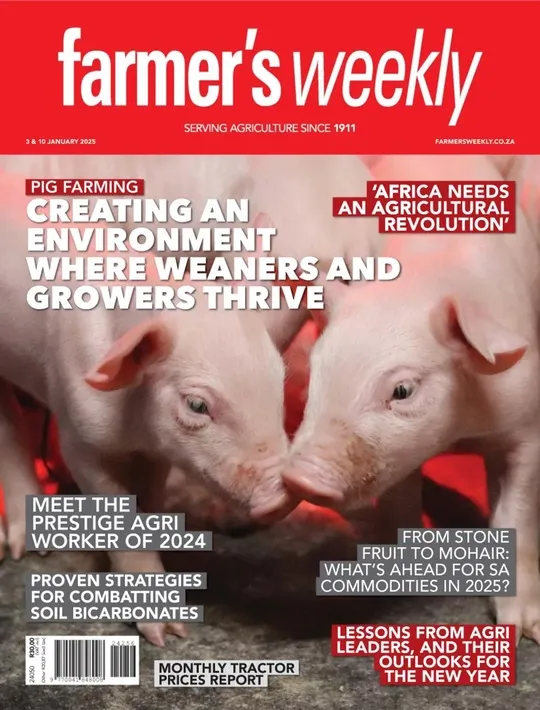
Summary
"Africa needs an agricultural revolution" leads Farmers Weekly's 3 & 10 January 2025 issue, with a 6-page Africa-focused feature examining food security, agroecology and policy reform across the continent. The cover's pig-farming focus — creating an environment where weaners and growers thrive — delivers 4 pages of practical livestock management. The double issue covers South African agriculture with commodity outlooks from stone fruit to mohair.
The commodity outlooks section runs from page 21 to 28, with price trends and production forecasts for 2025 across SA's major agricultural sectors. The features include lessons from agri leaders and their outlooks for the new year, and the Prestige Agri Worker of 2024 profile. The crops section on page 54 covers proven strategies for combatting soil bicarbonates. The vegetable production article prepares seedlings for the season and your conditions.
The news wrap covers the wine industry's tax deadline extension, Potatoes SA's supply reassurance, Madikwe reserve elephant deaths and Free State road safety. Regular columns include Managing for Profit, Labour Matters, New Norms in Agri Economics, the Farmer's Diary, Letters, Archive, auctions and classifieds. The lifestyle section runs The Hitching Post, On the Edge, Farmer's Feasts, crossword, Hillbilly Homes and Ask Our Vet.
—————
Content Guide
▸ Cover Feature
p.50 · Pig farming: Creating an environment where weaners and growers thrive
A 4-page practical guide covering pen temperature gradients, weaning-age nutrition transitions and stocking density benchmarks. Pigs weaned at 28 days gain 200g more per day than pigs weaned at 21 days over the first fortnight. Maintain a temperature gradient from 30 degrees C at the creep area to 24 degrees C at the dunging passage.
▸ Features
p.6 · 'Africa needs an agricultural revolution'
A 6-page analysis of Africa's agricultural potential, including case studies from Kenya, Nigeria and Zambia. The piece argues that agroecological methods — intercropping, cover-cropping, and reduced tillage — could boost smallholder yields by 40% without synthetic fertiliser imports. Ethiopia's teff value chain is highlighted as a model for export crop development.
p.21 · Commodity Outlooks 2025: Stone fruit to mohair
Price forecasts for SA's major agricultural commodities. The mohair market is predicted to stabilise at $85/kg after 3 years of volatility, driven by Chinese demand for luxury fibres. The stone-fruit outlook is cautious — the EU's new phytosanitary requirements could reduce SA plum exports by 15% in 2025.
p.36 · Lessons from agri leaders, and their outlooks for the new year
Interviews with 5 South African agricultural leaders, including the head of AgriSA and a KZN sugar-cane farmer. The consensus: water infrastructure investment is the single factor most likely to determine a farm's 5-year survival.
p.45 · Meet the Prestige Agri Worker of 2024
A profile of the winning farmworker, a Namibian-born vineyard manager who improved yield per hectare by 25% over 3 years through precision irrigation. His method involves soil-moisture sensors placed at 30cm and 60cm depths.
▸ Livestock / Crops
p.54 · Proven strategies for combatting soil bicarbonates
A technical guide for farmers dealing with high-bicarbonate irrigation water in the Northern Cape. The article recommends injecting sulphuric acid at 5ml per 1,000 litres of water to neutralise bicarbonates. A case study from the Vaalharts irrigation scheme shows yield improvements of 18% after treatment.
p.58 · Preparing seedlings for the season and your conditions
A step-by-step guide to hardening off vegetable seedlings before transplanting. Expose seedlings to outdoor conditions for 2 hours on day 1, increasing by 1 hour per day over 7 days. The failure rate drops from 30% to 5% with a full hardening-off schedule.
—————
Editor's Take
Farmers Weekly's first issue of 2025 is a workhorse agricultural publication that delivers practical, Southern Africa-specific content with minimal lifestyle padding. The Africa-needs-a-revolution feature is the issue's heavyweight piece — it moves beyond generalities to name specific countries, crops and yield percentages. The pig-weaning temperature-gradient table on page 51 is the kind of detail that makes the magazine worth keeping on the dashboard. The weakness is the design: the layout is barely evolved from 1995, and the photo reproduction on the commodity pages is poor enough that price charts are hard to read. The Prestige Agri Worker profile is well-intentioned but too short to do the subject justice. This issue is for the commercial farmer in Southern Africa who needs actionable commodity intelligence and technical advice, not for the hobbyist smallholder.
Strengths
• Africa agricultural revolution feature with country-specific case studies
• Pig-weaning temperature gradient and stocking-density benchmarks
• Soil-bicarbonate neutralisation protocol with dosage rates
Weaknesses
• Page layout and photo reproduction quality are dated
• Prestige Agri Worker profile underserves the subject
Verdict: Recommended — Technical agricultural content of genuine value to the SA commercial farmer, packaged in a dated format.
