
National Geographic Little Kids UK – Issue 48 2026
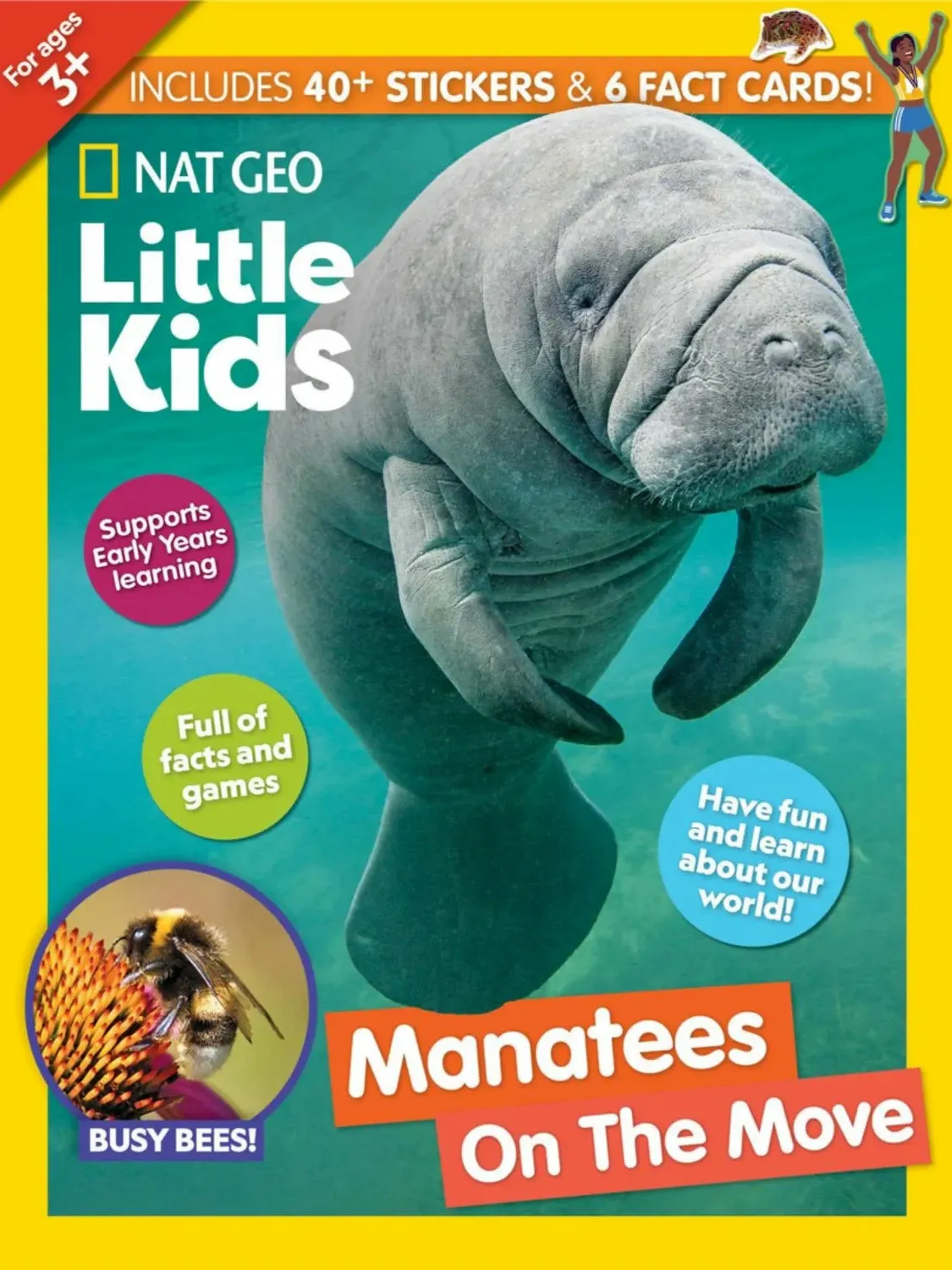
Summary
National Geographic Little Kids UK Issue 48 (2026, ages 3+) sends preschoolers on a bug-hunt through lightning facts, manatee herds, horned frogs, busy bees and beaver dams — with 40-plus stickers and 6 fact cards as the physical draw. The cover star is BUSY BEES!, with secondary hooks for manatees and horned frogs.
The 36-page issue opens with a sticker page (p.4) and moves through lightning strikes (thunder science), horned frogs (mega-mouthed ambush predators), busy bees collecting pollen (p.6), a numbers game (p.7), a spot-the-difference puzzle (p.14), manatees (p.8), beavers building a dam (p.24), a classroom search-and-find (p.26), the International Space Station (p.28), a Let's Visit Ethiopia page (p.32) and the Little Kids Big Quiz (p.34). The 6 fact cards cover lightning, manatees, horned frogs, bees, beavers and the ISS. Every spread includes a "Time to Chat" prompt, an action prompt and an on-page activity, supporting Early Years Foundation Stage learning goals.
The UK edition differs from the US version in paper quality and sticker count — the card-stock fact sheets are perforated for easy removal. The back-cover subscription offer promotes a free storage box for collectors.
—————
Content Guide
▸ Animal Features
p.8 · Manatees — Meet the munk bunch!
West Indian manatees grazing on seagrass in Florida's springs. The spread labels the manatee's whiskered snout, paddle-shaped tail and round body. Manatees eat up to 15% of their body weight every day. Count to 30 slowly — that is how many seconds a manatee can hold its breath while munching underwater.
p.16 · Horned Frogs — Mega-mouthed creatures
The Argentine horned frog lures prey by wiggling its toes, then opens its mouth wide enough to swallow a mouse whole. Its jaw is wider than its body. Compare the frog's mouth size to your child's hand — the frog can fit anything smaller than a tennis ball.
p.24 · Beavers Build a Dam — Clever little carpenters
A beaver fells a tree with its teeth, drags the branches to a stream and packs mud between them. The dam creates a pond that protects the beaver's lodge entrance. Build a mini dam in your sink with pebbles and twigs — watch how water pools behind the barrier.
▸ Science & Nature
p.4 · Lightning Strikes — It's thunder time!
A thundercloud diagram shows ice crystals rubbing together to build static electricity. Lightning bolts can reach 30,000 degrees Celsius — five times hotter than the Sun's surface. Count the seconds between lightning and thunder: every five seconds equals one mile of distance.
p.28 · International Space Station — An amazing astronaut centre
Astronauts float in zero gravity, sleep in Velcro-tethered sleeping bags and drink water from floating bubbles. The ISS travels at 17,500 miles per hour and orbits Earth every 90 minutes. Look for the ISS in the evening sky — it appears as a steady bright light moving faster than any aeroplane.
▸ Activities & Games
p.14 · What Is Different?
A two-scene spot-the-difference game: a meadow with bees, flowers and a horned frog hidden in the grass. Seven changes between the top and bottom images. Work from left to right and describe each change out loud — saying "the flower changed from red to blue" builds observation vocabulary.
p.22 · What Comes Next?
Pattern recognition with kitten and puppy paw-print sequences. The patterns alternate in colour and size — large brown paw, small black paw, large brown paw, ?. Use your child's own handprints on paper to create new patterns once the magazine page is finished.
▸ World Culture
p.32 · Let's Visit… Ethiopia!
Amazing pools (the Danakil Depression's hot springs), special bread (injera, a spongy flatbread made from teff flour) and record-breaking runners (Ethiopian athletes dominate long-distance racing). The spread includes a photo of runners training at altitude in Addis Ababa. Make injera at home using a simple teff-flour recipe — it takes three days of fermentation, so plan ahead.
p.34 · Little Kids Big Quiz!
Eight questions covering lightning, manatees, horned frogs, bees, beavers, the ISS, Ethiopia and numbers. The answers are printed upside-down at the bottom of the page. Let your child "be the teacher" and quiz you — reversing roles strengthens their recall and confidence.
—————
Editor's Take
Little Kids UK Issue 48 is the strongest of the three 2026 issues I have read from this title. The lightning spread (p.4) explains a complex phenomenon through a simple ice-crystal diagram that an adult can read aloud in 60 seconds. The beaver dam page (p.24) earns its keep with a sink-based extension activity. The Ethiopia "Let's Visit" page (p.32) is the only cultural-content page in the issue, which underrepresents the global-awareness goal of the Early Years curriculum. The sticker page opens the issue rather than closing it — unusual placement that means stickers are used up before the reading begins. The card-stock fact cards are perforated and UK editions use heavier paper than the US equivalent, which adds durability.
Strengths
• Lightning diagram explains 30,000°C temperature through visible ice-crystal friction
• Beaver dam page includes a sink-based mini-dam extension activity
• Ethiopia feature covers injera bread, Danakil hot springs and long-distance runners
Weaknesses
• Single cultural page (Ethiopia) is the only non-animal, non-science content
• Sticker page placed at the front, used up before the reading starts
Verdict: Recommended — A well-balanced preschool issue anchored by the beaver dam and lightning spreads. (16 words)
