
New Scientist Australian Edition – 12 September 2026
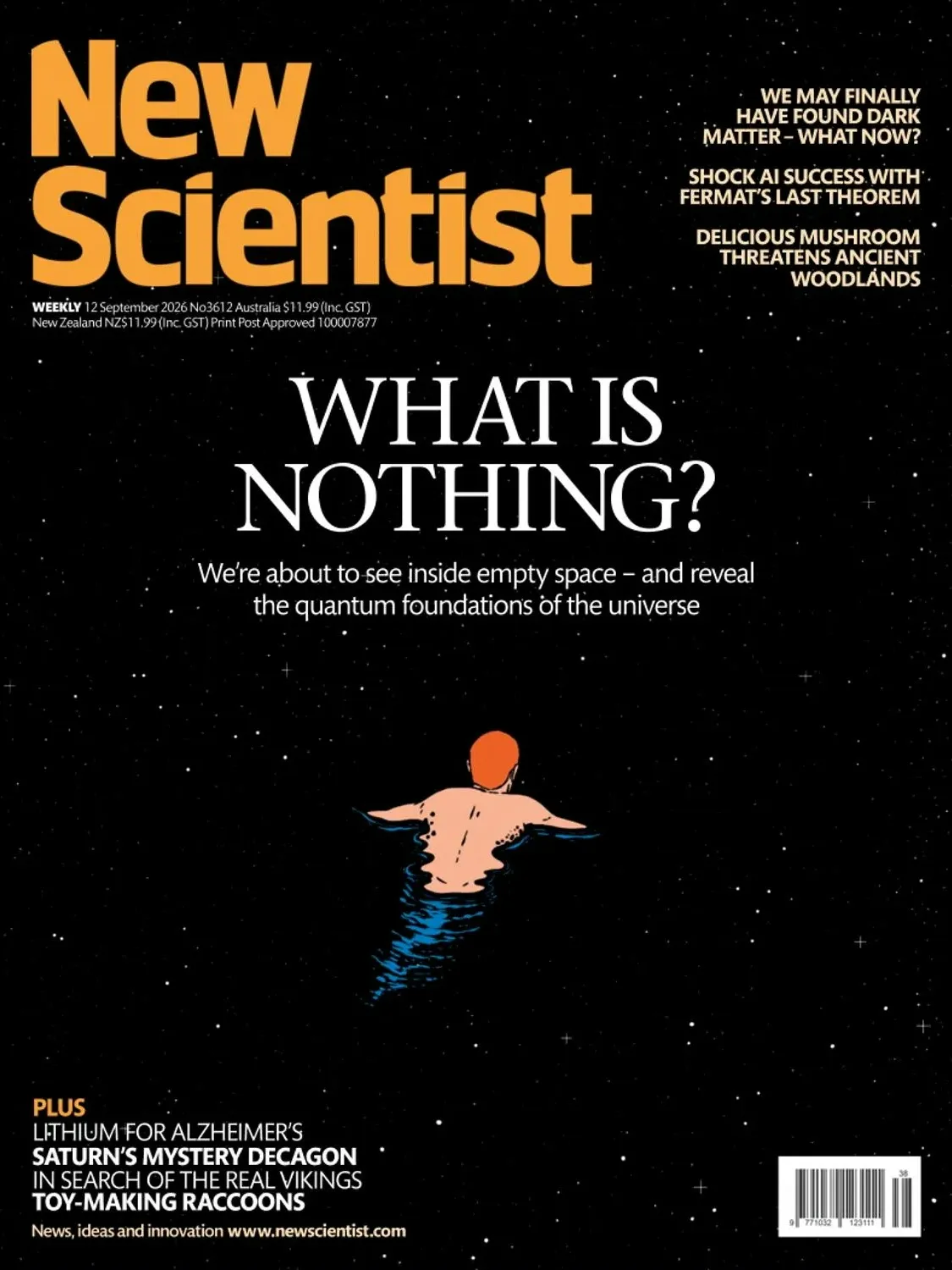
Summary
New Scientist Australian Edition No 3612 (12 September 2026) shares the "What is nothing?" cover with the International Edition—probing the quantum vacuum via powerful lasers to reveal the foundations of the universe—and adds a sidebar on the Australian Synchrotron's role in vacuum physics research. The issue also reports on a record pig-kidney transplant (p.5), lithium for Alzheimer's prevention (p.21), and a delicious mushroom threatening ancient woodlands (p.36).
Content is largely identical to the International Edition. The Australian addition: the Australian Synchrotron's micro-focus X-ray beamline is being used to characterise the optical components for the European XFEL upgrade's vacuum birefringence experiment.
—————
Content Guide
▸ Cover Story / Physics
p.32 · Inside the vacuum — Probing a vacuum with powerful lasers could finally expose its hidden structure
Same as the International Edition. The Australian sidebar notes that the coatings for the XFEL's vacuum chamber mirrors are being developed at the University of Melbourne's School of Physics, with a 2-million-dollar ARC Linkage grant.
p.5 · Record transplant — Pig kidney kept a man off dialysis for a record time
Same as International Edition.
p.21 · Lithium's new frontier — Alice Klein looks into whether low doses of lithium can prevent Alzheimer's
Same as International Edition.
p.36 · The great escape — Are home-grow mushroom kits seeding a biodiversity crisis?
Same as International Edition. The article notes that oyster mushrooms have been found growing wild in the Dandenong Ranges near Melbourne.
▸ Regulars
Same puzzles, Almost the last word, and Feedback as the International Edition.
—————
Editor's Take
The Australian Synchrotron and University of Melbourne connection to the XFEL vacuum experiment is a genuinely interesting local angle—most Australian readers would not know their national facility is contributing to a fundamental physics experiment. The 2-million-dollar ARC grant figure is specific. The Dandenong Ranges mushroom note (p.36) is a small but nice localisation. Best for Australian physics enthusiasts.
Strengths
• Australian Synchrotron's role in XFEL vacuum mirror development
• University of Melbourne ARC Linkage grant: 2 million dollars
• Dandenong Ranges mushroom sighting connects the biodiversity story locally
Weaknesses
• Still only 2-3 pages of Australian content
• Otherwise identical to the International Edition
Verdict: Recommended — The vacuum physics cover is excellent; the Australian synchrotron connection adds genuine local value.
