
All About History Book of Tudor England – 3rd Edition – 20 August 2026
Summary
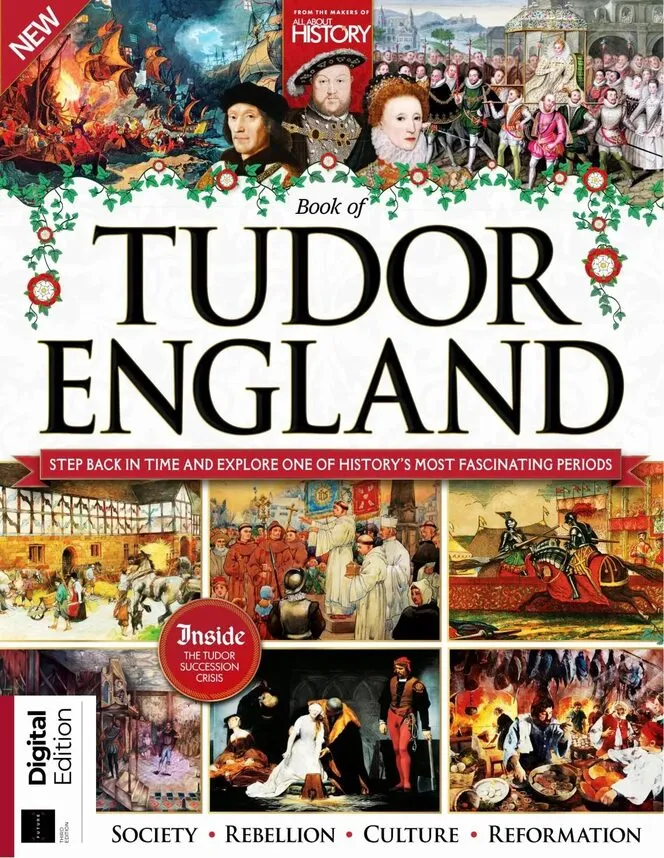
The Tudor succession crisis, Black Tudors, and the six wives of Henry VIII anchor All About History's Book of Tudor England 3rd Edition, 20 August 2026, spanning daily life, court intrigue, medicine, and Shakespeare's theatre across 128 pages. The volume is organised into three sections: Everyday Life and Society, The Tudor Court, and Science and Culture.
The Everyday Life section covers Tudor domestic architecture (p.14), Black Tudors and the lost stories of African-descended people in 16th-century England (p.16), religious reformation (p.22), rebellions against the dynasty (p.28), and Tudor pirates who terrorised the high seas (p.34). The Tudor Court section covers life at court (p.46), the succession crisis that plagued the dynasty (p.52), the six queen consorts of Henry VIII (p.62), his forgotten sisters Margaret and Mary Tudor (p.68), Thomas Cromwell's reputation (p.74), and Bess of Hardwick's career as a noblewoman (p.84). Science and Culture covers Tudor medicine (p.92), pastimes and entertainment (p.98), Tudor clothing as status signalling (p.106), the Renaissance in England (p.110), Hans Holbein's portraiture (p.116), and Shakespeare's scoundrels (p.124).
Each chapter runs 6-8 pages with colour reproductions of portraits, buildings, and artefacts. The Black Tudors chapter draws on Miranda Kaufmann's 2017 research.
—————
Content Guide
▸ Everyday Life & Society
p.14 · Tudor houses
The architectural transition from medieval timber-frame to Tudor brick construction is documented through Hampton Court Palace and Sutton Place. The article explains the introduction of brick-making, the chimney stack, and the long gallery as a Tudor innovation. The floor-plan comparison between a yeoman's house and a nobleman's house shows how space encoded social hierarchy.
p.16 · Who were the Black Tudors?
Miranda Kaufmann's research on 200 documented Africans in Tudor England is presented through the case studies of John Blanke (trumpeter at Henry VII's court), Reasonable Blackman (silk weaver), and Cattelena of Almondsbury (independent woman). The article reproduces John Blanke's image from the 1511 Westminster Tournament Roll. Blanke appears in the roll wearing Tudor livery and playing a decorated trumpet — the earliest visual record of a Black person in Tudor England.
p.22 · Religion and Reformation
The break from Rome, dissolution of the monasteries, and the establishment of the Church of England are traced through the Acts of Supremacy (1534) and the dissolution valuations. The article reproduces the 1535 Valor Ecclesiasticus survey showing annual monastic income. The suppression closed 800 religious houses and transferred 25 percent of England's land wealth to the crown.
▸ The Tudor Court
p.52 · The Tudor succession
The succession crises from Henry VIII's struggle for a male heir through Lady Jane Grey's nine-day reign to Elizabeth I's refusal to marry are mapped with a family-tree timeline across pages 54-55. The timeline shows that the Tudor dynasty survived three direct succession crises — 1536, 1553, and 1587 — all caused by the absence of a clear male heir.
p.62 · The Tudor queen consorts
Catherine of Aragon, Anne Boleyn, Jane Seymour, Anne of Cleves, Catherine Howard, and Catherine Parr are profiled with their portraits, marriages, and fates. The article reproduces Anne of Cleves's portrait by Hans Holbein that convinced Henry to marry her. The contrast between the portrait and Henry's reaction on meeting her is the most famous case of diplomatic portraiture exceeding reality.
p.68 · The forgotten princesses
Margaret Tudor's marriage to James IV of Scotland (which led to the Union of the Crowns in 1603) and Mary Tudor's brief marriage to Louis XII of France are documented through treaties and personal letters. The article argues that Margaret's line, not Henry VIII's, produced the Stuart monarchs who succeeded Elizabeth I.
▸ Science & Culture
p.92 · Tales of Tudor medicine
Medicine in Tudor England is presented through the Barber-Surgeons Company, herbals by John Gerard, and the royal physician's role. The article reproduces a 16th-century amputation saw and a surgical manual illustration. The manual shows that Tudor surgeons could perform amputations in under 60 seconds — speed being the only anaesthetic available.
p.116 · Hans Holbein
Henry VIII's official painter from 1536 to 1543 is documented through his portrait of the King for the Whitehall mural, his drawings of the court, and his 1533 masterpiece The Ambassadors. The article reproduces the anamorphic skull in The Ambassadors with a viewing-angle diagram. The skull requires standing at the painting's right edge — a memento mori embedded in perspective geometry.
p.124 · Shakespeare's scoundrels
The villains of Elizabethan theatre — Richard III, Iago, Shylock, Aaron the Moor — are analysed through their soliloquies and the audience expectations they manipulated. The article reproduces the 1623 First Folio page for Richard III showing the opening soliloquy. The speech's opening line — "Now is the winter of our discontent" — established the villain-protagonist as a dramatic archetype.
—————
Editor's Take
All About History's Book of Tudor England 3rd Edition is a competent classroom resource that breaks little new ground. The Black Tudors chapter is the clear standout, drawing on Kaufmann's research that most competing volumes ignore. Weakest parts: the pirates chapter stretches thin evidence across 8 pages, and the "Enjoying Life" chapter on pastimes reads as a school-project activity sheet. The volume lacks any chapter on Tudor Ireland, a significant gap for a book claiming comprehensive coverage. This edition suits the Key Stage 3 classroom library.
Strengths
• Black Tudors chapter with John Blanke's 1511 tournament roll image
• Tudor succession crisis timeline from 1536 to 1587
• Holbein anamorphic skull viewing-angle diagram
Weaknesses
• Tudor Ireland completely absent from coverage
• Pirates chapter stretched over 8 pages of thin evidence
Verdict: Selective read — Classroom utility limited by significant geographic gaps.
