
Science Illustrated Australia – Issue 123 2026
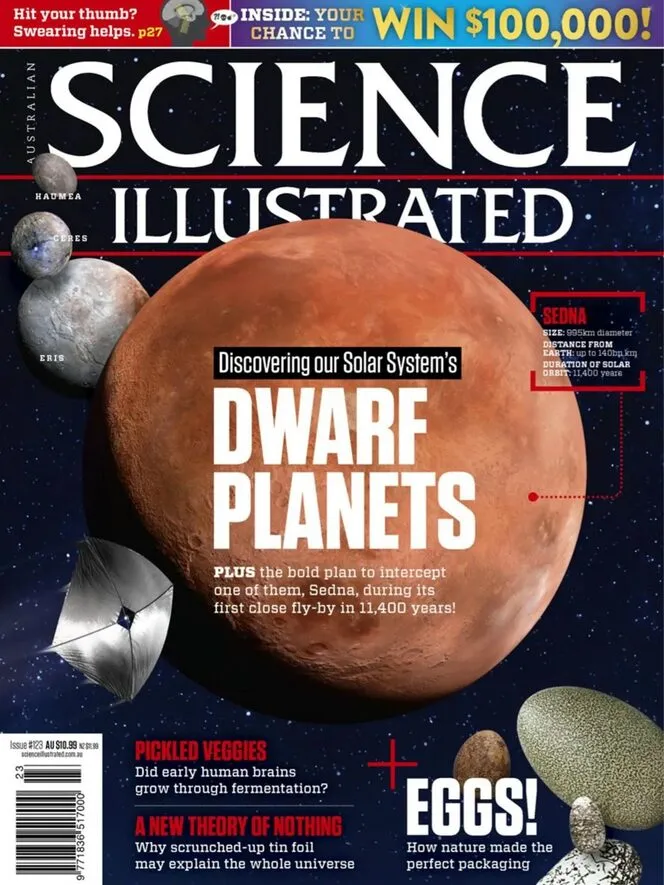
Summary
Issue 123 of Science Illustrated Australia, published 11 May 2026, launches a cover campaign to intercept dwarf planet Sedna during its once-in-11,400-year flyby, with a subscriber giveaway worth 100,000 Australian dollars. The 82-page edition runs seven features on brain evolution, egg biology, bullying, and the physics of nothing, plus a Pasteur biography and a hydrofoil revival story.
The cover story (p28) outlines a bold NASA-ESA trajectory that could reach Sedna by 2047 using a gravity assist from Jupiter. "What Made Human Brains Grow?" (p36) links the rise of Homo erectus to fermented-vegetable consumption 2 million years ago. "Eggs—Nature's Ingenious Packaging" (p42) breaks down the biomechanics of a chicken egg's 15,000 pores. "World's Longest Suspension Bridge" (p46) profiles the proposed 3,300-metre Messina Strait crossing. "A Fifth Force?" (p54) examines recent muon-g-2 data. "Bullying" (p60) covers school and cyber contexts. "The Search for Nothing" (p68) explores vacuum energy. Great Scientists (p78) profiles Louis Pasteur.
Megapixels (p6) opens with a scanning-electron-microscope image of a pickled vegetable cross-section and a photo of a hydrofoil prototype. Science Update (p10) runs 10 pages of short-form research. Ask Us! (p20) answers reader questions on topics from why onions make you cry to whether cats can see in colour. Test Yourself (p82) closes with 18 questions.
—————
Content Guide
▸ Cover Story / Features
p.28 · Dwarf Planets & the Race to Sedna
The feature maps a Jupiter gravity-assist window opening in 2038 that could put a probe at Sedna by 2047—just in time to catch its perihelion passage. It explains why Sedna's 11,400-year orbit suggests a ninth-planet perturber. Readers finish with a timeline of the three proposed mission architectures.
p.36 · What Made Human Brains Grow?
Fermented vegetables may have driven the tripling of hominid brain volume between 2.5 million and 500,000 years ago. The article cites a Harvard gut-microbiome study linking Lactobacillus consumption to increased BDNF expression in primates. It recommends adding one serving of fermented food per day as a practical cognitive-health step.
p.42 · Eggs – Nature's Ingenious Packaging
A chicken eggshell contains 15,000 pores and can withstand 4.5 kg of force along its long axis. The piece walks through shell formation in the hen's oviduct over 24 hours. Readers learn why storing eggs pointy-end-down extends freshness by up to 2 weeks.
p.54 · A Fifth Force?
The Muon g-2 experiment at Fermilab reports a 4.2-sigma deviation from the Standard Model. The article explains how a fifth fundamental force mediated by a hypothetical Z-prime boson could account for the anomaly. It closes with the expected timeline for the final Fermilab dataset in 2027.
▸ Regulars
p.10 · Science Update
Ten pages of research briefs: a 3D-printed titanium heart valve tested in sheep, quantum-dot TV tech reaching 100% colour volume, and a bat species found to echolocate through dense fog. Each item includes a journal citation.
p.20 · Ask Us!
"Why do we yawn?" and "Do fish sleep?" anchor a 2-page Q&A that also covers whether plants scream when cut. Answers are sourced from peer-reviewed studies and written at a year-10 reading level. The yawn answer cites a Princeton thermoregulation study.
p.78 · Great Scientists: Louis Pasteur
A two-page infographic timeline covers Pasteur's rabies vaccine (1885), his germ theory, and his invention of pasteurisation. A sidebar shows that pasteurisation reduced milk-borne disease by 90% within 20 years of adoption.
—————
Editor's Take
Issue 123 punches above its weight with the Sedna cover story—the 11,400-year orbit hook is genuinely unusual—but the bullying feature (p60) reads like a school-counsellor handout with no new research. The brain-evolution piece linking fermented food to BDNF is the smartest argument in the issue. Weakest is the suspension-bridge article, which rehashes Messina Strait specs already published in engineering blogs. This issue suits families and secondary-school science clubs; the egg biomechanics page alone is worth the read-aloud.
Strengths
• Sedna cover story with 2038 launch window and 11,400-year orbit hook
• Brain-evolution feature cites Harvard BDNF study on fermented food
• Eggshell piece packs 15,000 pores and 4.5 kg force resistance
Weaknesses
• Bullying feature lacks original interviews or recent study data
• Suspension-bridge article duplicates publicly available engineering specs
Verdict: Recommended — A strong general-science issue lifted by the Sedna cover and the fermented-food brain hypothesis; skip the bridge piece.
