
The Economic Times Wealth – August 24, 2026
Summary
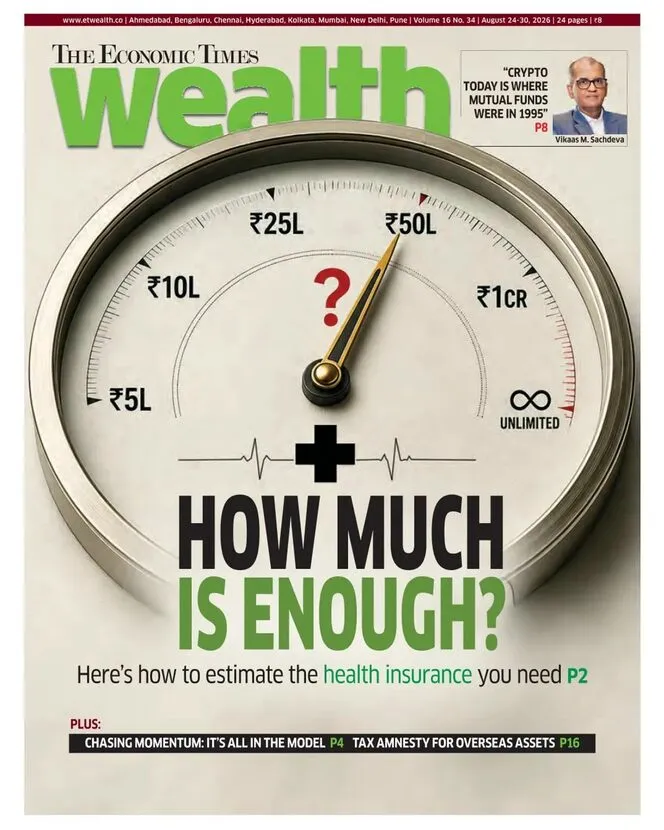
"How much is enough?" — The Economic Times Wealth 24-30 August 2026 (Volume 16 No. 34) tackles health-insurance coverage in an era of 12-14% medical inflation, arguing that a INR 5-10 lakh cover no longer protects a family against a serious illness. Preeti Kulkarni reports on how age, city, family history and hospital preference should determine the real number — not income (p2).
The cover story (p2) explains why traditional cover amounts are obsolete when a single ICU stay can cost INR 3-5 lakh in major cities and cancer treatment can exceed INR 25 lakh. Additional features cover momentum investing models (p4), why crypto today is where mutual funds were in 1995 (p8), and a tax amnesty for overseas assets (p16). The 24-page issue focuses on risk coverage and portfolio strategy.
Regular sections cover insurance planning, investment strategy and tax compliance. The issue targets middle-class Indian families who bought health policies 5-10 years ago and have not reviewed them since.
—————
Content Guide
▸ Cover Story / Insurance / Investment / Tax
p2 · How much health insurance do you need?
Preeti Kulkarni provides a framework based on age band, city tier, family medical history and preferred hospital room category. The article includes a coverage calculator: a 40-year-old in Mumbai with a family history of cardiac disease and a private-room preference needs INR 50 lakh minimum. Anyone who has not reviewed their health cover in 3 years should run the calculator before their next renewal date.
p2 — Age, family size and health history
Sub-section breaking down how each factor multiplies the required cover. A 60-year-old couple needs 40% more cover than a 30-year-old single person, the article calculates. Families with a history of diabetes or heart disease should add INR 10 lakh per hereditary condition.
p2 — The INR 1 crore question
Whether a INR 1 crore cover is necessary or excessive. The article compares premiums across age groups for INR 25 lakh, INR 50 lakh and INR 1 crore policies, using actual insurer quotes. Budget-conscious buyers can use the sweet-spot range identified in the table — the analysis suggests INR 50 lakh is the value-for-money ceiling for most families.
p4 · Chasing momentum: It's all in the model
A guide to momentum-investing strategies for Indian markets, including stock selection criteria, holding periods and exit rules. The article backtests a specific 12-month momentum model against the Nifty 50. Active traders can implement the 10-stock monthly rebalance strategy using the screening checklist provided.
p8 · Crypto today is where mutual funds were in 1995
Vikaas M. Sachdeva argues that crypto investing will follow the same adoption curve as mutual funds: early scepticism, regulatory evolution, then mainstream acceptance. The article cites mutual fund AUM growth from 1995 to 2005 as a comparison. Anyone allocating to crypto should limit exposure to 5% of their portfolio — the same percentage the article calculates was optimal for mutual funds in 1995.
p16 · Tax amnesty for overseas assets
Report on the government's compliance window for undeclared foreign assets, including the tax rate, penalty structure and disclosure timeline. The article names the specific schedules and forms required. Indian residents with overseas bank accounts or property should consult a CA before the window closes — the deadline printed here is the last date for filing under the scheme.
—————
Editor's Take
The health-insurance cover story is the most useful ET Wealth feature this month — it gives readers a concrete formula (age + city + family history + room type = minimum cover) rather than the usual generic "review your policy" advice. The crypto-mutual fund parallel is clever but over-simplified. The weakness is the momentum-investing piece, which assumes readers have the time and discipline to rebalance 10 stocks monthly — most do not. This issue is for Indian families overdue for a health-insurance review and investors curious about crypto's place in a portfolio.
Strengths
• Health-insurance calculator with specific INR recommendations by age and city
• Actual insurer premium quotes across three coverage levels
• Crypto-mutual fund adoption curve with comparative AUM data
Weaknesses
• Momentum-investing strategy too time-intensive for the average reader
• Tax amnesty piece lacks real-world examples of who benefits
Verdict: Recommended — the health-insurance calculator alone is worth the cover price for anyone with an outdated policy.
