
The Guardian Weekly – 31 July 2026
Summary
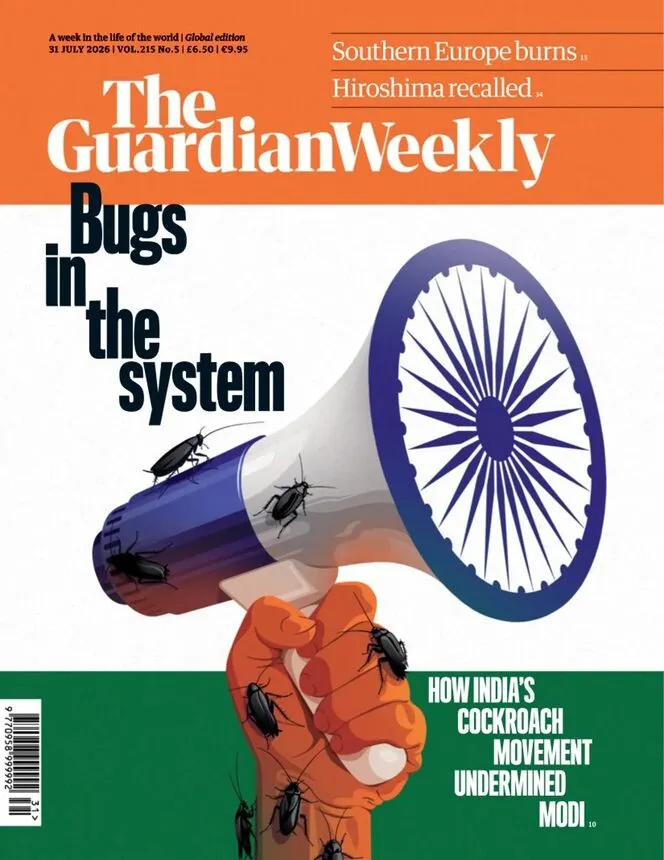
"Bugs in the system" — The Guardian Weekly 31 July 2026 reports on India's cockroach movement that began as a satirical protest after the chief justice called unemployed youth cockroaches, and has now cracked Narendra Modi's image as a strongman leader (p10). The issue also covers the Atlantic Ocean's evolution, Hiroshima survivor Koko Kondo's story, and John Carpenter on making horror films his way.
The big story (p10) traces how the cockroach meme turned into a political protest movement across Indian states. Spotlight sections cover France's Gironde wildfire evacuation (p15), Japan's Takaichi economic vision (p18), Palestine's swimming classes for Gaza children (p20), the Amazon's illegal gold mining war (p26), and a NASA scientist who believes the agency missed life on Mars (p30). Features include Simon Hattenstone's interview with Hiroshima survivor Koko Kondo (p34) and a look at life in British coastal towns (p40).
Opinion pages feature Steve Bloomfield on the ICC, Coco Khan on a French chicken shop row, and Jonathan Freedland on Burnham's bus-fare policy. Culture covers John Carpenter (p51), tribute acts making gigs affordable (p55), and LA's art deco library (p57). Tim Dowling's dog has a sheep phobia in Lifestyle (p60).
—————
Content Guide
▸ Cover Story / World Affairs / Features / Culture / Lifestyle
p10 · Cockroach party's progress creeps up on Modi
How a satirical label turned into a political force that is chipping away at the prime minister's dominance. The report names specific by-election seats the movement has contested and the vote shares achieved. Anyone tracking Indian opposition politics should keep this alongside the state-election results table published on the same page.
p15 · Inside the evacuation effort from Gironde's wildfires
Report from southwestern France where wildfires forced 10,000 residents from their homes. The piece describes the logistics of shelter, animal evacuation and air support. European homeowners in fire-risk zones can compare Gironde's evacuation protocol with their own region's plan using the checklist-box printed at the end.
p30 · Why a leading scientist thinks Nasa missed life on Mars
Interview with a planetary scientist who argues that 1970s Viking lander tests were flawed and may have detected life without recognising it. The article lists the specific experiments that could have produced false negatives. Astrobiology students can use the proposed redesign of the life-detection protocol as the basis for a research paper.
p34 · Hiroshima survivor Koko Kondo on horror, anger and forgiveness
Simon Hattenstone interviews Kondo, who was 6 years old when the bomb fell. She describes carrying her dead mother's hand and the decades of activism that followed. High-school history teachers can assign the article's first-person account alongside textbook coverage of August 6, 1945.
p51 · King of horror John Carpenter on making movies his way
Carpenter discusses his 50-year career from Halloween to The Thing, his decision to stop directing theatrical features, and his current work composing music for touring. He names the three films he considers his best and the one he regrets. Filmmaking students should read his advice on shooting a horror scene with a GBP 300,000 budget versus a GBP 30 million one.
p55 · Tribute acts steal the show and make gigs affordable again
How tribute bands are filling venues that originals skip, with the article citing 40% lower average ticket prices versus the real act. The piece names five tribute acts that the writer argues outperform their inspirations. Live-music fans on a budget can use the summer tour schedule printed in the margin.
p61 · Recipe — Pho now or pho later
A pho recipe using bone broth and rice noodles, with a 6-hour cooking time that breaks down to 20 minutes of active prep. The ingredient substitutions box lists alternatives for hard-to-find Vietnamese herbs. Home cooks can freeze the broth base for up to 6 months.
—————
Editor's Take
This is a powerhouse Guardian Weekly issue. The cockroach-movement feature is original political reporting that connects a meme to real electoral impact, and the Koko Kondo interview is the kind of first-person testimony that justifies the magazine's existence. The weakest section is the coastal towns photo essay, which is strong on images but thin on text. This issue is for readers who want one great long-read (the Hiroshima interview) and a broad scan of world news in a single sitting.
Strengths
• Cockroach movement feature with specific by-election data
• Koko Kondo interview — first-person Hiroshima testimony
• John Carpenter interview with budget-specific filmmaking advice
Weaknesses
• Coastal towns photo essay lacks substantive reporting to match the photography
• Science section too brief on the Mars life-detection story
Verdict: Essential — two genuinely important features (India protest movement, Hiroshima survivor) in one issue.
