
The Mediterranean Diet Book – 7th Edition – June 2025
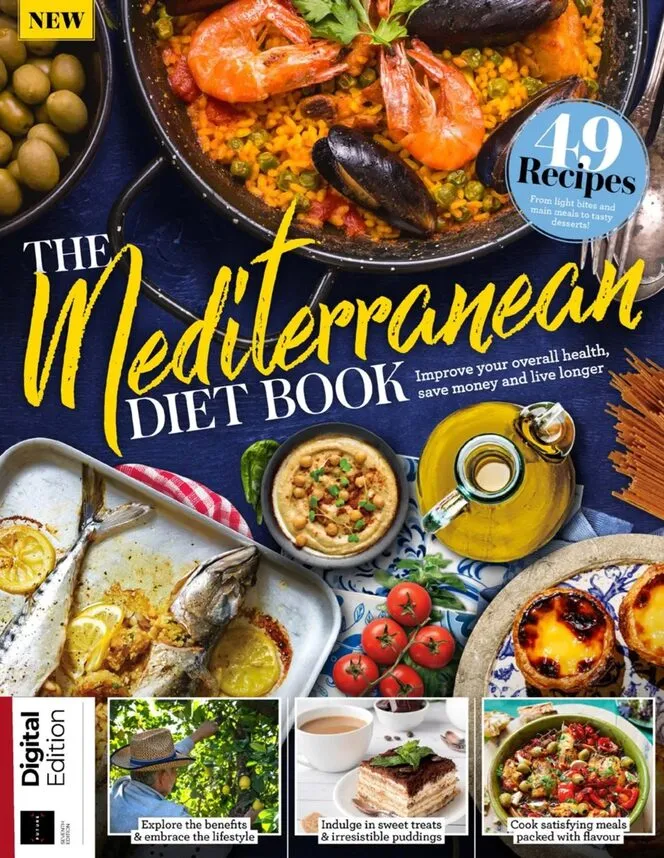
Summary
The Mediterranean Diet Book 7th Edition (June 2025) is a 128-page cookbook-plus-guide that traces the diet from its 1960s Seven Countries Study origins through 49 recipes organised into light bites, main meals, and desserts. Published by Future Publishing, the book argues that the Mediterranean diet is a lifestyle — not a restrictive regimen — and that its cardiovascular, anti-inflammatory, and mental-health benefits are reproducible outside the region.
The introduction (p.10) covers the diet's origins in Ancel Keys' post-WWII research in Pioppi, Italy, and the discovery that olive oil consumption did not correlate with heart disease in the local population. The "what to eat and drink" section (p.18) provides a pyramid and weekly meal framework. "What to have in moderation" (p.20) addresses red wine and red meat; "what to avoid" (p.21) lists ultra-processed foods and added sugars. The Mediterranean lifestyle chapter (p.22) emphasises communal eating, afternoon rest, and daily walking as equally important as the food itself.
The recipe section is divided into three parts: light bites (p.26-62, 19 recipes), main meals (p.66-108, 22 recipes), and desserts (p.112-126, 8 recipes). Standouts include gambas with aioli (p.40), Sicilian aubergine salad (p.34), timballo Siciliano (p.80), and Catalan fish stew (p.98). Each recipe includes a preparation time, serving size, and ingredient list in metric and imperial units. The book closes with an index and conversion chart.
—————
Content Guide
p.10 · The Origins of the Mediterranean Diet
Traces the Seven Countries Study and Ancel Keys' fieldwork in southern Italy, where he observed that men who ate primarily vegetables, bread, and olive oil had almost zero cardiovascular mortality. The chapter includes a timeline from 1952 to 2025 showing how the diet gained clinical acceptance.
p.18 · What to Eat & Drink
A one-page pyramid — vegetables at the base, red meat at the apex — with recommended weekly serving frequencies. Olive oil is listed as the primary fat. The chapter recommends 1.5 litres of water daily plus 1-2 glasses of red wine for those who drink. Meal planners get a one-glance reference.
p.34 · Sicilian Aubergine Salad
A 6-ingredient antipasto featuring roasted aubergine, capers, olives, tomatoes, red onion, and basil dressed in extra-virgin olive oil and red-wine vinegar. Prep time is 20 minutes plus 30 minutes resting. The recipe demonstrates how a few whole ingredients can replace a multi-component salad dressing.
p.80 · Timballo Siciliano
A baked pasta dish layered with aubergine, tomato sauce, hard-boiled eggs, and pecorino — closer to a savoury cake than a pasta bake. The recipe serves 6-8 and takes 1 hour 15 minutes total. This is the book's most ambitious dish, requiring simultaneous preparation of three components.
p.122 · Tiramisu
The classic Italian dessert adapted to use mascarpone at room temperature and espresso brewed double-strength. The recipe omits alcohol by default but offers a marsala variation. Preparation is 30 minutes plus 4 hours chilling. Home bakers will appreciate the tip about not over-beating the mascarpone.
—————
Editor's Take
A functional, no-excuses Mediterranean cookbook that prioritises recipe volume (49 dishes) over culinary innovation. The introduction is historically informative — the Seven Countries Study background is well-sourced — and the pyramid is usable. The weakness is that none of the recipes are new to anyone who owns a single other Mediterranean cookbook. Gambas with aioli, paella, moussaka, and tiramisu are standards. The photography is adequate but not aspirational. Also, the "Mediterranean lifestyle" chapter is only 2 pages and amounts to "walk more, eat with others." For a beginner who wants one book that covers both the diet principles and reliable weeknight recipes, this works. For experienced Mediterranean cooks, there is nothing here they don't already have.
Strengths
• 49 tested recipes with prep times and serving sizes
• Seven Countries Study background is well-researched
• Single-volume diet principles plus recipe collection
Weaknesses
• No recipe is novel — all are Mediterranean standards
• Mediterranean lifestyle chapter is only 2 pages deep
Verdict: Selective read — A reliable starter book, but experienced Mediterranean cooks will find no new recipes or insights beyond the 7th edition update.
