
Natural History Museum – Summer 2026
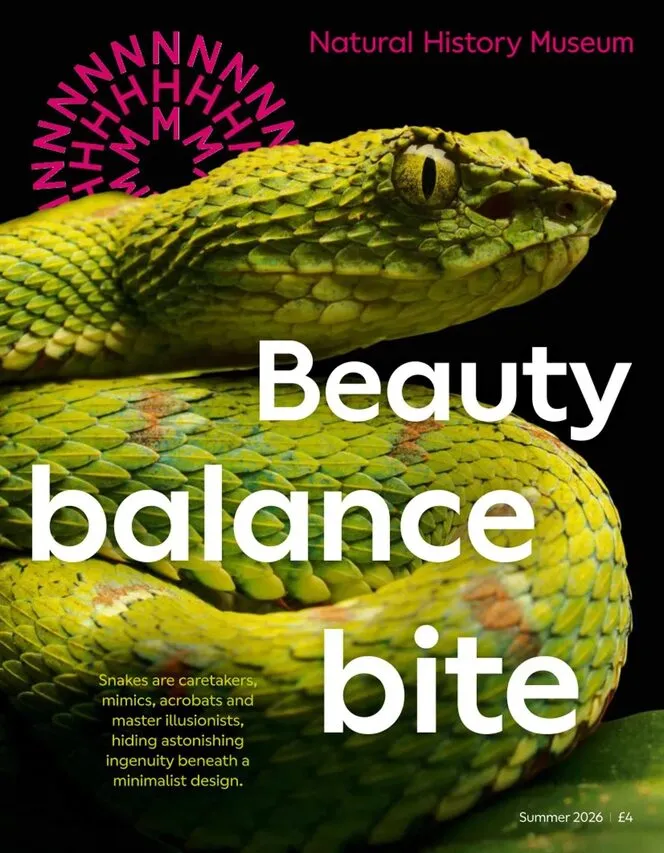
Summary
Natural History Museum Issue 61 (Summer 2026) takes readers inside "Jurassic Oceans: Monsters of the Deep" (p.24)—a new exhibition running until January 2027 that brings a life-size Kronosaurus and a 360-degree projection of a plesiosaur hunting ground to London. The issue also tackles the Martian mystery of methane spikes (p.30), the master craftspeople restoring museum specimens by design (p.36), and the political history of 140 years of museum moves (p.60).
Seven features run alongside a Journal section covering new acquisitions, What's On listings, and a science-in-focus piece on ancient teeth DNA. The back page features the Archive.
—————
Content Guide
▸ Cover Story / Exhibition
p.24 · Jurassic Oceans: Monsters of the Deep
A 6-page preview of the NHM's summer blockbuster exhibition. The centrepiece is a 10-metre Kronosaurus reconstructed from the most complete pliosaur skeleton ever found in Australia. The exhibition uses 180-degree projection mapping to simulate a Late Jurassic reef, and touch-table fossils include a real 160-million-year-old ichthyosaur paddle. The exhibition runs through 3 January 2027. Tickets are priced at 18 pounds for adults.
p.30 · The Martian mystery
The feature reports on the ExoMars Trace Gas Orbiter's detection of methane spikes in Gale Crater that cannot be explained by known geological processes. The three hypotheses: serpentinisation, clathrate release, or biological production. The article notes that NASA's Mars 2020 rover, now entering its extended mission, may be able to sample methane sources directly if it reaches the layered sulphates unit by mid-2027.
▸ Conservation / Restoration
p.36 · Masters by design
A 6-page profile of the NHM's conservation team, which restored the Dippy the Diplodocus cast for its UK tour. The article details the process: each of the 292 bones was laser-scanned, 3D-printed in lightweight polyurethane, and hand-painted to match the original's finish. The tour visited 12 venues over 4 years, drawing 1.8 million visitors.
p.42 · Rewriting the story of humans
The feature covers the NHM's human-evolution lab, which used new uranium-series dating on the Jebel Irhoud skull from Morocco, pushing the origins of Homo sapiens back to 315,000 years ago—100,000 years earlier than previously accepted. A 3D-printed model of the skull is on display in the Human Evolution gallery.
▸ Environment / Activism
p.50 · Standing up for nature: Rebecca Wrigley
Profile of the founder of Rewilding Britain, who argues that the UK needs to rewild 30 percent of its land by 2030. The article cites the organisation's first major success: the Knepp Estate pilot, where butterfly species increased from 28 to 56 species over 8 years.
p.54 · Secrets of the shore
A guide to the NHM's citizen-science Big Seaweed Search project. Volunteers have submitted 4,500 surveys from 287 UK beaches since 2020. The data shows that warmer-water seaweed species (Dictyota dichotoma) are extending their range northward at a rate of 12 km per year.
▸ History
p.60 · Museum moves: High ideals and low politics
A historical feature on the NHM's relocation from Bloomsbury to South Kensington in 1881, and the campaign for the Darwin Centre extension in 2002. The article argues that both moves were shaped more by political manoeuvring than by scientific need.
▸ Regulars
p.12 · Journal — What's on
Summer 2026 events at the Museum: the Wildlife Photographer of the Year exhibition opening in October; a Friday-night lecture series on ocean plastics; and a behind-the-scenes tour of the spirit collection.
p.22 · Exceptional specimens: Nature's undertakers
A single-page spotlight on the Museum's dermestid beetle colony, used to clean skeletons for the collection. The colony of 20,000 beetles consumes a rabbit carcass in 72 hours.
—————
Editor's Take
The Jurassic Oceans exhibition preview (p.24) makes you want to book a ticket immediately—the Kronosaurus reconstruction is spectacular, and the interactive elements sound genuinely engaging rather than gimmicky. The Masters by Design piece (p.36) is a quiet triumph; Dippy's 292-bone restoration story is more interesting than you would expect. The Martian methane feature (p.30) is thorough but feels out of place in a natural history museum magazine—it belongs in an astronomy publication. The Rebecca Wrigley profile (p.50) is needed (rewilding Britain is a major campaign) but reads like a fundraising brochure. Best for London visitors and NHM members; the Big Seaweed Search citizen science project is a genuine call to action.
Strengths
• Kronosaurus exhibition preview: specific, immersive, properly priced
• Dippy restoration detail: 292 bones, 12 venues, 1.8 million visitors
• Big Seaweed Search: measurable citizen science with northward-range data
Weaknesses
• Martian methane feature belongs in an astronomy magazine
• Rewilding profile reads like a fundraiser's brochure
Verdict: Recommended — The exhibition and conservation stories are excellent; a tight, well-produced issue for NHM members and visitors.
