
Horse Illustrated – Best of Breeds 2025
Summary
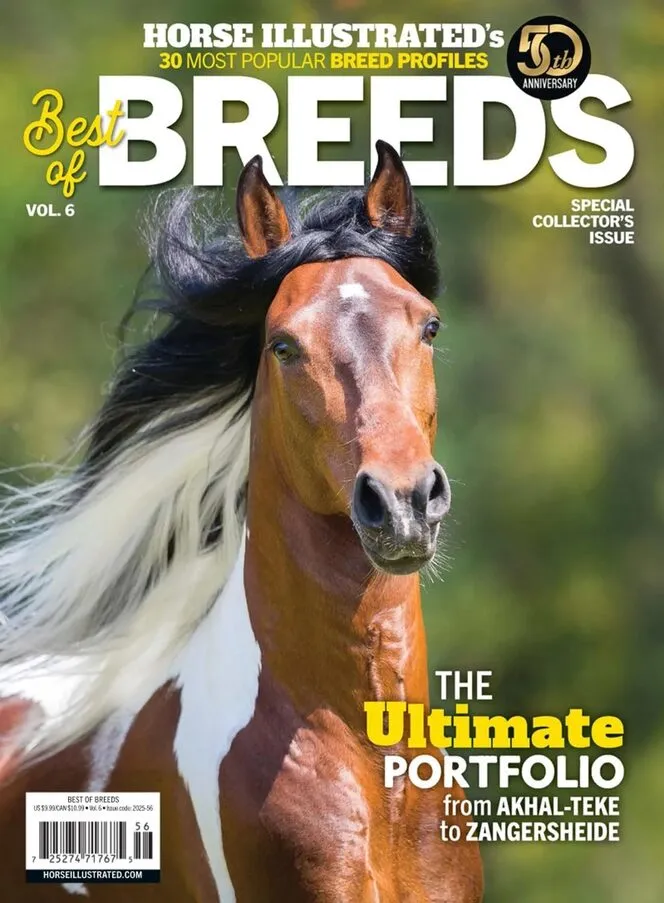
Priced at $9.99 and spanning 96 pages, Horse Illustrated Best of Breeds 2025 marks the sixth volume of the magazine's 30 horse breed portfolio, running alphabetically from the golden-coated Akhal-Teke that won 1960 Olympic dressage gold to Beauville Z, the Zangersheide gelding that took individual bronze at the 2024 Paris Olympics.
Volume 6 of this annual collector's series republishes the 30 most popular breed profiles from Horse Illustrated's archives, timed as the parent magazine closes in on its 50th anniversary in 2026. Editor in Chief Holly Caccamise frames the lineup as a survey of draft horses, gaited breeds, sport horses, stock breeds, ponies and a handful of rare breeds. Every profile pairs history with a Fast Facts box covering height, color, conformation and registry contact details.
The profiles lean on numbers over marketing prose: the Akhal-Teke's 2,500-mile, 84-day ride from Ashgabat to Moscow in 1935; the Icelandic's 982 import law that sealed over 1,000 years of genetic isolation; the Thoroughbred Makeover's 10 competitive divisions; the BLM's 177 herd management areas across 26.9 million acres. Registry statistics anchor nearly every breed, from 635,000 registered Appaloosas down to roughly 300 Akhal-Tekes in the U.S.
Photography from Christiane Slawik and other equine shooters carries the visual load, with hand-picked images refreshed for this edition. Association and breeder advertorials sit beside each profile, listing farm contacts and stud services. At 96 pages, the issue reads less like a monthly magazine and more like a breed-buyer's catalog you keep on the shelf.
—————
Content Guide
▸ Sport & Speed
p.88 · Thoroughbred
Built on three foundation stallions—the Darley Arabian, Godolphin Arabian and Byerley Turk—and a 1791 General Stud Book covering 387 mares, the Thoroughbred profile pivots quickly from racing history to second careers. It spotlights the Retired Racehorse Project's Thoroughbred Makeover, which since 2012 has crowned champions in 10 disciplines, from eventing and polo to ranch work, plus the Jockey Club's TIP and New York's TAKE2 retraining programs. If you shop off-track, search RRP and TIP listings before hitting a generic sale barn.
p.28 · Dutch Warmblood & Zangersheide
The two sport-horse bookends of the issue explain how modern sporthorse economics work. The KWPN profile breaks its open studbook into jumper, dressage, hunter, harness and Gelder types, notes 85-90 percent are riding horses, and cites Steffen Peters' Suppenkasper winning Tokyo team silver. The Zangersheide piece covers Léon Melchior's Lanaken studfarm and the 1992 studbook, now ranked No. 2 by the WBFSH after Beauville Z won Paris 2024 bronze. Check WBFSH studbook rankings before paying any breeder's warmblood premium.
p.18 · Arabian
The Arabian profile earns its 'most influential breed' claim with hard numbers: the Tevis Cup, a 100-mile endurance race run since 1955, has been won by a purebred or part-Arabian every year except two. It separates the Polish, Crabbet and Egyptian bloodlines and explains how each strain reached America through war or aristocratic buyers. Dressage-type and hunter-type conformation differences get spelled out for sport buyers. Ask any endurance breeder which strain their horses carry—the answer shapes rideability.
▸ Stock & Ranch
p.70 · American Quarter Horse
The Quarter Horse profile digs into AQHA's 1940 founding rule—all Quarter Horses had to run a quarter mile in 23 seconds or prove ranch capability—and traces the Doc Bar line from the 1956 stallion through 2023's World's Greatest Horseman winner Call Me Mitch. King Ranch and Waggoner Ranch get named as 100-year breeders. Ranch riding, now among the most entered AQHA events, gets its own section. Buyers wanting cow horses should scan pedigrees for Doc Bar on both sides, as champions here still do.
p.64 · Paint Horse & Appaloosa
The color-breed pair covers registration mechanics most buyers never learn until it costs them. The Paint profile explains tobiano, overo and tovero patterns, why the 1962-founded APHA is America's second-largest registry, and how APHA's Chrome Cash pays bonus money at NCHA and NRCHA events—including for Solid Paint-Breds that lack white. The Appaloosa piece traces the LP gene to 2011 DNA findings and 25,000-year-old cave paintings, with 635,000 horses registered today. Register solid Paints anyway; the payout program ignores coat color.
p.58 · BLM Mustang
The Mustang profile lays out adoption as a concrete path: 26.9 million acres of federal land, 177 herd management areas, and roughly 245,000 wild horses adopted out since the 1971 law. Requirements are listed plainly—adopters must be 18, prove feed and water access, and provide a minimum 400-square-foot enclosure per horse. The 2024 Mustang Classic, the first English-discipline national Mustang competition, and the Extreme Mustang Makeover's 100-day training format show where adopted horses end up competing. Anyone with a smaller budget should price a BLM adoption against a trained grade horse.
▸ Gaited & Trail
p.84 · Tennessee Walking Horse & Missouri Fox Trotter
The two big American gaited breeds get paired treatment through their owners. TWHBEA counts 234,418 registered Walkers, with riders logging 13,438 trail hours in 2023; the profile follows a mounted-archery rider, an endurance rider aiming at Tevis, and a competitive mounted orienteering national placer. The Fox Trotter piece covers the signature broken-diagonal gait at 10 mph, the 1948 registry, and Missouri's 2002 designation of the breed as state horse. For all-day trail miles, test-ride the fox trot before buying any Walk.
p.74 · Rocky Mountain Horse & Paso Fino
Both smooth-gaited profiles deliver buying-relevant history. The Rocky Mountain Horse actually developed in Kentucky's Appalachians, shaped by breeder Sam Tuttle and his stallion Tobe, and remains on the Livestock Conservancy's threatened list despite its famous chocolate coat with flaxen mane. The Paso Fino piece covers the three speeds of the breed's lateral gait, the 60,000-horse PFHA registry, and its Trail Horse Test Program with junior, senior and master levels. Rare-breed buyers get a conservation angle here that most breed guides skip.
p.42 · Icelandic Horse
The Icelandic profile explains the law few horse people know: a 982 decree bans horse imports into Iceland and bars any departing horse from returning, sealing the gene pool for over a millennium. It covers the four-beat tölt, the 30-mph flying pace raced in Iceland, and the breed's near-bombproof temperament, attributed to a land with no natural predators. Around 80,000 live in Iceland against 6,248 USIHC registrations in America. Tölt-test any Icelandic before purchase—the gait quality varies by individual.
▸ Draft & Heavy
p.22 · Belgian Draft & Percheron
The two working-draft profiles give real numbers on a niche most riders never price. The Belgian registry processes about 3,500 registrations yearly, making it America's largest draft studbook; the piece features a 19.1-hand, 2,780-pound logging horse still working Michigan timber and a 30-year-old therapy horse visiting assisted-living facilities. The Percheron profile counts 34,084 registered and follows the Ames hitch operation through six- and eight-horse teams, 45-minute harnessing routines, and the industry-standard practice of dyeing coats to match. Draft buyers should ask registries about breeder directories before contacting farms.
p.26 · Clydesdale
The Clydesdale profile carries a conservation warning most fans of the Budweiser hitches have never seen: fewer than 5,000 Clydesdales were estimated in North America as of 2023, with breeding declining since around 2010 as horsekeeping costs rose. History runs from mid-1700s Lanarkshire through the 1877 Scottish society, and the modern section documents the breed in dressage, therapeutic riding, and carriage tourism. Clydesdale crosses with Thoroughbreds and Quarter Horses are flagged as a growing sport-horse option. Rare-breed buyers get a 'watch' list designation straight from the Livestock Conservancy.
▸ Baroque, Heritage & Ponies
p.12 · Andalusian, Lusitano, Friesian, Lipizzan, Gypsy Vanner & Akhal-Teke
The baroque-and-rare cluster fills the issue's middle. The Andalusian-Lusitano profile cites a dozen Lusitanos at the Tokyo Olympics and Spain's Fuego at London 2012; the Friesian piece covers the black-only standard, Dutch-run keuring inspections, and 14,000 U.S. registrations; the Lipizzan article names the six foundation stallion lines and 900-plus U.S. horses; the Gypsy Vanner entry dates the breed's 1996 American arrival and counts 8,500 registrations. The Akhal-Teke profile stands out with its metallic coat science and Absent's 1960 Olympic gold. Compare the U.S. registry counts before choosing among these—supply gaps drive prices.
p.52 · Morgan & Standardbred
Two American originals built on single sires. The Morgan profile traces every horse to Justin Morgan's 1789 stallion, argues the breed is 'America's baroque breed' alongside Lipizzans, and follows Queen's Moody Blues to Grand Prix dressage plus ranch and hunter champions. The Standardbred piece covers Messenger's 1788 import, Hambletonian 10's 1,300-plus foals, the 2:30 mile that named the breed, and Newark's mounted police adopting ex-racers through the Standardbred Retirement Foundation. Off-track Standardbreds suit timid novices; the profile says so plainly.
p.24 · Connemara, Shetland, Welsh, Haflinger, Fjord & Miniature
The pony-and-small-horse cluster covers six breeds in under 20 pages, each with registry counts and type breakdowns. The Welsh article alone divides the breed into Sections A through D spanning 11 to 16 hands, with 45,000-plus registered. The Shetland profile sorts America's four types—Foundation, Classic, Modern, Modern Pleasure—and caps U.S. height at 46 inches. The Haflinger entry traces every horse to the 1874 stallion Folie; the Fjord piece notes 90 percent are brown dun; the Miniature section caps registration at 34-38 inches depending on registry. Match the child's height to the section, not the breed name.
—————
Editor's Take
The strongest thing here is density: 30 profiles packed with registry numbers, height ranges, coat standards and association contacts a buyer can act on the same day, and the Fast Facts boxes make it a genuine reference rather than coffee-table fluff. The weakest thing is that this is a reprint product—profiles ran in Horse Illustrated at different times, so depth swings from the Akhal-Teke's rich multi-page history to thinner sketches, and nothing addresses purchase prices, feed costs, or breed-specific health problems like Friesian aortic rupture or Draft-related metabolic issues. The advertorial padding from breeders also blurs the editorial-sales line. This issue is for shoppers in breed-selection mode, families choosing a first pony, and young riders building a reference shelf—not for experienced owners who already know their shortlist. At $9.99 it earns shelf space, but a true buyer's guide would add price bands and veterinary considerations.
Strengths
• 30 profiles each anchored with registry counts, Fast Facts and association contacts
• Specific competition data throughout, from Tevis Cup wins to Olympic medals and RRP Makeover divisions
• Fresh Slawik photography and readable type across uncluttered spreads
Weaknesses
• Archive reprints create uneven depth from breed to breed
• No purchase price, upkeep cost or breed-specific health guidance
Verdict: Recommended — Dense, actionable 30-breed reference for $9.99; only cost guidance and even depth fall short.
