
Canadian Wildlife – January-February 2026
Summary
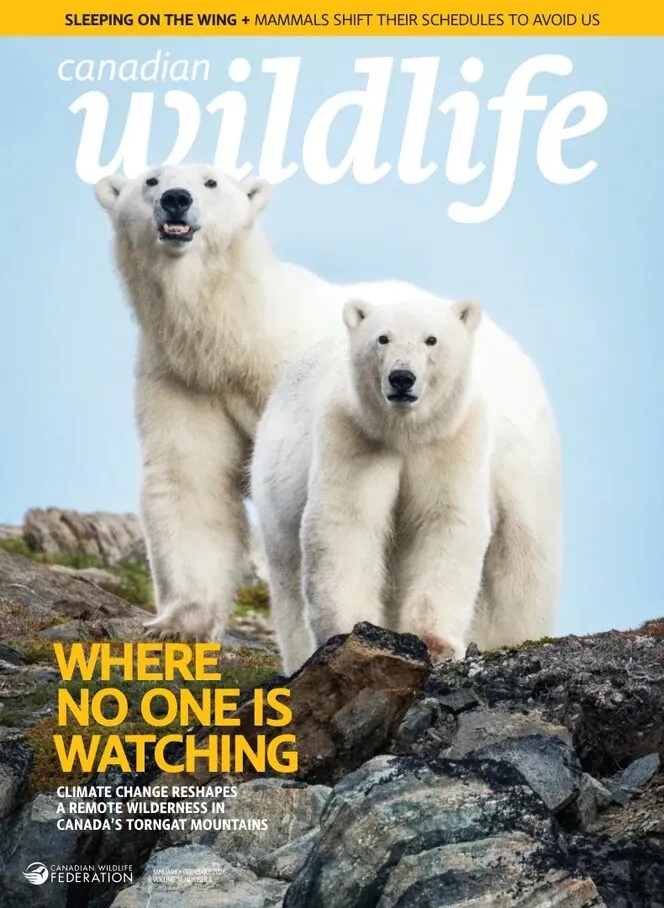
Canadian Wildlife January + February 2026 (Volume 31, Number 6) sends Zack Metcalfe to the Torngat Mountains, where a polar bear swims through an empty ocean and ancient tent rings emerge from thawing ground. Paul Zzka's cover photograph carries Where No One Is Watching.
Mirjam Guesgen's Secret Garden Keepers at p26 reports Toronto volunteers reclaiming ravines from invasive species, photographed by Joel Rodriguez. Wayne Lynch writes on the fastest predator on Earth at p9, and Alanna Mitchell reports lemurs evolving three times faster than their primate cousins at p10.
David Bird's birding column covers sleeping on the wing, from power naps to sleeping with one eye open. Mary Wittaker's field guide covers Joe-Pye Weed, feeding caterpillars in summer, migrating butterflies in autumn and sheltering bees all winter. Subscriptions run $29 for six issues, $47 in the US and $55 international.
—————
Content Guide
▸ Cover Story
p.14 · Where Land is Torn Like Paper
Zack Metcalfe reports from the Torngat Mountains, Canada's most remote national park, where climate change reshapes a wilderness nobody watches. A polar bear swims through an empty ocean, and ancient tent rings surface from thawing ground. Remote parks are where change is measured because nobody else is there. Ask what monitoring covers your nearest remote park.
▸ Science and Habitat
p.9 · Out There — The fastest predator on Earth
Wayne Lynch writes on the fastest predator on Earth, one of the issue's species columns. Speed is easier to marvel at than to measure. Look up how the speed was recorded before repeating the figure.
p.10 · Bigger Picture — Lemurs evolve three times faster than their primate cousins
Alanna Mitchell reports that lemurs evolve three times faster than their primate cousins. Faster evolution changes how we read a species' future. Read the rate before applying it to any other primate.
p.6 · In Focus — A starfish glides beneath the St. Lawrence estuary
Jean-Christophe Lemay photographed a starfish beneath the St. Lawrence estuary for the photo contest. Contest images set the standard for ethical wildlife photography. Give any estuary species the distance it chooses when you photograph it.
▸ People and Places
p.26 · The Secret Garden Keepers
Mirjam Guesgen reports that Toronto volunteers are reclaiming ravines from invasive species, restoring native ecosystems and rediscovering their connection to the land beneath the city, with photographs by Joel Rodriguez. Urban ravines are the overlooked half of Canadian nature. Join one invasive species pull in your own city this spring.
p.44 · Engage — Introducing CWF's new Chief Conservation Officer, Amanda Reed
CWF introduces Amanda Reed as its new Chief Conservation Officer, who will oversee conservation programmes and stakeholder relationships across the country. Leadership changes decide where a charity's money goes. Read the new officer's priorities before you renew a membership.
p.46 · Right Here — Cape Breton, Nova Scotia
The back page visits Cape Breton, Nova Scotia, photographed by Justin Crosby. Place pages give readers somewhere concrete to go. Check access and season before driving to Cape Breton.
▸ Wildlife and Regulars
p.34 · Birding — Sleeping on the wing
David Bird reports that birds adopt remarkable strategies during epic transoceanic migrations, from power naps to sleeping with one eye open. Migration is the hardest thing a bird does and the least observed. Watch one flock at dusk and think about where it will be at dawn.
p.36 · Field Guide — Joe-Pye Weed
Mary Wittaker's field guide covers Joe-Pye Weed, which feeds caterpillars in summer, fuels migrating butterflies in autumn and shelters bees all winter. A single plant carries three seasons of wildlife. Plant one Joe-Pye Weed where pollinators can reach it.
p.40 · Urban Wildlife — Striped Skunks, Snowshoe Hares and Gray Foxes
April Overall reports that striped skunks, snowshoe hares and gray foxes are giving up their twilight hours to avoid humans entirely at night. Animals shift their clocks around us more than we notice. Walk one route at dawn and again at midnight and compare what you see.
—————
Editor's Take
Where Land is Torn Like Paper is the strongest page in Canadian Wildlife January + February 2026, because a polar bear in an empty ocean and tent rings emerging from thawing ground in the Torngat Mountains makes climate change visible in one place. The Secret Garden Keepers is the most hopeful, with Toronto volunteers pulling invasive species in ravines, and the lemur evolution rate gives Bigger Picture a number. Weakest is the front-of-book: the fastest predator column never names the animal in the summary available, and the In Focus starfish caption is thin. The Amanda Reed page is an announcement, not reporting. Buy this for the Torngat cover and the Toronto ravines.
Strengths
• Torngat cover gives a bear and tent rings
• Lemur piece gives a three-times evolution rate
• Ravine volunteers restore real city land
• Joe-Pye Weed covers three seasons of use
Weaknesses
• Fastest predator column never names the animal
• Amanda Reed page is an announcement
Verdict: Selective read — the cover and ravine stories, weaker front-of-book.
