
Parrots – February 2026
Summary
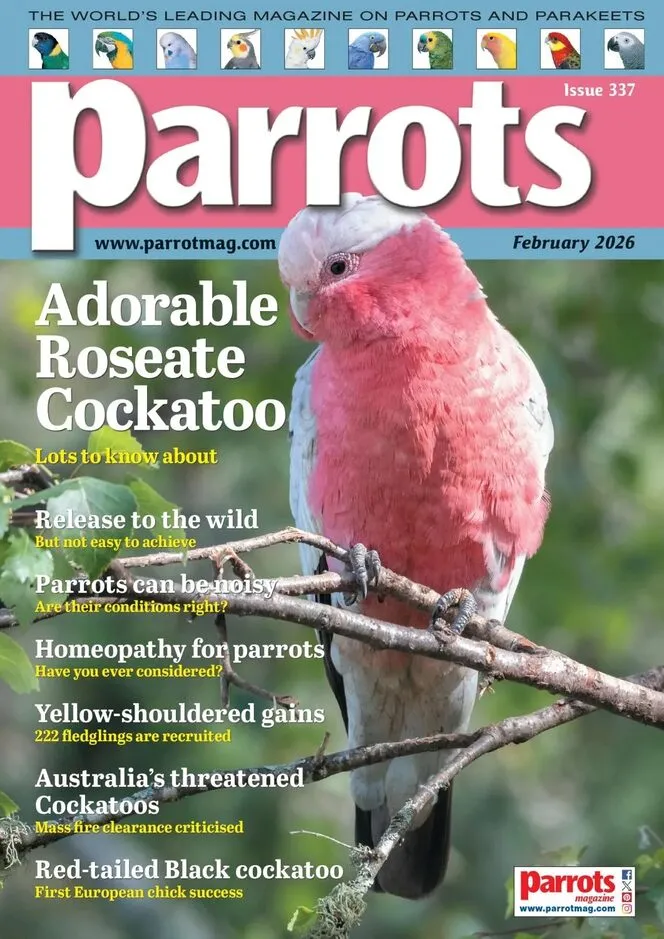
Parrots magazine February 2026 (Issue 337) leads with Jim Hayward on Roseate Cockatoo (Galah) breeding – four-figure UK sale prices and Australian colour mutations like Roseino, Cinnamon and Pied – alongside the failed Spix's Macaw reintroduction in Brazil (all 11 released birds tested positive for PBFD), a record 222 Yellow-shouldered Parrot fledglings recruited on Venezuela's Macanao Peninsula, and Leslie Moran's step-by-step homeopathic first-aid protocol for parrots.
Issue 337 of Parrots magazine (February 2026, UK) anchors on the Roseate Cockatoo, Eolophus roseicapillus, with Jim Hayward walking readers through aviary construction, sexing by iris colour, bread-and-milk calcium supplementation, and the working of nest cavities from eucalyptus wood. Companion features by Rafael Zamora Padron explain how a winter 'rest diet' of dandelion leaves and low-oilseed mixes synchronises Amazon pairs for breeding, while a Spotlight on Species profiles the rarely-kept Blue-crowned Racquet-tail (Prioniturus d. discurus) from the Philippines, including subspecies diagnosis by crown colour and racquet-tail shaft length.
Conservation reporting drives the back half. Rosemary Low follows Prof. Silveira's Red-browed Amazon project from a 2021 IBAMA confiscation of 24 chicks through a planned April-May 2026 soft-release in Alagoas; David Waugh documents 222 Yellow-shouldered Parrot fledglings protected by Provita's Ecoguardians at Macanao; and Andrew Chounding dissects a Western Australia prescribed burn that critics say killed nesting Carnaby's and Baudin's Black Cockatoos after a two-day vehicle-only DBCA assessment. Editor's note: circovirus, bornavirus and PDD screening is now standard for every pre-release Amazon.
Regulars give the issue its working-breeder flavour. Leslie Moran's Holistic Parrot column turns avian accidents into a usable kit: Arnica montana 30C for window strikes, Aconite for shock, Hypericum for crushed toes, plus a chard-versus-spinach Vitamin K comparison for blood-clotting support. Eb Cravens warns that intelligent macaws can copy loud cockatoo screeching overnight – meaning boarded Greys may return home with new four-letter words. News shorts cover Sammy the wolf-whistling Timneh Grey of Three Cocks, a possible record Kakapo breeding season (84 laying females, population about 240), and PBFD in Brazil's Spix's Macaw flock.
—————
Content Guide
▸ Cover Story & Species Profiles
p.16 · The Adorable Roseate
Jim Hayward's cover feature walks UK keepers through every stage of Galah husbandry: sexing adults by iris colour (cocks dark brown, hens pinkish-almond to red-brown), building a 6m x 1.2m x 1.82m aviary with 16-gauge welded mesh, and supplying willow twigs and eucalyptus leaves as nest-box material. Hayward explains how a thin wooden liner inside a galvanised steel box (10 inches x 20 inches) prevents egg-crushing and egg-eating in young pairs, and why bread-and-milk remains a useful calcium carrier despite modern objections. Readers get the exact clutch-and-incubation data: three eggs laid on alternate days, hatching at 25 days, fledging around seven weeks. Four-figure UK prices contrast sharply with the bird's status as a culled agricultural pest in Australia.
p.14 · Spotlight on Species: Blue-crowned Racquet-tail
A rare-in-aviculture Prioniturus d. discurus profile from a Dutch specialist breeder explains how to tell the male from the female by racquet-shaft length, and how to distinguish the three accepted subspecies by crown colour – whiteheadi with reduced blue, the nominate discurus with blue extending over the nape, and mindorensis with a green forecrown and bluish-mauve hindcrown. Birds inhabit primary and secondary forest up to 1,500 metres in the Philippines, nest colonially in tree cavities, and lay three-egg clutches; the natural diet runs on fruit, berries, ficus seeds, and bananas (which makes them plantation pests). Anyone considering this rare species should plan for loud contact calls and the difficulty of acquiring stock.
p.12 · Preparing the Amazon's!
Rafael Zamora Padron of Loro Parque Fundacion lays out a calendar-driven feeding protocol for breeding Red-Spectacled and other Amazona parrots in temperate Europe. The fix for infertile eggs and pair-aggression is a winter 'rest period': switch to a lower-oilseed mix with dandelion leaves and thistle seeds, build activity with scattered foraging, then ramp calories back up as daylight and temperature rise. Keepers running warmer indoor aviaries in particular must watch fat accumulation that suppresses gonad development. The same logic applies to delicate species like the Yellow-Billed Amazon, which needs temperatures held above 15 degrees C.
▸ Health & Husbandry
p.22 · The Holistic Parrot: Parrots & homeopathy
Leslie Moran supplies a build-it-yourself homeopathic first-aid kit with measured doses: Arnica montana 30C for window strikes, bruising and shock; Aconite napellus for anxiety, fright and shock after a predator encounter; Ledum palustre for puncture wounds and bite scratches (especially from cats, whose claw bacteria are fatal to birds); and Hypericum perforatum for crushed or bitten toes caught in cage doors. Preparation steps – sterilise, dilute pellets in distilled water, preserve with brandy in a 1-2 oz glass dropper bottle, succuss 100 times against a book – are spelled out so owners can stock bottles that last. Pair this protocol with the chard-versus-spinach chart (Swiss chard delivers 232mg/kg Vitamin K versus spinach's 135mcg/oz) to support natural blood clotting in case of bleeds.
p.34 · Complete Psittacine: Parrots that learn about noisemaking
Eb Cravens uses a Moluccan Cockatoo named Wasu – re-homed for excessive screaming – to show how a garden flight packed with eucalyptus branches, hollow logs and macadamia nuts can redirect vocal energy into chewing and foraging. The warning for pet owners: intelligent macaws (his Scarlet hen Jubilee picked up Wasu's worst decibel within two days) and impressionable fledglings will copy loud species in any mixed boarding, breeder facility, or pet shop. Three practical rules follow – quarantine new arrivals' vocal influence, ask your boarding facility what birds share the airspace, and never mix fledgling conures or Amazons with louder species.
▸ Conservation in the Field
p.28 · Releases back into the wild – not easy
Rosemary Low traces the Red-browed Amazon (Amazona rhodocorytha) reintroduction in Alagoas, Brazil, from IBAMA's October 2021 confiscation of 24 chicks through Prof. Luis Fabio Silveira's plan to soft-release 16 birds in April-May 2026 at Utinga, Coruripe and Sao Miguel dos Campos. The piece is unusually honest about losses: female no.14 vanished, female no.20 had to be retrieved from the ground, ten pre-release birds failed behavioural tests and were retained for captive breeding. Survival depends on two years of pre-release aviary training inside the forest, sub-10-gram steel leg bands for ID, and the presence of the four surviving wild Alagoas Red-brows to act as teachers. The Rare Species Conservatory Foundation has more than 100 fourth-generation captive Red-brows; EAZA's EEP no longer exists.
p.36 · Yellow-shouldered Parrot population increases
David Waugh reports Provita's Macanao Peninsula project has recruited 222 Yellow-shouldered Parrot (Amazona barbadensis) fledglings in a single year, lifting the population from 700 in 1989 to 1,900-2,100 today. Core tactics are simple and replicable: a permanent Ecoguardian ranger force, 24/7 nest surveillance starting five days after the first chick hatches (24 April 2025), repair of poaching-damaged cavities with netting and plaster, transfer of at-risk chicks to monitored nests, and a 2024 census that recorded 2,005 individuals at seven roost sites. Provita also trained 31 National Guard and Inparques officers and runs a Cotorra Margaritena Festival. The 2032 vision: viable populations across the species' historic range plus a reintroduction on at least one extirpated island.
p.42 · Endangered cockatoo habitat
Andrew Chounding details a Western Australia prescribed burn on the 15,000-hectare Willmot-Quindinillup block of Mt Roe National Park that critics including Birdlife WA's Vivian Read and field zoologist Dr Phil Runham say killed nesting Carnaby's and Baudin's Black Cockatoos. The DBCA assessment: two staff, two days, vehicle-only – far below the federal minimum of 12 person-hours over six days for a 50-hectare site. Canopy temperatures during the incendiary drop would have hit 100-200 degrees C inside nesting hollows. Greens MLC Jess Beckerling is pushing for an independent review of the state's burn methodology. Useful checklist for any reader responding to a similar controversy: demand the raw field data, log the staff-hours on site, and require on-foot nest inspections.
▸ News Shorts & Regulars
p.6 · Parrot News from around the world
Five February news shorts worth flagging: Sammy the Timneh Grey died at the Old Railway Line Garden Centre in Three Cocks, Powys after 15 years of wolf-whistling regulars (1,700 Facebook reactions); New Zealand's Kakapo programme expects its best breeding season since 1977, with 84 females laying off a rimu fruiting event (population now about 240, up from 51 in 1995); Brazilian police opened 'Operation Blue Hope' after all 11 released Spix's Macaws tested positive for circovirus/PBFD, fining the breeding centre 1.8 million reais; Uruguay's MGAP greenlit a military-led mass cull of Monk Parakeets using anticoagulant-laced grease and tree adhesives ahead of the March apple harvest; and Jama Masjid Police recovered about 150 Alexandrine, Rose-ringed and Plum-headed parakeets from Delhi's Kabutar Market following a PETA India complaint.
p.26 · A Year in Review 2025
Catalina Tate of Feathers Together (Tyne & Wear) recaps a busy year for the rehoming charity: the August Tropical Bird Show at Temple Park Centre, a Sulphur-crested Cockatoo called Olly collected from West Yorkshire, an unexpected Ducorps Cockatoo named Jakey originally booked as a 'cockatiel', and 32 exhibition budgies surrendered in one intake – a record. The headline arrival: Leo the Green-winged Macaw, dropped off by another rescue that recognised they needed specialist care. Ruby's return-and-rehome story shows the network in action. Garden Feathers in Boldon Colliery is open seven days for anyone looking to rehome a cockatoo, macaw, or finch.
—————
Editor's Take
Issue 337 is a working breeder's issue dressed as a hobbyist magazine. Hayward's Roseate feature and Padron's Loro Parque Amazon protocol deliver real, repeatable husbandry data – nest-box dimensions, dietary cycling calendars, subspecies diagnosis. Low's Red-browed Amazon report and Waugh's Yellow-shouldered Parrot coverage carry genuine field weight, and Chounding's Western Australia burn investigation adds overdue scrutiny. Weaknesses are real: Moran pushes homeopathy without citing outcome data, the Holistic Parrot column reads like advertorial for her own sprouting brand (the same advert appears on pages 2, 25 and 45), and the centre pages are dense with advertising. The magazine is strongest for European keepers and conservation-watchers, weaker for North American cockatiel owners who'll find little here.
Strengths
• Hayward's Galah cover story gives concrete nest-box dimensions and dietary numbers you can act on today
• Two long-form conservation reports (Red-browed Amazon, Yellow-shouldered Parrot) with verifiable field data
• Moran's protocol includes a usable chard-versus-spinach Vitamin K chart for bleeds
Weaknesses
• The Holistic Parrot column reads as advertorial for Leslie Moran's Best Bird Food Ever brand
• Ad density is high – F10, Northern Parrots, Liberta cages and sprouting crowd every few pages
Verdict: Recommended — Strong cover feature and field conservation; thin on original photography and advertorial-heavy health column.
