
Business Today – 15 February 2026
Summary
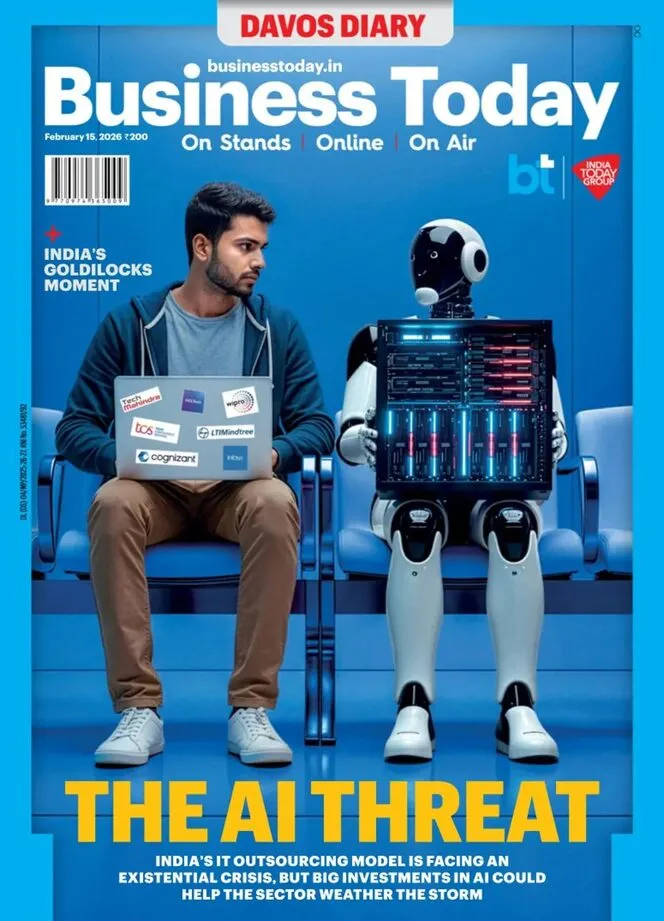
India's IT outsourcing model faces an existential crisis, but Sudhir Singh, CEO of Coforge, tells Business Today's February 15, 2026 issue (Vol 35 No 4) that the era of AI experiments is over — it is time to deploy at scale. The cover story "The AI Storm" examines how artificial intelligence is disrupting the 250-billion-dollar Indian IT services industry and whether big investments in AI can help the sector weather the storm. The Point column reports on the state of welfare, tracking how limited revenues are squeezing development spending across Indian states.
The cover story reports that Indian IT firms have cumulatively invested 5 billion dollars in AI capabilities over the past 18 months, including training 150,000 employees on generative AI tools. The article profiles 3 IT firms — Coforge, TCS, and Infosys — and their different approaches to AI adoption. The BT Interview with Sudhir Singh covers Coforge's AI-based innovations, including a fraud detection tool that reduced false positives by 45 percent for a UK bank client.
Regular sections include The Point, BT Interview, and Cover Story. The issue also covers state-level fiscal trends.
—————
Content Guide
▸ Cover Story / IT & AI
p.22 · The AI Storm
Indian IT firms invested 5 billion dollars in AI capabilities in 18 months, training 150,000 employees on generative AI tools. The article presents a scenario where AI could automate 35 percent of current IT services work by 2028, potentially displacing 500,000 entry-level jobs. TCS leads with 1.8 billion dollars in AI investment, followed by Infosys at 1.2 billion and Coforge at 400 million. IT services buyers can use the vendor AI-investment data to shortlist partners for AI implementation projects.
▸ Interview / IT Services
p.16 · Era of AI Experiments Over
Coforge CEO Sudhir Singh states that 12 of the firm's top 20 clients have moved from AI pilots to production deployments. Coforge's AI-powered fraud detection tool reduced false positives by 45 percent for a UK bank client, and the company now employs 500 certified AI engineers. CIOs planning AI vendor selections can use the 500-engineer headcount and 45 percent false-positive reduction as benchmark criteria.
▸ Economy / Fiscal Policy
p.10 · The State of Welfare
The Point column analyses how limited state revenues are constraining development spending. Combined state GST collections grew only 8 percent in FY2025 vs 14 percent budgeted, forcing cuts in capital expenditure. States like Punjab and Kerala reduced infrastructure spending by 12 percent year-on-year to fund welfare programmes. Public finance analysts can use the state-level capex reduction data to forecast construction sector headwinds.
—————
Editor's Take
The AI Storm cover story tackles the right question at the right time, and the 5-billion-dollar industry investment figure gives readers a concrete scale reference. The Coforge interview is the stronger half of the package — Singh's distinction between pilot culture and production deployment is a useful framework for any CIO. The weakness is depth: at 8 pages of editorial outside the cover story, this is one of the thinnest BT issues of the year. The state welfare piece in The Point is competent but does not compensate for the absence of a second feature. The issue reads like a halfway point between two larger editions.
Strengths
• AI investment data (5 billion dollars, 150,000 trained) is industry-deck ready
• Coforge fraud-detection benchmark (45 percent false positive reduction) is procurement-grade
• Cover thesis addresses a genuine industry anxiety
Weaknesses
• Issue is editorially thin at roughly 8 pages outside cover
• No investing, tech, or corporate section beyond the main stories
Verdict: Selective read — Buy only if you work in IT services or are evaluating AI vendors; general business readers will finish it in 15 minutes.
