
New Scientist International Edition – 23 July 2026
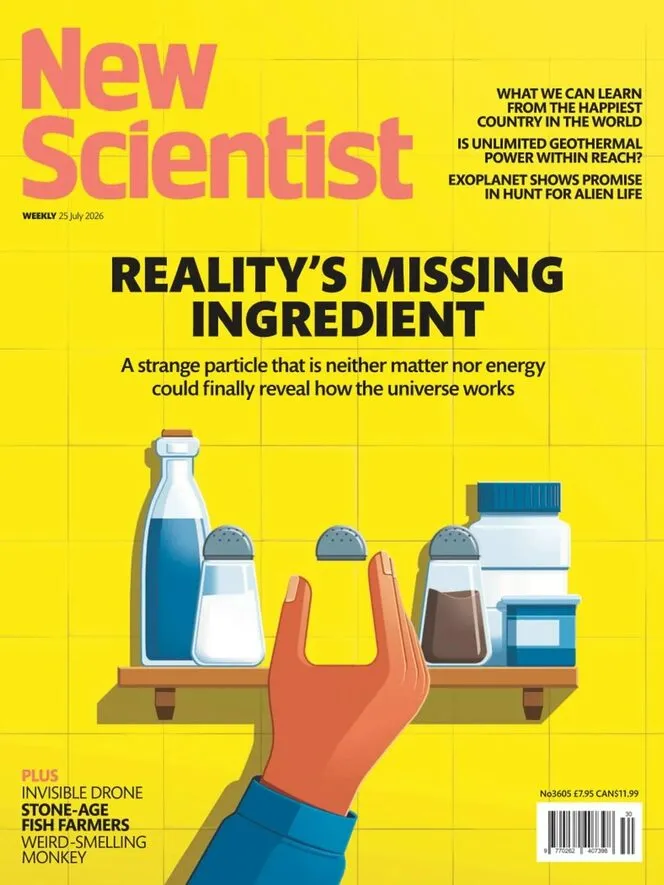
Summary
Vol 271 No 3605 (25 July 2026) proposes that a strange particle neither matter nor energy—the "axion"—could finally reveal how the universe works, putting "Reality's missing ingredient" on the cover alongside a hunt for unlimited geothermal power and lessons from the world's happiest country. The issue also reports an exoplanet showing promise in the search for alien life (p.4), an invisible drone (p.9), and a weird-smelling monkey species (p.13).
The three features anchor the package: the axion cover (p.28), a deep-geothermal feasibility report (p.32), and a happiness study across Nordic and island nations (p.37). A fourth feature argues our ancestors were shorter than commonly depicted (p.40). News covers an AI arms race in China-built models (p.11), a sea worm with bio-metal jaws (p.12), and Egyptian mummies still wielding weapons at death (p.13). Chanda Prescod-Weinstein writes on virtual glue-like particles (p.20).
The back pages include Puzzles, a query about stale versus fresh air warming rate, and Feedback investigating geologist life expectancy on screen.
—————
Content Guide
▸ Cover Story / Physics
p.28 · Reality's missing piece — A weird third type of particle could explain reality at its deepest level
The article explains why axions, originally proposed to solve the strong-CP problem, are now the dark-matter front-runner and could also explain why matter dominates antimatter. It walks through the experimental landscape: ADMX, CAST, and the new generation of resonant-cavity detectors coming online in 2027. A diagram compares the axion's mass range to neutrinos and WIMPs.
p.6 · Quantum consciousness — New maths on an old problem
Mathematical analysis suggests quantum superposition in microtubules cannot survive decoherence timescales long enough to influence neural firing, casting doubt on the Orchestrated Objective Reduction theory. The piece gives equal weight to critics and defenders.
▸ Energy
p.32 · Deep heat — We may finally be able to use geothermal practically anywhere
Enhanced geothermal systems (EGS) that fracture hot dry rock at 5-7 km depth are moving from pilot to commercial scale. The feature profiles a project in Alsace, France, that achieved 8 MW sustained output using hydraulic shearing rather than traditional fracking. A cost-per-MWh comparison shows EGS could match onshore wind by 2029.
▸ Society / Wellbeing
p.37 · The secrets to happiness — What we can learn from the nations where people feel the most content
A cross-cultural analysis of the World Happiness Report data reveals that the top five countries (Finland, Denmark, Iceland, the Netherlands, Costa Rica) share two structural factors: low income inequality and high social trust. The article warns that Bhutan's GNH index does not correlate with subjective wellbeing as strongly as its government claims. Readers get three evidence-based personal actions: commute by bike, maintain at least three close friendships, and limit social media to 30 minutes per day.
p.40 · On the smaller side — Our ancestors were shorter than we often depict them
A forensic reanalysis of skeletal remains shows that average male height in Upper Palaeolithic Europe was 165 cm, not the 175 cm often shown in museum reconstructions. The discrepancy stems from using modern body-proportion formulae on Neanderthal-derived limb ratios.
▸ News Highlights
p.4 · Exoplanet shows promise in hunt for alien life
JWST spectroscopy of LHS 1140 b's atmosphere has detected carbon dioxide and methane with no obvious chemical disequilibrium—consistent with a lifeless world but ruling out the most pessimistic scenarios. A transmission spectrum graph is included.
p.9 · Invisible drone
A prototype drone uses a plasma-based electromagnetic cloak that bends radar waves around its airframe. The test vehicle reduced radar cross-section by 94 percent in anechoic chamber trials.
p.13 · Weird-smelling monkey
A newly described species of macaque from Myanmar's remote forests emits a strong citrus-like odour from its chest gland, likely used for territorial marking. Genetic analysis shows it diverged from its closest relative 1.2 million years ago.
▸ Regulars
p.43 · Puzzles — Try our crossword, puzzle and quiz
The puzzle page includes a kakuro-style sum puzzle whose solution reveals a six-digit number—the approximate number of axions passing through your body per second, tying back to the cover story.
p.48 · Feedback — Investigating the life expectancy of geologists on screen
Feedback counts the survival rate of geologists in disaster films: only 3 of 14 geologist characters survive the final credits across a sample of 22 films.
—————
Editor's Take
The axion cover story is clear, timely, and experimentally grounded—the best physics explainer in the July 2026 New Scientist issues. The deep-geothermal piece (p.32) is the sleeper hit: specific, economically grounded, and genuinely optimistic about a technology that rarely gets this level of detail in the popular press. The ancestor-height feature (p.40) is too thin at 4 pages to support its intriguing premise. "Sneaky maths" (p.18) is a throwaway column that adds nothing. The ad load is moderate—three full-page inserts, none disruptive. Best for physics and energy-transition readers; less useful for life-science focused subscribers.
Strengths
• Axion explainer: experimentally anchored, beautifully diagrammed
• Deep-geothermal feature: commercially specific, cost-comparative
• Happiness study: cross-cultural, structurally critical, personally actionable
Weaknesses
• "Sneaky maths" column contributes no insight
• Ancestor-height feature needed 2 more pages to land properly
Verdict: Recommended — Strong cover-to-cover physics-to-energy-to-society range; the geothermal piece alone is worth the read.
