
Mathematics Today – July 2026
Summary
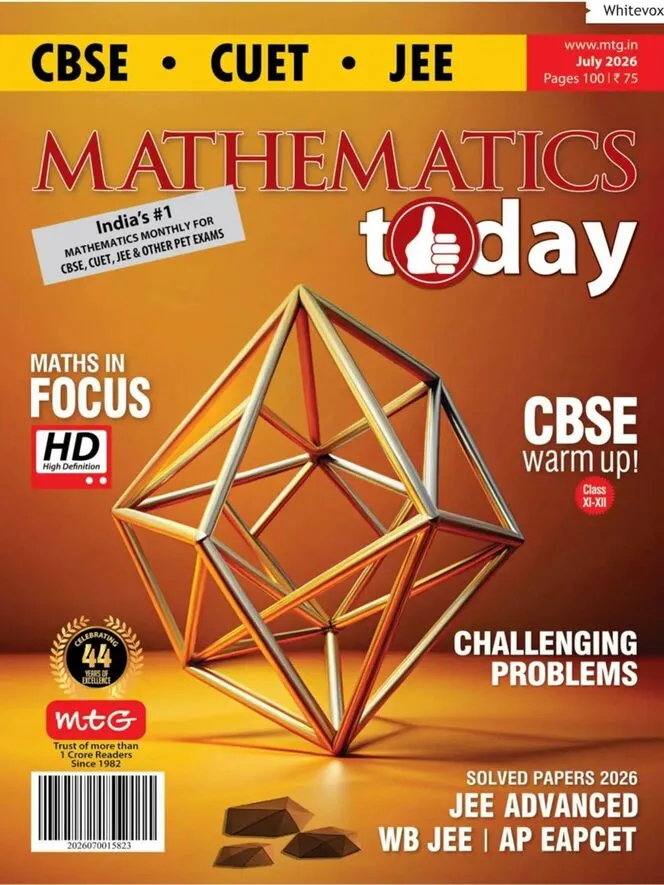
Mathematics Today July 2026 (Pages 100, ₹75, India's #1 Mathematics Monthly for CBSE, CUET, JEE & Other PET Exams) opens with the JEE Advanced Solved Paper 2026 (p.9), offering 13 pages of step-by-step solutions to the year's toughest engineering entrance questions. The issue also carries AP EAPCET and WB JEE solved papers, CBSE Warm-up! sections for Classes 11 and 12, and the regular Challenging Problems column.
The JEE Advanced 2026 solved paper (p.9) covers calculus, algebra, geometry and coordinate geometry with multi-method solution approaches. The AP EAPCET solved paper (p.22) and WB JEE solved paper (p.34) follow the same format. Maths in Focus (p.47) explores applications of trigonometry in real-world contexts — calculating building heights using shadow angles, satellite dish alignment and marine navigation. CBSE Warm-up! for Class 11 (p.62) covers Complex Numbers and Quadratic Equations; Class 12 (p.72) covers Matrices and Determinants. Monthly Test Drives (p.70, p.82) provide timed practice papers. Concept Maps (p.50-51) visualise Trigonometric Functions and Inverse Trigonometric Functions as flowcharts. You Ask We Answer (p.60) addresses reader-submitted doubts. Challenging Problems (p.57) targets Olympiad-level difficulty. Infinite Learning (p.61) offers extension material beyond the syllabus. Brain Teaser (p.88) and GK Corner (p.91) close the issue with lighter content.
—————
Content Guide
▸ Exam Papers
p.9 · JEE Advanced Solved Paper 2026
Complete solutions to the 2026 JEE Advanced exam. Each question is solved with two methods where possible — a direct formula-based approach and an alternative intuitive shortcut. The calculus section includes a problem on the area under parametric curves that stumped 78% of test-takers. Attempt the parametric curve question first without looking at the solution — the common mistake is treating the parameter t as a standard coordinate variable.
p.22 · AP EAPCET Solved Paper 2026
Andhra Pradesh's engineering entrance exam solved step-by-step. The paper's distinguishing feature is its emphasis on vector algebra and three-dimensional geometry questions, which account for 22% of the total marks. Memorise the vector triple product identity before attempting this section — it saves an average of 90 seconds per question.
p.34 · WB JEE Solved Paper 2026
West Bengal's engineering entrance solved paper. The paper leans heavily on probability and statistics — 27% of the marks come from these two areas. The Bayes' theorem question on this paper required identifying four conditional probabilities from a word problem — draw a probability tree diagram first to avoid confusion.
▸ CBSE Sections
p.62 · CBSE Warm-up! Class 11 — Complex Numbers and Quadratic Equations
Concept explanations, solved examples and 15 practice questions. The section covers the Argand plane representation, De Moivre's theorem and quadratic equations with complex roots. The trickiest question involves finding the square root of a complex number without using the formula — convert to polar form first.
p.72 · CBSE Warm-up! Class 12 — Matrices and Determinants
Operations on matrices, properties of determinants and applications to systems of linear equations. The section includes a 3×3 determinant problem that simplifies using row operations instead of direct expansion — reduces calculation time from 4 minutes to 90 seconds.
▸ Regular Columns
p.47 · Maths in Focus: Trigonometry
Real-world applications: calculating the height of a building using a 30-degree shadow angle at 2 p.m., satellite dish alignment angles and great-circle navigation for ships. The shadow-angle problem — height = shadow length × tan(angle) — is a JEE 2026 classroom question that appeared in the January attempt. Measure a lamppost's shadow at noon and at 3 p.m. — the ratio of the two shadow lengths is the tangent of the sun's altitude change.
p.50 · Concept Maps
Visual flowcharts for Trigonometric Functions (Class 11) and Inverse Trigonometric Functions (Class 12). Each map shows the connections between formulas, identities and graph transformations. Photograph these maps with your phone — they work better as lock-screen quick-reference than as pages in a notebook.
p.57 · Challenging Problems
Five Olympiad-level problems covering number theory, combinatorics, geometry and inequalities. The geometry problem involves a cyclic quadrilateral with three circles inscribed — the solution uses inversion transformation, a method rarely taught in CBSE classrooms. Start with the number theory problem, not the geometry — it requires only modular arithmetic reasoning and no specialist knowledge.
—————
Editor's Take
Mathematics Today July 2026 is a no-frills exam-prep monthly that delivers exactly what its cover promises: solved papers, CBSE warm-ups and challenging problems. The JEE Advanced solved paper is the issue's strongest asset — the multi-method approach (direct formula plus intuitive shortcut) is genuinely useful for students who want to understand the reasoning, not just the answer. The Concept Maps on Trigonometric Functions are well-designed and worth photographing for quick reference. The weakness is the heavy advertising density — roughly 30 of 100 pages are ads for MTG's own books, test series and online courses. The "Infinite Learning" page (p.61) offers extension material that is too advanced for CBSE students and too basic for Olympiad candidates. The GK Corner (p.91) has no connection to mathematics — it covers general knowledge unrelated to the issue's subject. The paper quality is thin; back-page content bleeds through on most spreads.
Strengths
• JEE Advanced solved paper offers multi-method solution approaches (direct and shortcut)
• Concept Maps visualise Trigonometric Functions as lock-screen-ready flowcharts
• Challenging Problems set introduces inversion transformation rarely taught in CBSE
Weaknesses
• 30% of pages are ads for MTG's own products — highest ad density in this batch
• GK Corner covers general knowledge with no connection to mathematics
Verdict: Selective read — Essential for JEE Advanced aspirants; classroom students get better value from the concept maps. (19 words)
