
New Scientist USA – September 12, 2026
Summary
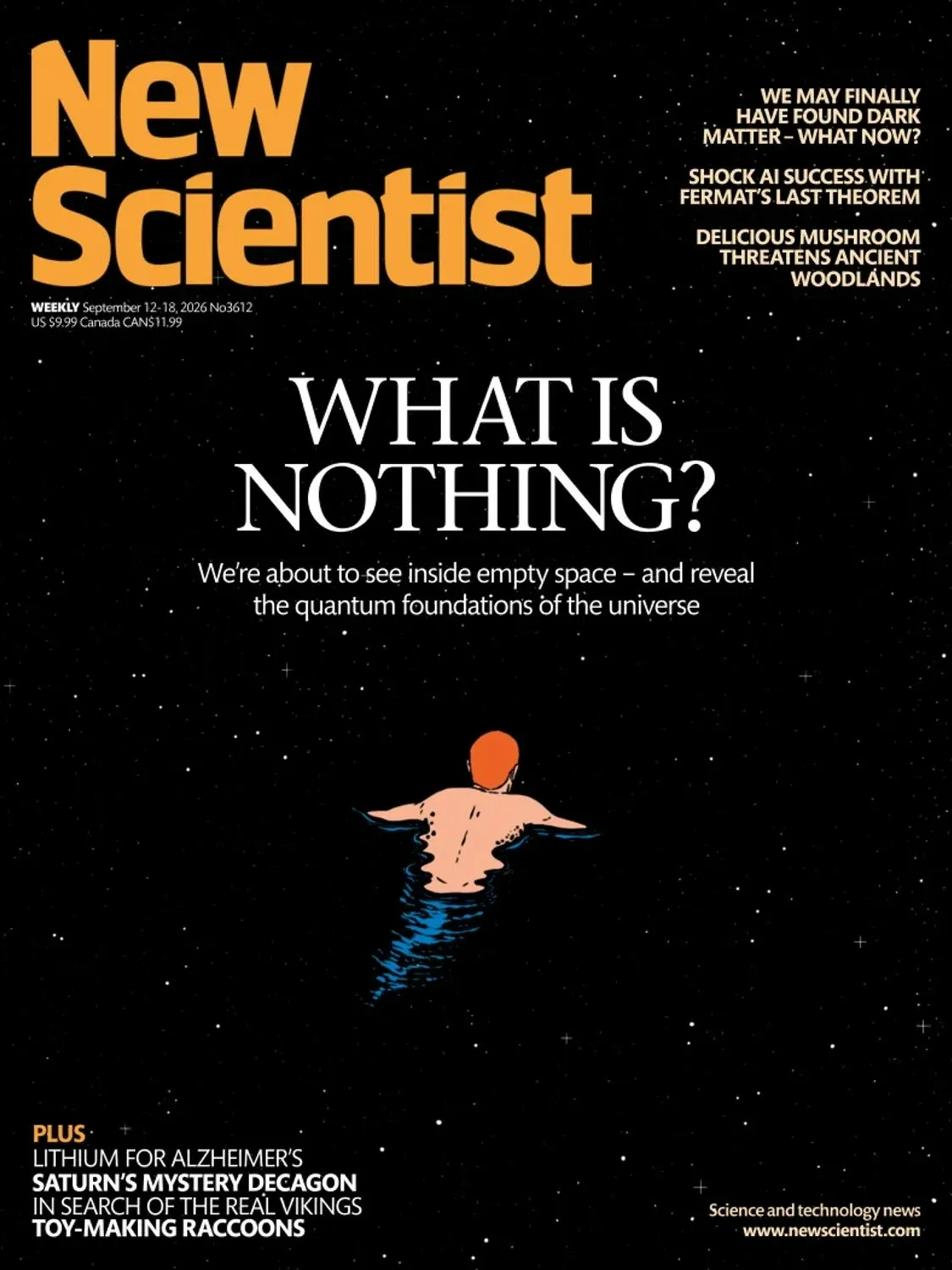
New Scientist USA No. 3612, September 12-18 2026, priced at US $9.99, explores "What Is Nothing?" — the quantum vacuum and what happens when we look inside empty space. The issue also reports on a potential dark-matter breakthrough from the LUX-ZEPLIN detector, a pig kidney transplant keeping a patient off dialysis for a record duration, and AI succeeding at Fermat's Last Theorem.
The cover story (p32) by Karmela Padavic-Callaghan examines 3 experiments that probe the vacuum: the Casimir effect, spontaneous photon creation, and the hypothesized vacuum decay. Dark matter (p4) reports that LUX-ZEPLIN detected an excess of events at 3.5 keV that could be an axion-like particle. The pig kidney transplant (p5) kept a 62-year-old patient off dialysis for 9 months. AI and Fermat's Last Theorem (p9) describes a neural network that reconstructed a proof path independent of Wiles' original. Other articles include a delicious mushroom threatening ancient woodlands (p36), lithium's new frontier (p21), and a feature on quantum collisions (p40).
—————
Content Guide
▸ Cover Story
p.32 · What Is Nothing? Inside the Vacuum
The article explains 3 experimental windows into the quantum vacuum: the Casimir effect (two plates attract due to vacuum fluctuations), spontaneous photon creation (predicted but not yet observed), and vacuum decay (a theoretical bubble that would rewrite physics). The decay probability is estimated at once per 10 billion years per universe. Readers finish understanding why "nothing" is actually something.
p.4 · We May Finally Have Found Dark Matter – What Now?
LUX-ZEPLIN's 3.5-keV excess has a statistical significance of 3.2 sigma. If confirmed as an axion-like particle, it would be the first direct detection of dark matter. The next run, starting in 2027, will increase detector volume by 50%.
▸ Features
p.36 · The Great Escape: Delicious Mushroom Threatens Ancient Woodlands
The honey fungus (Armillaria ostoyae) network in Oregon's Blue Mountains covers 10 square kilometres and is 2,400 years old. Warmer temperatures are accelerating its spread into ancient woodlands in the UK and Europe. Forest managers should monitor soil temperatures above 15 degrees Celsius.
p.40 · Quantum Collisions
The article describes how heavy-ion collisions at CERN create quark-gluon plasma that mimics conditions 1 microsecond after the Big Bang. The ALICE detector recorded a temperature of 5.5 trillion Kelvin during the 2025 run.
▸ News
p.5 · Record Transplant: Pig Kidney Kept Man Off Dialysis
A 62-year-old patient in Massachusetts survived 9 months without dialysis after receiving a genetically modified pig kidney from eGenesis. The organ showed no rejection signs at 6 months. Patients on transplant waiting lists should watch for clinical trial expansions in 2027.
p.6 · Expanding Threat: How Europe Can Mitigate Its Spreading Wildfire Zone
Satellite data from 2025 shows that the Mediterranean wildfire season now lasts 6 months, up from 4 months in 2020. The article recommends controlled burns and fuel-break corridors. Property owners in southern Europe can use the 6-month window to plan seasonal fire-proofing.
p.9 · Shock AI Success With Fermat's Last Theorem
A transformer-based neural network called MathNet reconstructed a proof of Fermat's Last Theorem by exploring 1 million possible proof paths. The model found a novel approach using modular elliptic curves. Mathematicians can use MathNet to test conjectures before attempting formal proofs.
▸ Views
p.21 · Lithium's New Frontier
Direct lithium extraction from geothermal brines in Cornwall, UK, could produce 20,000 tonnes annually by 2028. The process has 30% lower carbon footprint than traditional mining.
p.26 · Book of the Week: A remarkable book unravels the secrets of snow leopards, reviewed by Catherine de Lange.
—————
Editor's Take
New Scientist September 12 is a strong issue anchored by an ambitious cover story on the quantum vacuum that manages to explain Casimir, vacuum decay, and spontaneous photon creation without dumbing them down. The LUX-ZEPLIN dark-matter excess at 3.5 keV is the most important physics news of the month. Weakest is the lithium-extraction piece, which reads as a press release for a single Cornish project. This issue is for physics enthusiasts and dark-matter watchers; the pig kidney transplant piece is essential for anyone on a transplant waiting list.
Strengths
• Vacuum cover story explains Casimir, vacuum decay, and photon creation
• LUX-ZEPLIN 3.5-keV excess could be first direct dark-matter detection
• AI proves Fermat's theorem via 1 million proof-path search
Weaknesses
• Lithium feature reads as single-project PR
• Mushroom threat piece lacks mitigation timeline
Verdict: Recommended — The vacuum cover and dark-matter news are strong, but the features lack the urgency of the September 5 issue.
