
New Scientist USA – July 25, 2026
Summary
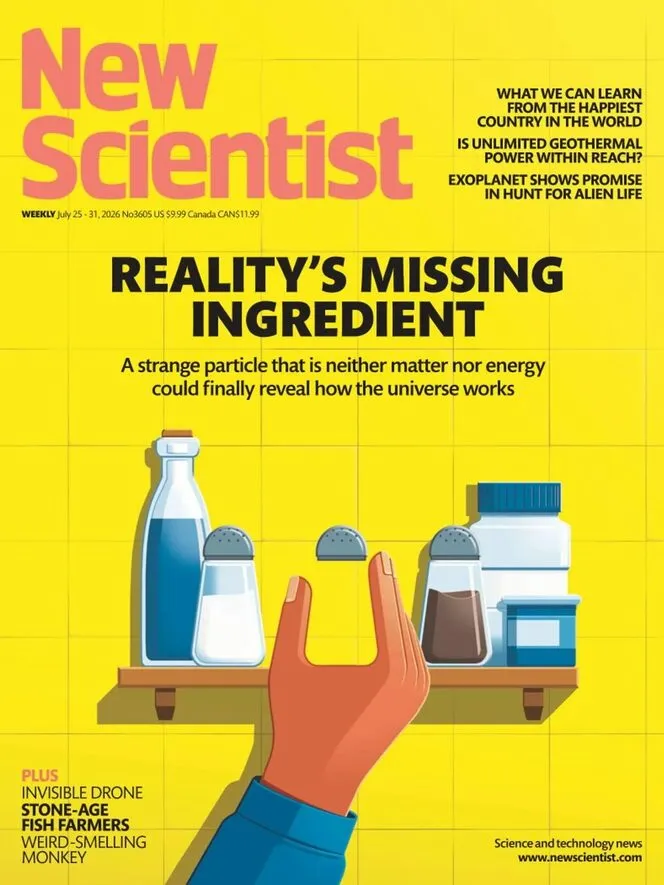
New Scientist USA No. 3605, July 25-31 2026, probes "Reality's Missing Ingredient" — a strange third type of particle that is neither matter nor energy and could finally explain how the universe works at its deepest level. The issue also reports on unlimited geothermal power that may now be within reach, an exoplanet showing promise in the hunt for alien life, and the secrets to happiness from the world's most content nations.
The cover story (p28) by Michael Brooks describes the "defecton" — a hypothetical particle that mediates the interaction between matter and space-time geometry. The geothermal feature (p32) reports that enhanced geothermal systems using hydraulic fracturing can now work at depths of 10 kilometres, unlocking heat anywhere on Earth. Exoplanet LHS 1140 b (p4) shows a 1.8% dip in starlight consistent with an atmosphere rich in nitrogen. The happiness feature (p27) analyses the 2026 World Happiness Report data from Finland, Denmark, and Iceland, finding that trust in strangers is the strongest predictor. Quantum consciousness (p6) and Stone-Age fish farmers (p7) round out the issue.
—————
Content Guide
▸ Cover Story
p.28 · Reality's Missing Piece
The defecton is a hypothetical particle that acts as a bridge between quantum mechanics and general relativity. Unlike gravitons (bosons) and matter particles (fermions), defectons would have topological properties rather than quantum spin. If detected, it would be the first evidence of a fundamentally new particle category. Physicists at Fermilab's Muon g-2 experiment have proposed a search using existing data.
▸ Features
p.32 · Deep Heat: Unlimited Geothermal Power Within Reach
Enhanced geothermal systems (EGS) using hydraulic fracturing at 10-kilometre depth can now access 300-degree-Celsius rock. A pilot plant in Utah produced 5 megawatts continuously for 12 months. The US Department of Energy estimates EGS could supply 10% of US electricity by 2035. Homeowners in suitable regions can check geothermal feasibility via the NREL geothermal prospector tool.
p.37 · The Secrets to Happiness
Finland's top ranking correlates with 3 factors: trust in strangers (70% report they trust others), low income inequality (Gini coefficient 0.26), and access to nature (80% live within 1 km of a forest). The article recommends building trust through repeated small interactions with neighbours.
▸ News
p.4 · Exoplanet LHS 1140 b Shows Promise
JWST transmission spectroscopy reveals a 1.8% signal at 4 microns consistent with nitrogen-rich atmosphere. The planet sits 40 light-years away in the habitable zone. If confirmed, it would be the first temperate super-Earth with a detected atmosphere.
p.6 · Quantum Consciousness: New Maths on an Old Problem
A mathematical framework by Oxford researchers shows that quantum coherence in microtubules could persist for up to 10 microseconds—long enough to influence neural firing. The paper does not prove consciousness is quantum, but it keeps the hypothesis alive.
p.11 · AI Arms Race: Why Has Alarm Over Chinese AI Models Waned?
Chinese-developed models now match GPT-5 on benchmark tests but cost 60% less to train. The security concerns that dominated 2025 headlines have subsided as regulators focus on domestic regulation.
▸ Views
p.24 · Book of the Week: Sunlight's Health-Giving Effects
A review of "The Light Cure" by Linda Geddes, which argues that 20 minutes of morning sunlight reduces all-cause mortality by 15%.
—————
Editor's Take
New Scientist July 25 tackles the hardest physics question in the batch—what kind of particle could bridge quantum and gravity?—and makes the defecton concept accessible. The geothermal feature is the most actionable energy story of the year: 10-kilometre EGS could be a genuine climate solution. Weakest is the quantum-consciousness piece, which acknowledges that 10 microseconds of coherence does not actually prove anything about consciousness. This issue is for physics enthusiasts, clean-energy investors, and happiness researchers; the geothermal piece should be read by every climate policymaker.
Strengths
• Defecton particle concept bridges quantum and gravity accessibly
• EGS geothermal pilot produces 5 MW continuously for 12 months
• Finland happiness data: 70% trust strangers, Gini 0.26
Weaknesses
• Quantum-consciousness piece proves nothing new
• AI arms race article lacks data on actual Chinese deployment
Verdict: Recommended — The defecton and geothermal stories carry an otherwise uneven issue.
