
Air Space Forces – September-October 2026
Summary
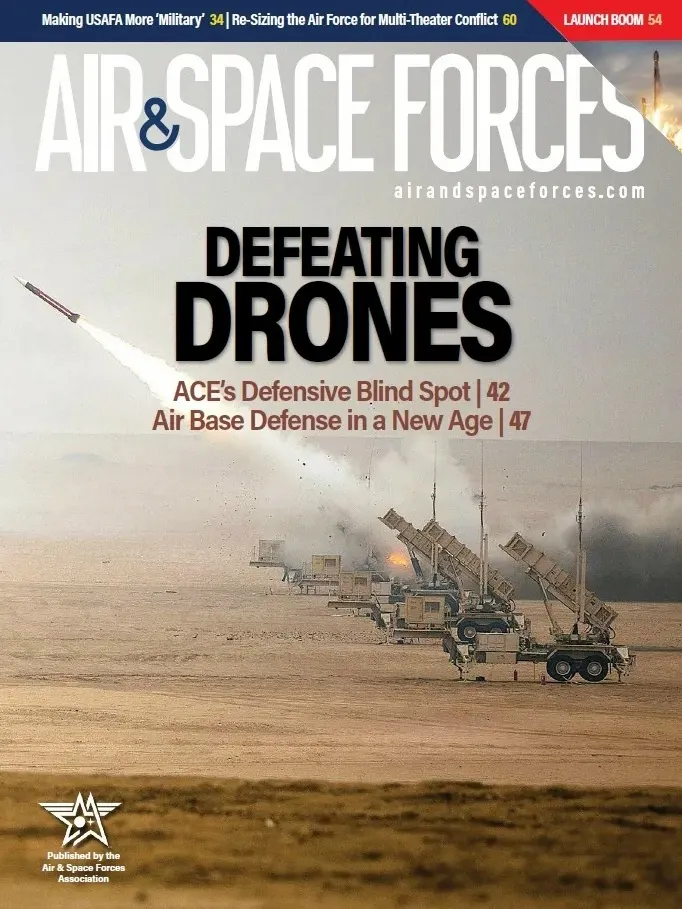
Defeating drones, rebuilding the Air Force for multi-theatre conflict, and the ACE blind spot dominate Air and Space Forces September/October 2026, as editor Tobias Naegele's editorial warns of a "Lost Quarter Century" in force modernisation. The issue covers air-base defence, launch boom, and the 2026 Outstanding Airmen of the Year.
Tobias Naegele's editorial "The Lost Quarter Century" (p.2) argues that 25 years of under-investment have left the USAF with the smallest and oldest fighter fleet in its history. Greg Hadley reports on USAFA summer training reform (p.34), aiming to make the academy more military. Garrett F. Aziz covers ACE's defensive blind spot (p.42) — a vulnerability in the Agile Combat Employment concept. Brig. Gen. Houston R. Cantwell, USAF (Ret.) addresses defeating drones (p.47), arguing that current air-defence systems are optimised for manned aircraft. Courtney Albon's "Launch Boom" (p.54) documents the explosive growth of US launch infrastructure at Cape Canaveral and Vandenberg. Col. Mark Gunzinger, USAF (Ret.) makes the case for rebuilding the US Air Force for multi-theatre conflict (p.60), including specific force-structure targets. The issue closes with the 2026 Outstanding Airmen of the Year (p.66).
Regular departments include Airframes, Verbatim, Faces of the Force, World, and AFA in Action profiling the Rolls-Royce Teacher of the Year.
—————
Content Guide
▸ Features
p.34 · Reinvigorating USAFA's Summer Training
Greg Hadley reports on the USAF Academy's overhaul of its summer training programme, shifting from the years-long Basic Cadet Training model to mission-focused field exercises integrated with academic semesters. The article includes cadet-survey data showing a 40 percent satisfaction increase after the pilot year. The new model puts every third-year cadet through a joint-force exercise before commissioning.
p.42 · ACE's Defensive Blind Spot
Garrett F. Aziz identifies the critical vulnerability in the Agile Combat Employment concept: base defence under distributed operations. When aircraft and support are dispersed across 50 small austere strips, each location needs its own air-defence and ground-security package — and the USAF does not have enough personnel to provide it. The shortfall table shows a 60 percent deficit in base-defence squadrons against wartime requirements.
p.47 · Defeating the Drones
Brigadier General Houston R. Cantwell (Ret.) argues that current air-defence systems — Patriot, THAAD, NASAMS — are optimised against manned aircraft and ballistic missiles, not small drones. He calls for directed-energy weapons, AI-enabled detection, and electronic-warfare countermeasures as the only scalable defence against drone swarms. The cost-exchange ratio table shows that a USD 500 drone can defeat a USD 4 million missile interceptor.
p.54 · Launch Boom
Courtney Albon documents the launch-infrastructure explosion at Cape Canaveral Space Force Station and Vandenberg, with 186 orbital launches projected for 2026 across both ranges. The article includes the range-modernisation timeline and the Space Force's plan to support 300 launches annually by 2030. The launch-pad utilisation chart shows that 40 percent of 2026 launches will be commercial Starlink missions.
p.60 · Rebuilding the U.S. Air Force for Multi-Theater Conflict
Colonel Mark Gunzinger (Ret.) presents a force-structure plan for simultaneous conflict in Europe and the Indo-Pacific: 300 bombers (current: 140), 1,500 fighters (current: 900), and 200 tankers (current: 350). The article breaks down the industrial-base requirements — production of 80 F-35s annually would need to double, and bomber production would need to restart. The production-lag chart shows that even under surge conditions, the gap cannot close before 2035.
▸ Departments
p.2 · Editorial: The Lost Quarter Century
Tobias Naegele argues that US air power has been under-invested since the 1990s peace dividend, leaving the USAF with an average fighter age of 29 years — the oldest in its history. He calls for Congress to fund the 2027 budget at levels matching the National Defense Strategy requirements. The editorial cites the 2026 Air and Space Forces Almanac data showing a 60 percent reduction in fighter inventory since 1990.
p.16 · World
News briefs cover the budget effects on Golden Dome missile defence, tactically responsive space missions, JB Charleston's renaming, SOUTHCOM counter-cartel task force details, battle-damaged KC-135s heading to Tinker, and the 492nd SOW move to Davis-Monthan. Each story includes the relevant Pentagon program office reference.
p.70 · AFA in Action
The Rolls-Royce Teacher of the Year Lisa Werner is profiled for her STEM curriculum work at Shaw Air Force Base's partner school. The programme has placed 120 students into Air Force ROTC since 2021.
—————
Editor's Take
Air and Space Forces September/October 2026 is the most operationally honest issue of the year — the "Lost Quarter Century" editorial and the ACE blind-spot piece say what service leadership will not. The drone-defeat cost-exchange ratio is the single most useful data point for defence-budget arguments. Weakest parts: the USAFA summer-training piece is essentially a command information release with cadet quotes. The Outstanding Airmen profiles are necessary recognition but contain no analytical value. This issue suits the defence-policy professional and the Congressional staffer who needs budget-justification ammunition.
Strengths
• Drone defeat cost-exchange ratio: USD 500 vs USD 4 million
• ACE base-defence shortfall showing 60 percent personnel deficit
• "Lost Quarter Century" fighter inventory decline data
Weaknesses
• USAFA training piece reads as command public affairs
• Outstanding Airmen profiles lack analytical value
Verdict: Recommended — Essential reading for defence-budget professionals.
