
All About History Secret Services – 2nd Edition – 27 August 2026
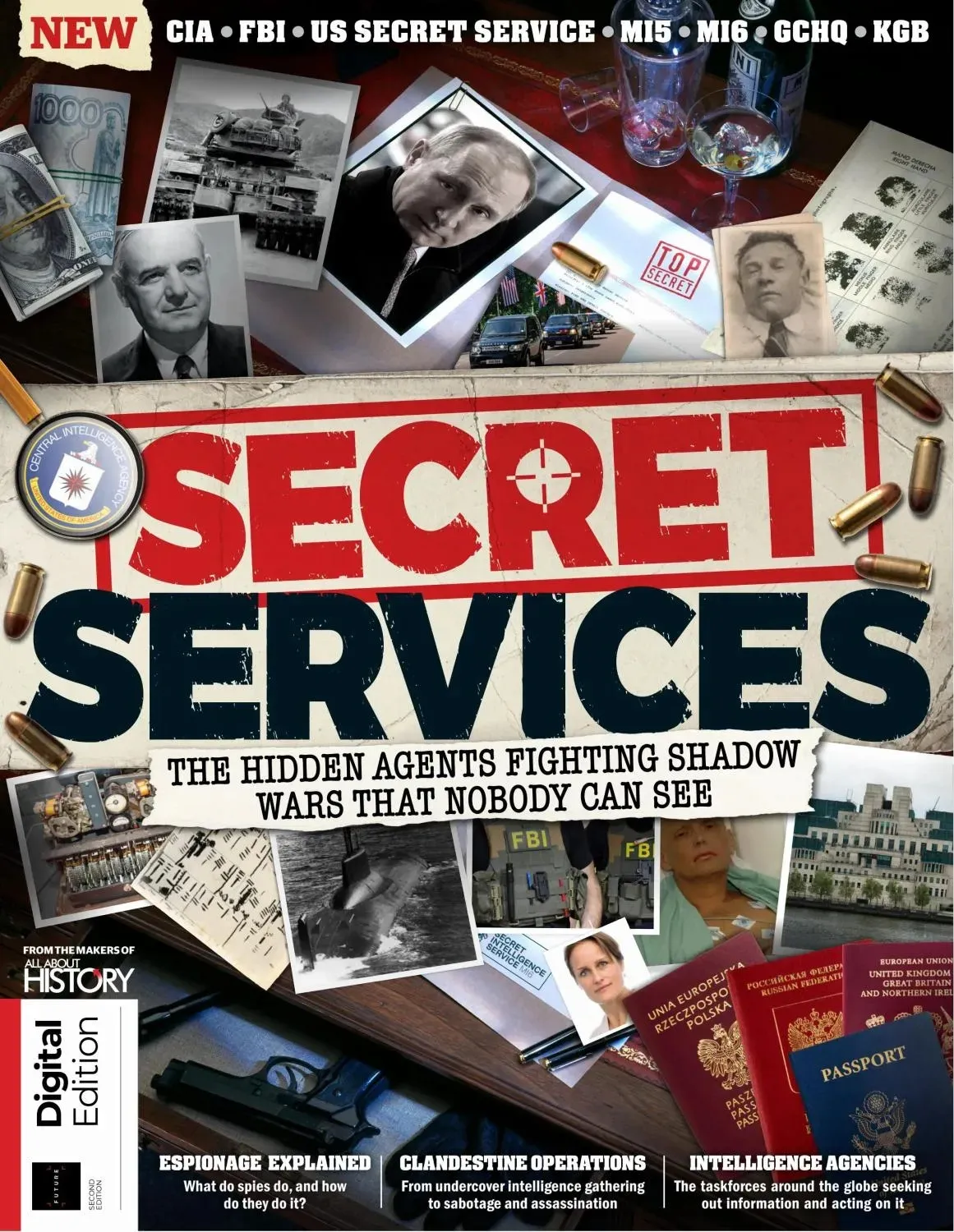
Summary
Catherine Curzon opens All About History's Secret Services 2nd Edition, 27 August 2026, with a walk through the hidden agencies fighting shadow wars — from Walsingham's Elizabethan spy network to GCHQ's digital intercepts. The 128-page volume covers MI5, MI6, CIA, FBI, US Secret Service, KGB, SMERSH, and Mossad across three sections: Secret Services, Clandestine Operations, and Mysterious Missions.
The Secret Services section profiles MI5's defence-of-the-realm mandate (p.14), MI6's foreign intelligence history from Room 40 to the Iraq War (p.18), the FBI's "fidelity, bravery, integrity" doctrine (p.28), and the KGB's successors (p.50). Clandestine Operations covers Operation Citadel double-agents (p.58), the Overlord deception campaign declassified (p.66), and the CIA's anti-communist operations across Latin America and Southeast Asia (p.82). Mysterious Missions tackles the disappearance of Commander Lionel Crabb (p.92), the Somerton Beach man (p.98), secret signals, the Dyatlov Pass incident (p.112), and MKUltra mind-control experiments (p.120).
The edition closes with a Putin-era assessment and the presidential motorcade explained. Each chapter includes maps, agent profiles, and declassified document reproductions.
—————
Content Guide
▸ Secret Services
p.14 · Defend the realm
MI5's mandate from its 1909 founding through the Cold War double-agent programmes is traced with org charts showing the director-generals and their operational priorities. The article reproduces the 1956 "Fluency Committee" report on Soviet penetration of British intelligence. The org chart makes clear why MI5 handles domestic while MI6 operates abroad — a distinction blurred in most spy fiction.
p.18 · For king and country
MI6's evolution from the Admiralty's Room 40 codebreakers through the Cambridge Five betrayal to post-9/11 liaison with US agencies. The article includes the 1973 Hunt-Stewart memo that redefined MI6's legal status. The memo text is useful for any debate on whether intelligence agencies require statutory frameworks.
p.28 · Fidelity, bravery, integrity
The FBI's journey from J Edgar Hoover's COINTELPRO abuses through the post-9/11 intelligence reforms is presented with a timeline of directors and their tenures. The article reproduces the 1976 Church Committee findings on domestic surveillance. The Church Committee recommendations remain the standard against which FBI reform is measured.
p.38 · SMERSH: Stalin's spy hunters
SMERSH's wartime mission — counter-intelligence within the Red Army — is documented through declassified Soviet files showing 10,000 agents deployed across front-line units. The organisational chart shows SMERSH reporting directly to Stalin rather than military command. The chain-of-command explains why SMERSH inspired such fear within the Red Army itself.
▸ Clandestine Operations
p.58 · Spies of Operation Citadel
The Soviet double-agent network that penetrated the German 1943 Kursk offensive is reconstructed through NKVD files and German Abwehr records. The article identifies the key agent codenames — Werther, Anna — and the exact German divisions they compromised. The order-of-battle comparison table shows how Stalin knew Hitler's plan before his own generals did.
p.66 · Overlord declassified
The D-Day deception campaign — Operation Fortitude, the fictitious First US Army Group, the double-cross system — is documented through declassified British Security Coordination files. The article reproduces the inflatable-tank photographs and the fake wireless traffic logs. The wireless-traffic analysis shows how the Allies maintained the illusion of a Pas de Calais invasion for 40 days after Normandy.
p.82 · The CIA versus communism
CIA covert operations from Iran 1953 to Chile 1973 are presented with declassified National Security Council directives. The article includes the Langley memo on propaganda budgets for each operation. The budget table shows that anti-communist cultural funding exceeded paramilitary spending in Latin America.
▸ Mysterious Missions
p.92 · The disappearance of Commander Crabb
British frogman Lionel Crabb vanished during a 1956 inspection of a Soviet cruiser in Portsmouth Harbour. The article compiles MI5 files released in 2025, showing the official inquiry concluded "accidental death" but the intelligence community suspected capture. The MI5 memo reproduced shows the rescue operation was terminated after 72 hours.
p.112 · Death in the Ice Valley
The 1959 Dyatlov Pass incident is examined through the re-opened 2020 Russian investigation. The article reproduces the autopsy diagrams and the final prosecutor's report attributing deaths to "hypothermia and physical trauma." The avalanche-slab analysis published alongside the article challenges the official conclusion.
p.120 · These thoughts are not your own
MKUltra — the CIA's 1950s mind-control programme — is documented through the 1973 Inspector General's report and the surviving files not destroyed by CIA director Richard Helms. The article reproduces the list of 149 subprojects. The list shows that LSD experiments were only one part of a wider programme including sensory deprivation, hypnosis, and electroshock.
—————
Editor's Take
All About History's Secret Services 2nd Edition covers too many agencies in too few pages. The SMERSH and Operation Citadel chapters deliver genuinely fresh material from recently declassified sources. Weakest parts: the presidential motorcade explainer is filler that belongs in a driving magazine, and the "From Putin with love?" final chapter lacks editorial rigour — it speculates without attribution. This edition suits the GCSE student writing a Cold War intelligence essay who needs agency profiles in one place.
Strengths
• SMERSH org chart reporting directly to Stalin
• Operation Citadel double-agent network with division-level detail
• MKUltra subproject list from surviving CIA files
Weaknesses
• Presidential motorcade explainer has no place in a spy volume
• Putin chapter speculates without source attribution
Verdict: Selective read — Three strong chapters, but uneven overall.
