
Inside History Collection – The Black Death 2026
Summary
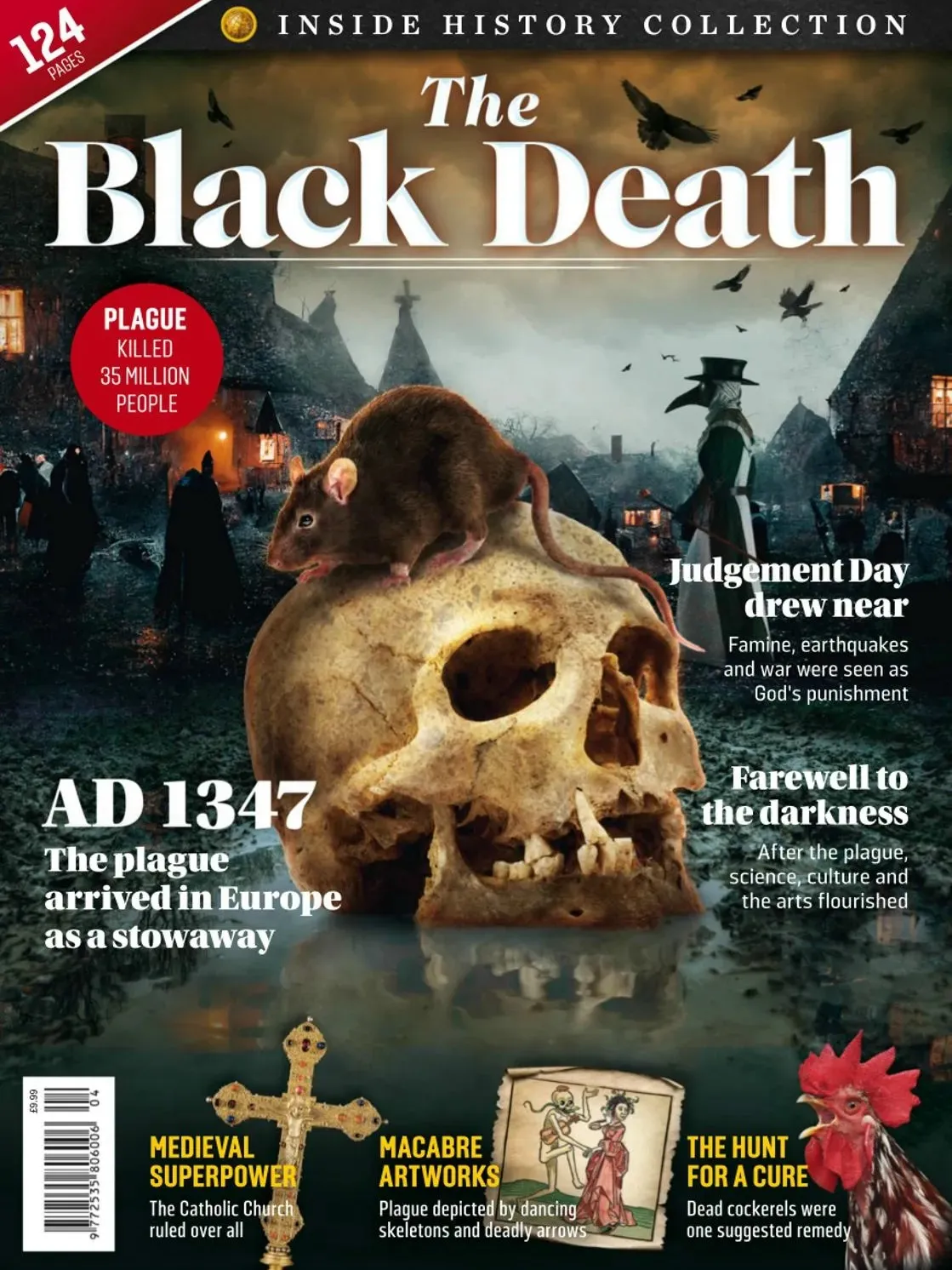
Inside History Collection: The Black Death (2026) traces the 1347-1351 pandemic that killed 35 million people across Europe — a third to a half of the continent's population — across 13 chapters and 124 pages. From 12 Genoese merchant ships docking at Messina to the long-term economic transformation that followed, the book examines the plague's symptoms, scapegoating, art, medicine and aftermath.
The narrative opens with the ships arriving in Sicily in October 1347, crew members already dead or dying with large boils. The Prelude to the Plague (p.12) sets the medieval context: crowded cities, poor sanitation and a population with no immunity. Church Ran Europe (p.20) explains how the Catholic Church's monopoly on knowledge made it impossible to explain the disease. The Black Death chapter (p.28) covers the three types — bubonic, pneumonic and haemorrhagic — with symptom descriptions and transmission routes. Blamed for the Plague (p.38) documents how Jewish communities were scapegoated across Germany, France and Italy, with entire communities burned alive. Monks Died in Droves (p.48) covers the ecclesiastical impact: monasteries emptied, mass graves dug on consecrated ground. Death in the Arts (p.56) examines Danse Macabre imagery that emerged from plague-era mortality. Search for a Cure (p.62) covers medieval medicine: bloodletting, prayer, flagellation and isolating the sick. Plague Ravages Florence (p.72) uses Italian city-state records to show 65% mortality. The Watermill Took the Strain (p.90) reveals how labour shortages drove technological innovation — the price of iron tripled in 50 years as watermills replaced human labour.
—————
Content Guide
▸ The Plague Arrives
p.12 · Prelude to the Plague
October 1347: 12 Genoese merchant ships docked at Messina, Sicily, with crew carrying buboes and coughing blood. The city ordered the ships to leave, but infection had already spread ashore. The disease travelled at 2.5 kilometres per day on average across Europe — roughly walking speed. Mark 2.5 kilometres on a map of your local area — that is how far the plague advanced each day.
p.28 · The Black Death
Three plague types: bubonic (swollen lymph nodes called buboes, flea-borne, 60% mortality within a week), pneumonic (lung infection, cough-borne, 95% mortality within 24 hours) and haemorrhagic (bloodstream infection, 100% mortality within hours). The blue-black marks under the skin gave the disease its name. If you developed bubonic plague in 1348 without treatment, you had a 6-in-10 chance of dying within seven days.
▸ Society & Scapegoating
p.38 · Blamed for the Plague
Jewish communities were massacred across Europe — in Strasbourg, 2,000 Jews were burned alive in February 1349. Pope Clement VI issued a papal bull protecting Jews, but local authorities ignored it. The article uses contemporary chronicler Gilles li Muisis's account: "animals roamed freely through fields, towns and waste land." The Strasbourg massacre of 1349 killed 2,000 people in a single day — the entire Jewish population of the city.
p.48 · Monks Died in Droves
Monasteries were hit particularly hard because monks cared for the sick. The Abbey of Meaux lost 44 of 56 monks. The resulting leadership vacuum accelerated the decline of monastic authority across Europe. A surviving monk after the plague would have been responsible for the work of four dead colleagues.
▸ Aftermath & Legacy
p.72 · Plague Ravages Florence
Florence lost 65% of its population — 60,000 of 92,000 residents died within six months. The city's wealth did not protect it; cramped housing and poor sanitation ensured the disease reached every social class. Giovanni Boccaccio's Decameron, written during the plague, describes seven young women and three young men fleeing Florence to wait out the epidemic in a country villa.
p.90 · The Watermill Took the Strain
Labour shortages drove technological innovation: the price of iron tripled in 50 years as millwrights built water-powered equipment to replace dead workers. This period of "small-scale industrialisation" laid groundwork for later Renaissance technology. A single watermill could do the work of 40 labourers — the equivalent of an entire dead village's workforce.
p.98 · Farewell to Darkness
The plague's long-term effects: wages rose 40% for surviving workers, serfdom declined, and the social mobility created conditions for the Renaissance. The chapter argues that the Black Death, not the printing press, was the true starting point of modern Europe.
—————
Editor's Take
Inside History Collection: The Black Death is a well-structured single-topic compendium that organises the plague narrative into distinct chapters — symptoms, scapegoating, art, medicine, economics — making it more useful than a chronological history that would blur the three-year event into a single traumatic block. The Florence 65% mortality statistic (p.72) and the Strasbourg 2,000-Jews-burned chapter (p.38) are the strongest entries, each anchored by primary source testimony. The Watermill chapter (p.90) is the most surprising — connecting labour shortage to iron prices and industrial innovation gives the plague an economic legacy that most popular histories ignore. The weakness is the visual presentation: the page layouts are dense with text blocks that lack the illustration density expected from a 124-page collection about such a visually rich subject. The symptom diagrams (p.28) are the only anatomical illustrations; the art chapter (p.56) reduces Danse Macabre to a single paragraph.
Strengths
• Florence 65% mortality statistic uses contemporary city-state census records
• Watermill chapter links labour shortage to iron price tripling and technological innovation
• Blamed for the Plague chapter includes Pope Clement VI's ignored papal bull
Weaknesses
• Visual density low — only one anatomical illustration for symptom diagrams
• Death in the Arts chapter reduces Danse Macabre iconography to a single paragraph
Verdict: Recommended — The best single-volume Black Death primer for general readers; teachers will find the chapter organisation useful for lesson planning. (20 words)
