
Who Do You Think You Are – October 2026
Summary
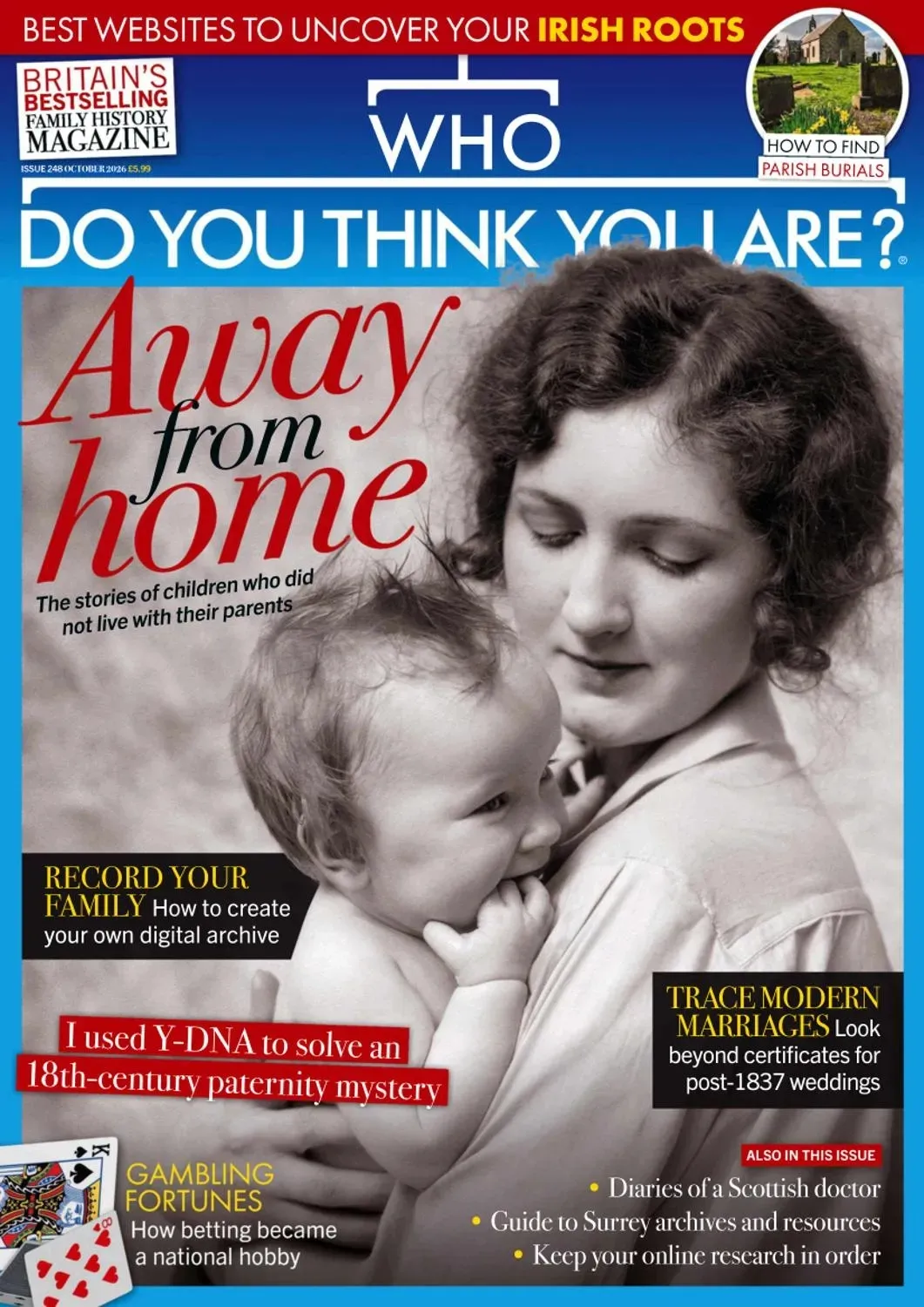
Issue 248 of Who Do You Think You Are? lands at £5.99 with a cover focused on children who did not live with their parents — nurse children, orphans, and the adopted. Leah Wade unpacks census terminology that trips up researchers, while Lauren Potts shows how to build a digital family archive before photos and letters degrade. Caroline Roberts traces 250 years of gambling history and why Victorians saw betting as a national menace.
Leah Wade's cover feature on page 14 explains how terms like "nurse child" and "orphan" in census returns often hide complex family arrangements. Chloe O'Shea on page 28 demonstrates that marriage certificates are only the starting point for female ancestors — parish settlement orders and bastardy bonds fill in the gaps. Jonathan Scott curates Irish heritage websites. Alan Crosby examines a Victorian family scandal and attitudes toward illegitimacy. Paul Blake reads parish burial registers for hidden genealogical clues.
Regulars include the Q&A panel, a Surrey research guide, and the diaries of Dr John Stewart Muir on page 68 as this month's Gem from the Archive. Nick Peers tests Goldie May automation tools for tree-building. Alan Cooper's Y-DNA results, told on page 62, show how far a single chromosome test can take a brick-wall case. The issue closes with TV history programming and book picks.
—————
Content Guide
▸ Cover Story / Research Advice / Reader Stories / Regulars / Guides
p.14 · Children in Care
Leah Wade decodes census terms — "nurse child," "orphan," "adopted" — that sound straightforward but often mask foster arrangements, informal kinship care, or parish apprenticeships. Cross-check the census against the Poor Law union records for the parish where the child appears.
p.21 · Digital Memories
Lauren Potts shows how to create a durable digital family archive using photo scanning, oral-history recording, and cloud storage. Start with the most fragile items: tintypes, daguerreotypes, and pre-1950s letters on acidic paper.
p.24 · Reader Story — Rachel and Victor Darvey
Stella tells Claire Vaughan about Rachel and Victor Darvey, whose story weaves through wartime letters and unexpected discoveries. Search the British Red Cross archives for POW correspondence if your ancestor was interned.
p.28 · Focus On: Beyond Marriage Certificates
Chloe O'Shea demonstrates how parish settlement orders, bastardy bonds, and workhouse admission registers reveal more about female ancestors than marriage records ever do. A settlement examination often names the exact parish a woman was removed from.
p.35 · Best Websites for Irish Heritage
Jonathan Scott picks online resources for tracing Irish roots, from the National Library's Catholic parish registers to the Valuation Office books. Start with the freely accessible Irish Genealogy website for pre-1864 civil registration substitutes.
p.38 · Record Masterclass: Parish Burial Registers
Paul Blake reveals how burial registers — not just death certificates — can show cause of death, social standing, and even the location of a grave within the churchyard. Look for marginalia noting "plague," "childbed," or "suicide" for contextual clues.
p.54 · Tech Tips: Goldie May Tools
Nick Peers demonstrates how Goldie May automates record-hinting and tree-building across multiple subscription sites. Set it to search one census decade at a time to avoid overwhelming your tree with unverified hints.
p.56 · Victorian Gambling
Caroline Roberts traces 250 years of gaming history, explaining why Victorians saw betting — from church bazaars to horse racing — as a national threat to public morality. Check the 1853 Betting Act records at The National Archives for local prosecution cases.
p.64 · Around Britain: Surrey
Essential resources for tracing Surrey family, a county whose records blend London migration patterns with rural parish stability. Guildford Muniment Room holds the best collection of manorial documents outside the capital.
—————
Editor's Take
Issue 248 earns its cover price through sheer breadth — seven distinct research angles across census terminology, digital archiving, Irish records, and Victorian social history. The children-in-care piece fills a real gap in family-history publishing. The Goldie May tech tutorial is genuinely useful for anyone managing multiple subscriptions. Weakness: three of the eight major features run at only two to three pages each, which leaves the gambling story feeling truncated. The Surrey guide could have doubled in length. Best suited for intermediate researchers who have hit a wall with standard BMD certificates and need to widen their search vocabulary.
Strengths
• Children-in-care census guide solves a common research trap
• Goldie May walkthrough justifies the cover price alone
• Seven practical features across all major UK record types
Weaknesses
• Victorian Gambling piece undershoots its potential at two pages
• Surrey regional guide is thinner than comparable county entries
Verdict: Recommended — Dense with practical record advice; skip only if you work exclusively outside UK/Irish records.
