
Forbes Africa – December 2025 – January 2026
Summary
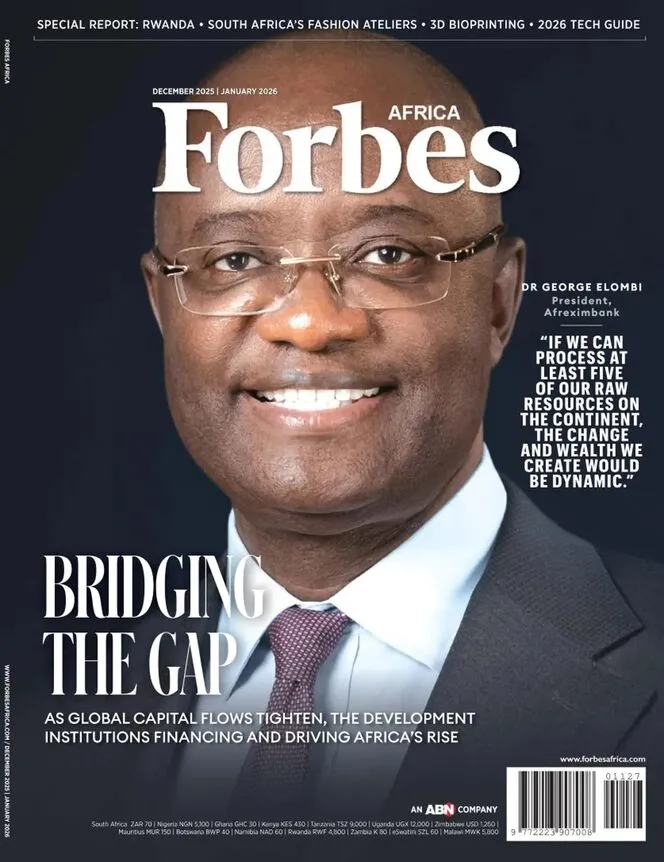
As global capital tightens, African development finance institutions led by Afreximbank's Dr George Elombi turn inward — building domestic savings pools to fund the continent's infrastructure pipeline.
Forbes Africa December 2025 / January 2026 (volume 15, number 6) opens with the cover story "Fortresses Of Sovereignty: Africa's Growth Architects" (p.18), where Oluwatomisin Amokeoja reports on multilateral lenders shifting from foreign-aid dependency to domestic-resource mobilization. Ethiopia hosts UN COP32 in 2027 — the first sub-Saharan African country to do so since 2010 — covered in "New Chapter In African Climate Diplomacy" (p.12). The AGOA Dilemma (p.15) examines the uncertain renewal of US trade preferences. Rwanda's technology transformation is the subject of "Tech In The Hills" (p.32), a special report on Kigali's digital public services. Axsome's Herriot Tabuteau features in "Brain Man" (p.46), a contrarian biotech story. Forbes Life covers "Creative Couture: The Journey Of An African Fashion Garment" (p.52), tracing a single piece from cotton farm to runway.
Renuka Methil opens with an Editor's Note on the richness of community stories. Regular sections cover CEO Strategies, Tech, Sport, and The Next Wave.
—————
Content Guide
▸ Cover Story
p.18 · Fortresses Of Sovereignty: Africa's Growth Architects
Oluwatomisin Amokeoja profiles Dr George Elombi and the shift by African multilateral lenders toward domestic capital mobilization. The Africa Finance Corporation has deployed $2.3 billion in infrastructure projects across 35 countries. CFOs of African development institutions can benchmark their own capital-raise strategies against the case studies.
▸ Focus / Climate
p.12 · New Chapter In African Climate Diplomacy
Freddie Hiney reports on Ethiopia hosting UN COP32 in 2027 — the first sub-Saharan African host since South Africa in 2011. The article details Ethiopia's hydropower capacity expansion to 6,000 megawatts. Anyone tracking carbon credit markets should note the host-country leverage it creates.
p.15 · The AGOA Dilemma
Paula Slier examines the uncertain renewal of the African Growth and Opportunity Act. She cites that 39 countries rely on AGOA preferences for duty-free access to US markets. Garment manufacturers can use the expiry timeline to scenario-plan for 2028.
▸ Special Report
p.32 · Tech In The Hills
Chanel Retief reports on Rwanda's digital government transformation. Kigali now processes 90 percent of government services online through the Irembo platform. The infrastructure stack is available for other African governments to license.
▸ Contrarian
p.46 · Brain Man
Amy Feldman profiles Herriot Tabuteau, CEO of Axsome Therapeutics, which developed a breakthrough treatment for treatment-resistant depression. The drug generated $800 million in revenue in 2025.
▸ Forbes Life
p.52 · Creative Couture: The Journey Of An African Fashion Garment
Manelisi Dabata traces a single garment from a cotton farm in Burkina Faso to a runway in Lagos and a retail rack in Paris. The supply-chain breakdown shows that the farmer receives 3 percent of the final retail price.
▸ Tech / Sport
p.74 · Skin In The Game
Tiana Cline reports on printable skin substitutes developed by a Cape Town biotech firm. The product costs $50 per square centimeter — 80 percent below imported alternatives.
p.84 · Global Glory
Mark Gleeson projects that Africa's biggest sporting event will generate a record profit of $112.84 million, driven by broadcast rights and sponsorship. Event planners can use the revenue breakdown as a budgeting reference.
—————
Editor's Take
This is a serious issue for readers who track African infrastructure finance. The cover story on domestic capital mobilization is genuinely important — it captures a structural shift that most Western media miss. The AGOA piece provides a practical deadline for manufacturers dependent on US trade preferences. The weakest piece is "Brain Man," which reads as a biotech PR release with no negative scenario — Axsome's valuation has always been volatile, and the article does not mention it. "Skin In The Game" is fascinating but too short: printable skin substitutes deserve deeper sourcing. Still, the cover story and AGOA analysis make this one of the more policy-useful Forbes Africa issues this year.
Strengths
• Domestic capital mobilization thesis with project names and amounts
• AGOA expiry timeline useful for manufacturers
• COP32 host-country leverage analysis
Weaknesses
• Brain Man profile omits valuation volatility
• Skin In The Game under-paged relative to topic importance
Verdict: Recommended — The most policy-relevant Forbes Africa issue of the season; buy for the infrastructure finance coverage.
