
Psychology Now – Volume 12 1st Edition – June 2026
Summary
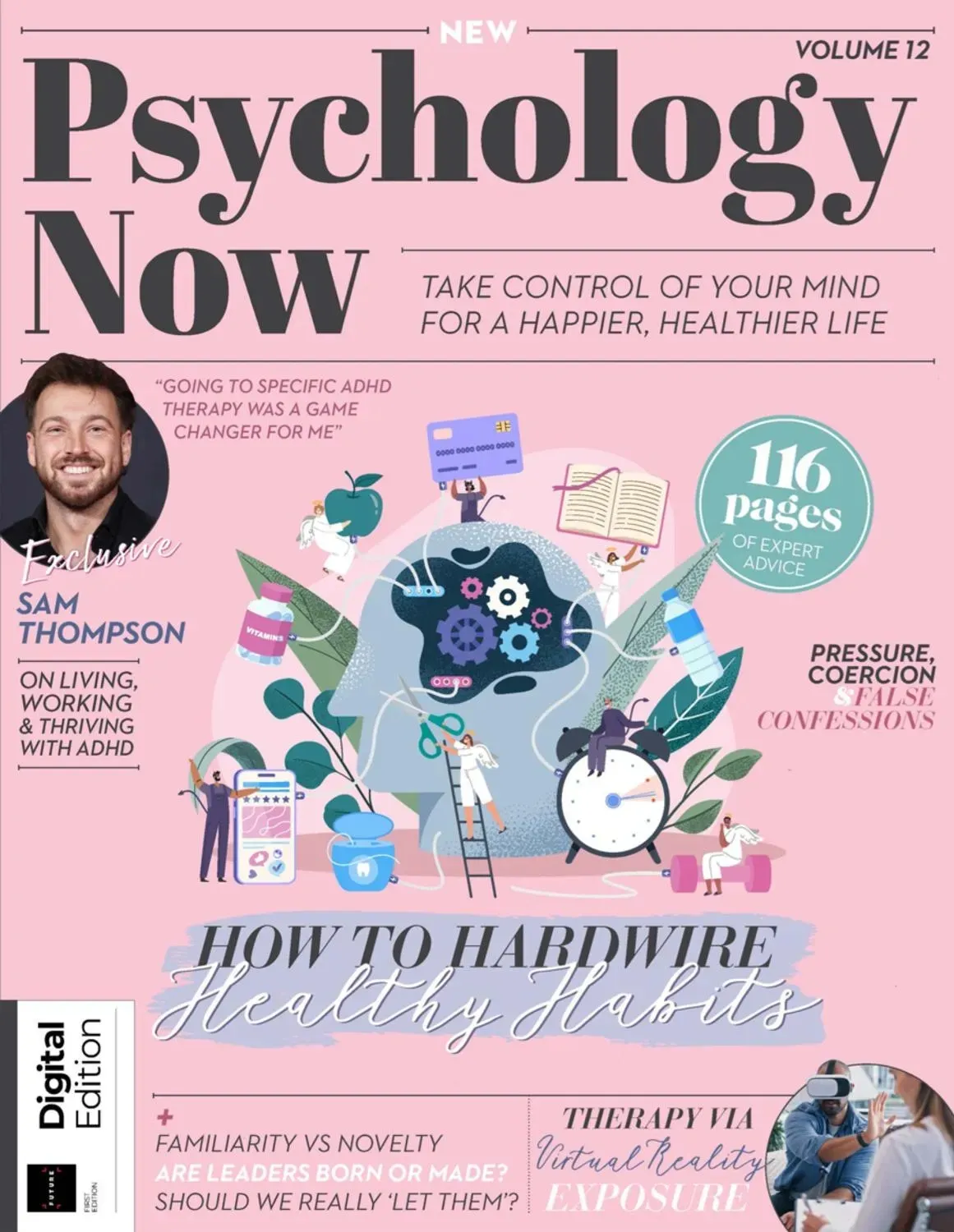
Psychology Now Volume 12, 1st Edition, June 2026, anchors its 116 pages around an exclusive interview with Sam Thompson on living, working, and thriving with ADHD. The edition also covers the drama triangle, false confessions, anticipatory grief, protest behaviours in relationships, and the making of a radical mind.
Thompson's interview (p22) runs 6 pages and describes his late-in-life ADHD diagnosis at age 30. The Drama Triangle article (p12) explains Stephen Karpman's 3 roles—Victim, Rescuer, Persecutor—and how to exit each. The Truth About False Confessions (p28) profiles 3 cases where innocent individuals confessed under interrogation pressure. Other articles cover emotional overflow (p32), the meaning of "let them" (p36), good and bad habits (p42), dopamine dressing (p50), virtual reality therapy (p56), and comfort versus curiosity (p60). The edition also explores whether leaders are born or made (p88), understanding teenage embarrassment (p92), spotting addiction signs (p94), emotional preparation for retirement (p100), and mental health in men (p110).
—————
Content Guide
▸ Cover Feature
p.22 · Exclusive Interview: Sam Thompson
Thompson describes his ADHD diagnosis at 30 and the specific therapy that helped: CBT combined with coaching. He estimates that 60% of his creative output is driven by hyperfocus, while 40% comes from structured routines. Readers with suspected ADHD can use the Adult ADHD Self-Report Scale (ASRS) printed on page 24.
▸ Core Psychology
p.12 · What Is the Drama Triangle?
Karpman's 3 roles are explained: Victim ("poor me"), Rescuer ("let me help"), and Persecutor ("it's your fault"). The article provides a 3-question diagnostic per role and an exit strategy: move to the Empowerment Triangle (Creator, Challenger, Coach). Readers can identify their default role in 2 minutes.
p.28 · The Truth About False Confessions
Cases profiled: the Central Park Five (1989), Brendan Dassey (2007), and a 2024 UK case where a man confessed to a murder he did not commit after 16 hours of interrogation. The article cites a 2025 Innocence Project statistic: 25% of DNA exonerations involved false confessions. Defence lawyers should request full interrogation video in every case.
p.36 · Should We Really "Let Them"?
The "let them" concept from Mel Robbins is examined: letting others make their own choices without interference. The article adds a caveat: "let them" does not apply when safety or legal obligations are involved. A 2025 study shows that practising detachment reduces relationship anxiety by 25% in 8 weeks.
p.60 · Comfort or Curiosity?
A 2025 decision-making framework: when faced with a choice, ask whether you are prioritising comfort or curiosity. Curiosity-based choices lead to 30% higher long-term satisfaction in a University of Chicago study. Readers can apply the framework to their next career or relationship decision.
▸ Wellbeing
p.50 · Start Dopamine Dressing
The article recommends wearing bright colours (red, yellow, orange) on low-motivation days to boost dopamine levels. A 2024 study from the University of Hertfordshire shows that red clothing increases confidence ratings by 15%.
p.56 · How Virtual Reality Is Reshaping Therapy
VR exposure therapy for PTSD shows 80% symptom reduction after 12 sessions, compared to 60% for traditional exposure therapy (2025 Oxford study). The article lists 3 VR therapy providers: Psious, Oxford VR, and Limbix. Costs range from 50 to 150 dollars per session.
p.72 · The Making of a Radical Mind
A 2025 University College London study profiles 3 pathways to radicalisation: grievance, network, and ideology. The article recommends early intervention at the grievance stage through open dialogue and community connection.
p.100 · Emotionally Preparing for Retirement
A 2025 study from the University of Zurich found that retirees who plan for emotional well-being (not just finances) report 40% higher life satisfaction. The article provides a 4-week emotional-preparation plan starting with identity exploration.
p.110 · Mental Health in Men
The article cites the 2025 WHO report showing that men are 3 times more likely to die by suicide than women, yet 50% less likely to seek therapy. It recommends male-friendly therapy options: walk-and-talk therapy, men's groups, and online-only sessions.
—————
Editor's Take
Volume 12 is the strongest Psychology Now edition in this batch—the Sam Thompson interview is honest and specific about ADHD therapy, and the false-confessions piece has genuine legal utility. The drama triangle article explains Karpman's model clearly enough for a reader to apply it in 2 minutes. Weakest is the "comfort or curiosity" framework, which is a single good question stretched into a 4-page article. This edition is for anyone interested in ADHD, criminal psychology, or retirement transitions; the false-confessions data should be read by every defence lawyer.
Strengths
• Thompson interview names specific ADHD therapy: CBT plus coaching
• False-confessions piece cites 25% DNA exoneration rate
• Drama triangle exit strategies are immediately actionable
Weaknesses
• Comfort-or-curiosity framework is a single question padded to 4 pages
• Dopamine dressing advice lacks controlled study support
Verdict: Recommended — The strongest Psychology Now volume in the batch; the Thompson and false-confessions pieces justify the price.
